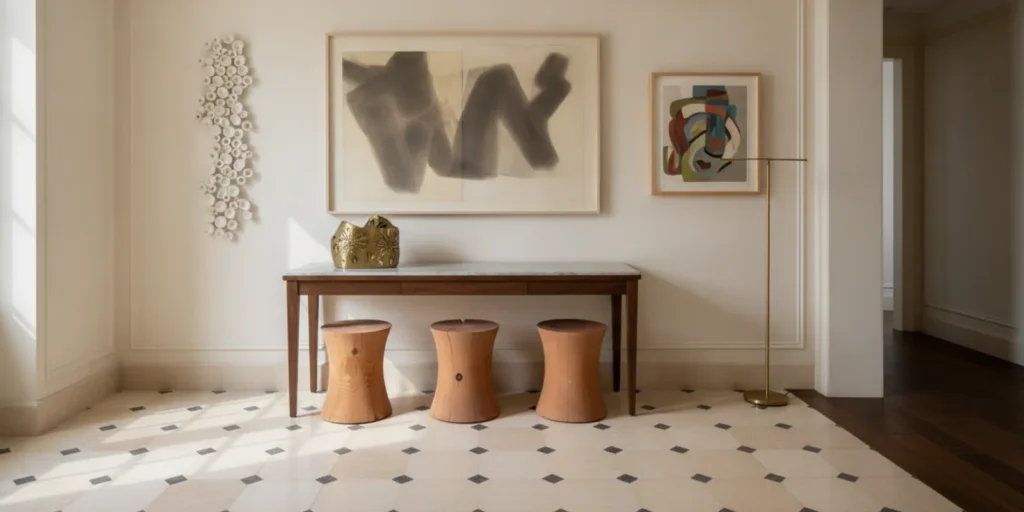
Flexible display planning for a rotating art collection begins with a question that is more nuanced than where to hang the next work: how can a home remain coherent and comfortable while the collection changes? The answer is not to make every wall a gallery. It is to understand the architecture, the works, and the rhythms of daily life, then create a considered framework that can accommodate change without sacrificing the character of the rooms.
Discuss a whole-home design commission
What does a rotating collection ask of a private residence?
A collection may change because a work moves to another residence, a new piece arrives, or the owner wants to live with different works at different times. Each change affects more than the wall that once held the art. It can alter the balance of a room, the way people move through it, and the relationship between one piece and the objects around it.
That is why a rotation plan should be conceived as part of the home, not as a sequence of isolated hanging decisions. A successful setting gives each work enough presence while allowing the rooms to remain inviting and personal. Art is the starting point, but the goal is still a residence: a place for conversation, rest, reading, and daily routines.
Begin by distinguishing what is genuinely likely to change from what should remain stable. A principal work may be central to a room for years, while smaller works, works on paper, or pieces in a secondary space may move more often. This distinction helps determine where adaptability is valuable and where a fixed, carefully composed setting will better serve the architecture.
For a broader view of how an art-led home can be shaped around a collection, see this guide to interior design for art collectors. Here, the focus is narrower: planning for change over time, rather than planning a collection’s first display.
How should you map the collection before planning display?
Start with an inventory that describes how the collection actually lives. This need not be a formal catalogue. A working record can note each work’s dimensions, medium, framing, preferred orientation, current location, and any known handling or installation considerations. Add a photograph and a short note about the role the piece plays for you: a work you want to encounter every day may need a different setting from one you prefer to experience occasionally.
Then group the works in ways that help with future decisions. You might consider scale, subject, palette, medium, or the dialogue between particular artists. The point is not to impose a curatorial rule on a private collection. It is to make relationships visible before moving pieces. Two works that seem unrelated by medium may speak to one another through color or proportion; a collection arranged only by size could miss that possibility.
- Identify the anchors. Which works define a room or have a strong connection to a particular view, architectural feature, or family story?
- Mark the flexible group. Which works are candidates for periodic movement, and which require a more stable home?
- Record relationships. Note pairings or groupings that you would like to preserve, even if the works are displayed in different rooms at different times.
- Separate intention from assumption. A piece is not automatically a rotation candidate simply because it is small or easy to move. Its meaning and handling needs matter too.
This preparatory thinking is related to, but distinct from, deciding how to display a fine art collection at home. A rotation plan adds the question of what should happen after the first arrangement: what moves, what remains, and how the room recovers its balance.
Which parts of a room should remain adaptable?
Not every surface should be treated as interchangeable. Start with the room’s fixed conditions: the placement of doors and windows, circulation routes, architectural details, built-in elements, and the way daylight changes through the day. Then consider furnishings, sightlines, and the distance from which a work is usually viewed. An artwork may read differently from a doorway than it does from a chair; the room should support the encounters that matter most.
Adaptability can come from restraint as much as from hardware. A wall kept visually calm may welcome different works without needing a new scheme each time. A coherent background, well-considered lighting, and a deliberate arrangement of furniture can allow the art to change while the room retains its identity. In another setting, the architecture may call for a stronger fixed composition that gives one significant piece a lasting place.
Think in terms of zones rather than declaring the whole residence a gallery. A principal wall might be reserved for a central work; a passage or another suitable area could accommodate a changing group. Secondary display locations should be selected for their actual light, circulation, and use—not simply because there is an empty wall. A collection deserves considered placement, and people deserve rooms that function without weaving around art or treating every movement as a museum visit.
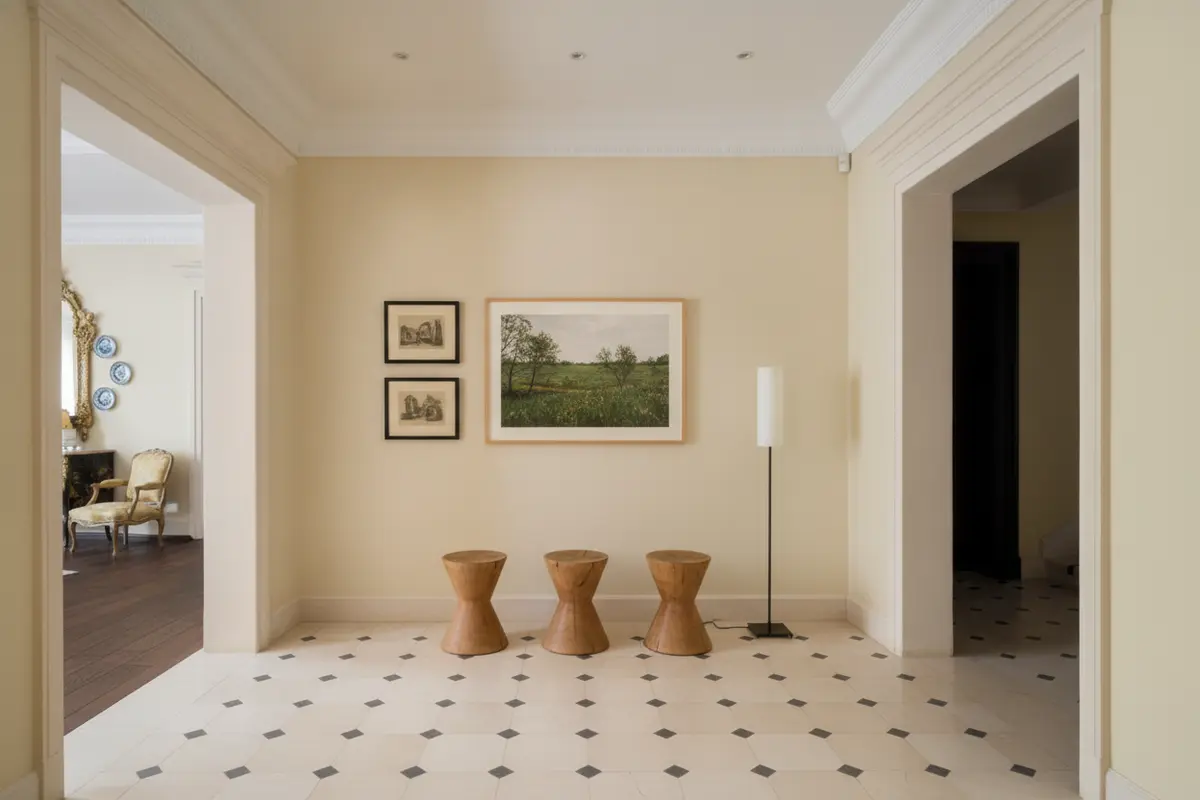
A rotating art display can prompt interest in movable panels or revolving elements, but a mechanism is not automatically a good residential solution. Research on rotating and revolving room transformations offers one perspective on how hardware can alter interior space; it is a specialized design question, not a requirement for a successful collection plan. Cornell’s overview of pivoting and transformative interiors discusses that broader spatial idea. In a private home, any moving element must be evaluated against the particular architecture, use, and works involved.
How can a display plan accommodate change without feeling temporary?
A flexible home should not feel unfinished between rotations. Design the room to have a complete composition with the current arrangement, rather than relying on the promise of a future piece to make it feel whole. That means considering the balance of art, furnishings, lighting, and negative space as a single setting. If a work leaves, the room should still feel intentional while the next arrangement is being considered.
One useful exercise is to imagine several plausible states for a room: the present arrangement, a version with the principal work temporarily elsewhere, and a future arrangement with one or two different pieces. These are not predictions or rigid schedules. They are a way to test whether a proposed setting has enough visual coherence to accommodate a real change. If each alternate state requires moving substantial furniture or disturbing the room’s essential character, the plan may be too dependent on one exact configuration.
Make a distinction between a reversible adjustment and a renovation-level intervention. Rearranging furniture or changing the grouping on a wall may be relatively simple, while new architectural work or a built-in display element has a longer life and should answer a broader need. For substantial projects, adapting art display can be coordinated with the home’s larger design and renovation decisions rather than treated as a late addition. CW DESIGN’s design approach places a residence and its specific conditions at the center of the work.
For example, a collector might keep a significant painting in a principal living space, while allowing a smaller group in a study to evolve. That arrangement gives the home a stable visual anchor and a more changeable setting, without suggesting that every room must be repeatedly rearranged. The right balance depends on the collection and the people who live with it.
What should you consider for light, handling, and installation?
A rotation plan should respect the needs of individual works. Medium, condition, frame, glazing, and the character of the proposed location can all affect whether a piece is suitable for a particular display. This article is not a conservation assessment: for questions about a work’s condition, safe handling, or environmental needs, consult an appropriately qualified art-care professional. Do not assume that a piece can be moved or displayed in the same way as another work of similar size.
Lighting also deserves a room-by-room review. Observe the available daylight and the existing artificial light before deciding where a work belongs. Note whether the work will be seen in morning, afternoon, or evening conditions, and whether a lighting adjustment affects the room’s other uses. A thoughtful display should make the work legible without making the living space harsh or uncomfortable. For a related discussion, see how to light artwork in a luxury home.
Before any change, consider the full installation sequence: who will assess and handle the work, what access is needed, and how the room will be protected. The answer can vary with the artwork, building, and installation. Avoid treating a rotation as a casual swap when a work’s scale, materials, or location call for specialist attention. A well-planned change protects the work and preserves the calm of the home.
Which planning approach fits the kind of change you expect?
The table below is a discussion tool, not a prescription. A room’s architecture and the collection’s requirements should determine the approach. In many residences, combining a stable anchor with a modestly adaptable area is more appropriate than trying to make every surface changeable.
| Planning approach | Best suited to | What to plan | Main consideration |
|---|---|---|---|
| Stable focal display | A work with a lasting relationship to a room or its architecture | Composed sightlines, lighting, furnishings, and a durable visual setting | Keep the display resolved without relying on frequent changes |
| Curated rotation zone | A smaller group expected to change occasionally | Suitable wall area, room use, work relationships, and a clear installation plan | Protect the room’s balance between rotations |
| Multi-room collection plan | Works moving among different parts of a home or residences | Inventory, destination conditions, priorities, and coordination of each move | Assess each location individually; do not assume identical conditions |
| Architectural adaptation | A substantial project where fixed spatial conditions limit display options | How display decisions relate to the broader renovation and interior design | Use a moving or built-in element only when it answers a specific need |
A useful next step is to mark a simple plan of the rooms and note the works that might occupy each location. Include circulation, furniture, and the viewpoints from which the art will be encountered. This can reveal whether the challenge is a single display decision or a whole-home relationship between rooms. A Tribeca loft project offers an example of art considered within a residence’s architectural character; it is the relationship between art and space—not a prescribed rotation formula—that matters.
How does a collection plan connect to a whole-home commission?
For a collector undertaking a substantial redesign, the most useful time to consider future display is before room decisions are fixed. Early discussion makes it possible to understand which works are central, where a collection may change, and what the home needs to support those intentions. Design decisions can then respond to the actual rooms and the client’s life, rather than relying on a generic gallery template.
This calls for an on-site understanding of the residence. Proportions, light, circulation, architectural character, and the way the client uses the rooms are experienced in place. Photographs or a list can help prepare a conversation, but they do not replace seeing the home and understanding its particular qualities. The design must be grounded in that lived setting.
CW DESIGN brings together interior design, furniture restoration, and fine arts training under the creative leadership of Catherine Weinstock. That multidisciplinary perspective can be relevant when a whole-home project asks how existing furnishings, art, and architectural character should sit together. See the firm’s background and approach, or explore the residential project portfolio for a sense of the range of settings.
A collection-first plan is not a promise that every work will have a predetermined place forever. It is a thoughtful framework for change: one that recognizes what should remain constant, what can evolve, and how the home can continue to feel distinctly its own. Related perspectives on art-first interior design and timeless interior design explore how a residence can be shaped around enduring personal meaning rather than a fleeting display effect.
Speak with CW DESIGN about your residence
Frequently Asked Questions
How often should a private art collection rotate?
There is no universal schedule. The right rhythm depends on the works, the collector’s wishes, the rooms, and the practical needs of each installation. Some pieces may remain in a meaningful setting for years; others may move when the collection or the household’s priorities change. Begin with intention rather than a calendar.
Does a rotating collection require special gallery hardware?
No. A well-considered rotation plan can rely on a stable room composition and carefully chosen locations. Specialized mechanisms may suit a particular architectural problem, but they should not be treated as a default. Any hardware or moving element needs to be assessed in the context of the home and the works.
Can every artwork be part of a rotation?
No. Some works may have handling, condition, display, or personal considerations that make frequent movement inappropriate. Consider each work individually and seek qualified advice about conservation or installation questions. A flexible plan should make room for works that need stability.
What should a collector prepare before discussing a design project?
A preliminary inventory, photographs, approximate dimensions, and notes about which works feel essential or changeable can make the conversation more focused. It is also useful to describe how the rooms are used and what you hope a rotation will make possible. These materials help frame the questions; the residence itself still needs to be understood on site.
A considered display plan lets a collection change without asking a home to lose its sense of permanence. Begin with the works and the rooms as they are, then shape an adaptable framework that honors both the art and the life unfolding around it.
Pingback: Integrating Art into a Historic Townhouse Renovation – CW DESIGN