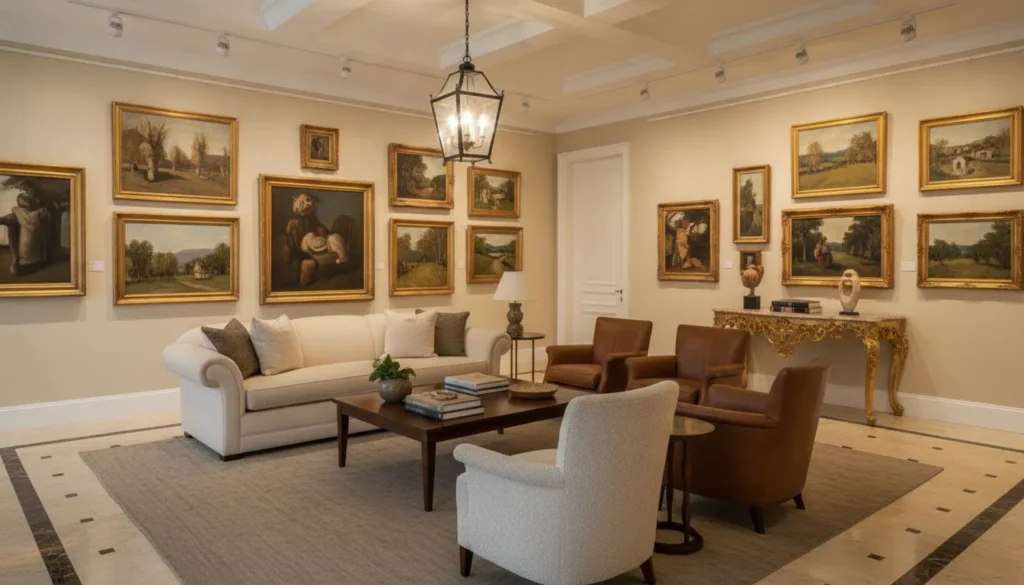
To display a fine art collection at home, treat each work as part of the architecture. Balance gallery discipline with the comfort and movement of residential life. The most successful arrangement considers sightlines, scale, spacing, light, framing, and conservation before a single piece is permanently installed.
Schedule a consultation to design a gallery-worthy home around your collection.
How to display fine art collection at home begins with the character of the art and the rooms around it. Establish a clear visual anchor, allow deliberate breathing room, control light, and test every sightline from the ways people actually use the house. The goal is a warm, curated residence where art and architecture remain in dialogue.
This collection-first perspective is central to art-first interior design. Furnishings, materials, and lighting should support the collection rather than compete with it. A home can feel sophisticated and deeply lived in at the same time when display decisions are made as part of the whole interior.
The Difference Between Gallery Display and Residential Display
A gallery display isolates art in a controlled environment, while a residential display must protect the work and accommodate meals, conversation, circulation, and rest. The best home installations borrow museum-like discipline without becoming sterile. They give every piece an intentional relationship to its neighbors, the architecture, the furnishings, and the daily life of the household.
| Consideration | Gallery display | Residential display |
|---|---|---|
| Light | Illumination is tightly managed for viewing and conservation. | Light must protect the art while supporting the room’s atmosphere. |
| Circulation | Movement is organized around an exhibition route. | Placement responds to doorways, seating, entertaining, and changing views. |
| Curation | Works may follow a period, medium, artist, or exhibition narrative. | Grouping can also respond to scale, color, architecture, and personal associations. |
| Comfort | The setting is intentionally neutral. | Furniture, textiles, and materials make the art central but the room inviting. |
| Framing | Frames serve the exhibition and controlled conditions. | Frames protect the work while engaging the room’s architecture and furnishings. |
In a private home, the collection does more than command attention. It establishes a rhythm that can be seen from a foyer, a seating area, or an adjoining room. A work may need more space around it in a calm library, yet belong in a closer conversation with smaller pieces in a passage. The answer depends on the work and the room, not on a universal formula.
Begin by studying the home as a sequence of experiences. Note the first work seen on arrival, the pieces visible from principal seating, and the places where art can be appreciated without being exposed to unnecessary impact. CW DESIGN’s collection-first design approach treats these relationships as part of one considered composition rather than as a final decorating exercise.
What Is the Best Height, Spacing, and Sightline for Fine Art?
For many installations, place the center of a work approximately 60 inches from the floor, then adjust for furniture, ceiling height, viewing position, and architecture. Keep grouped frames roughly 2 to 3 inches apart when that interval suits their scale. These measurements are starting points, not substitutes for observing how the room is actually seen.
Start with the viewer, not the wall
A common gallery reference places the center of an artwork about 60 inches above the floor. The measurement creates a useful shared sightline when several works are installed together. It should shift when the work is primarily viewed from a sofa, positioned above a substantial console, or encountered from a stair or hallway. The eye should experience the installation as settled within the architecture.
- Measure the center: Mark the center of the frame, not simply the top edge.
- Identify the viewing position: Consider standing, seated, and moving sightlines.
- Account for scale: Include the frame, mat, visual weight, and surrounding furniture.
- Test the approach: View the work from the distance and angle used most often.
- Check adjoining rooms: Confirm that doorways and transitions create a natural sequence.
Before drilling, make paper templates for every frame and tape them to the wall. This reveals whether a group is too high, too dense, or competing with a mantel, console, window, or architectural transition. It also allows the arrangement to be refined without risking the wall or the artwork. The Kansas City Art Institute describes the 60-inch convention as a starting point and emphasizes adjustment for the specific installation in its gallery hanging guidance.
Use spacing to establish rhythm
Spacing creates the quiet rhythm that lets a collection read as intentional. Gaps of approximately 2 to 3 inches often work for a salon-style group, although larger works and heavier frames may need more air. Consistency is useful, but variation can be meaningful when it reflects a change in scale or creates emphasis. Accidental inconsistency is what makes a display feel unresolved.
- Choose a repeatable interval: Decide on a starting gap before arranging the group.
- Measure frame edges: Use the outside dimensions, not just the image area.
- Protect negative space: Let a strong work hold its own visual territory.
- Respect architecture: Preserve sightlines around corners, doors, and built-ins.
- Step back often: Judge the composition from the room’s normal approach.
How to Display Fine Art Collection at Home Without Visual Chaos
To create visual dialogue without disorder, begin with one anchor work, build outward by relationship, and reserve negative space as carefully as you reserve wall space. Group works through a shared quality such as palette, subject, period, medium, or scale. Then remove anything that competes with the composition. Restraint gives a collection presence.
Choose a genuine relationship
A group does not need identical frames or matching proportions to feel coherent. Look for a connection that is visible but not forced. A restrained palette can link very different media. A gradual change in scale can create a measured rhythm. Shared subject matter can create a conversation, while a quiet work can provide the pause that allows a more commanding piece to breathe.
The central work might be the largest, most significant, or simply most visually authoritative piece. Place it first, then add one work at a time. After every addition, ask whether the new piece deepens the conversation or merely fills a gap. This is a practical expression of the art-first design philosophy: the room supports the collection, and the collection gives the room its point of view.
Let the architecture participate
Paper templates are particularly valuable when a wall includes a mantel, a console, a niche, or an uneven ceiling. Tape the templates in place and observe the group from the entry, seating, and adjacent rooms. In an irregular interior, visual alignment may matter more than strict mathematical leveling. A display should look composed within its surroundings, not correct only when measured close to the wall.
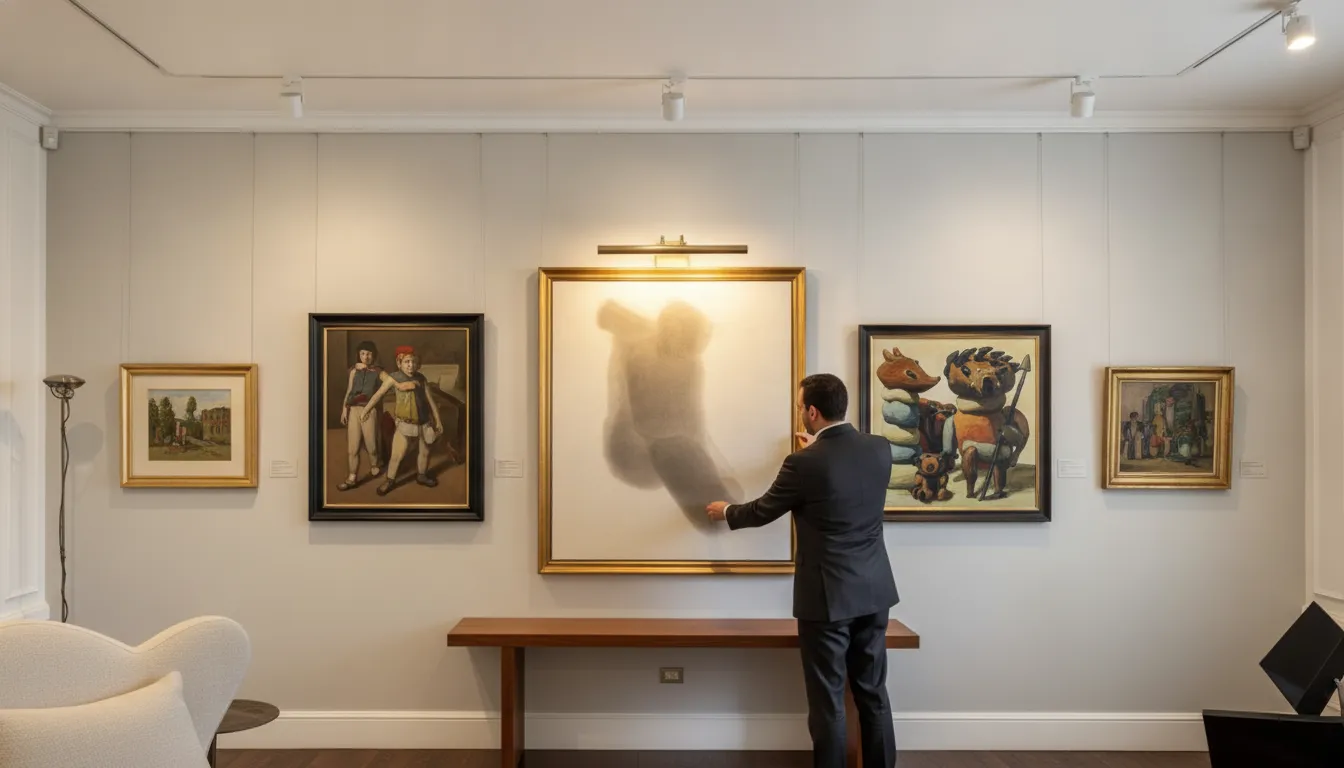
- Anchor the composition: Start with the work that should hold the room’s attention.
- Build in sequence: Add pieces outward and reassess the whole after each one.
- Vary with intention: Use scale or medium to create movement, not visual noise.
- Edit decisively: Remove a work when the eye cannot find a clear resting place.
- Keep a record: Photograph the approved arrangement before installation.
For a whole-home collection, solve each wall in relation to the next. A concentrated grouping in a library may need a quieter transition in the hall. CW DESIGN’s art-oriented residential projects demonstrate why art, furniture, and materials are best considered together rather than room by room.
What Lighting Protects Fine Art While Letting It Shine?
Use layered, controlled illumination that reveals color and texture while limiting direct sunlight and ultraviolet exposure. Diffused daylight, UV-protective glazing, adjustable accent lights, and carefully aimed picture lights can support both conservation and atmosphere. The correct solution depends on the medium, glazing, room orientation, and the hours when the collection is most often viewed.
Light shapes how a surface is perceived. Glare can flatten a painting, while a harsh beam can create distracting reflections and uneven brightness. A residence benefits from more than one lighting layer: ambient light for the room. Accent light for the collection, and task or architectural light for movement through the space. Controls should allow the display to be adjusted for daylight, entertaining, and quiet evening viewing.
Coordinate light with framing
Framing and lighting should be resolved together. Appropriate glazing can reduce ultraviolet exposure and reflections, while archival materials and suitable backing create a protective buffer. Significant or vulnerable works deserve advice from a reputable framer or conservator. Yale University Library recommends avoiding direct sunlight, considering UV-protective glazing, and using archival framing in its collection display guidance.
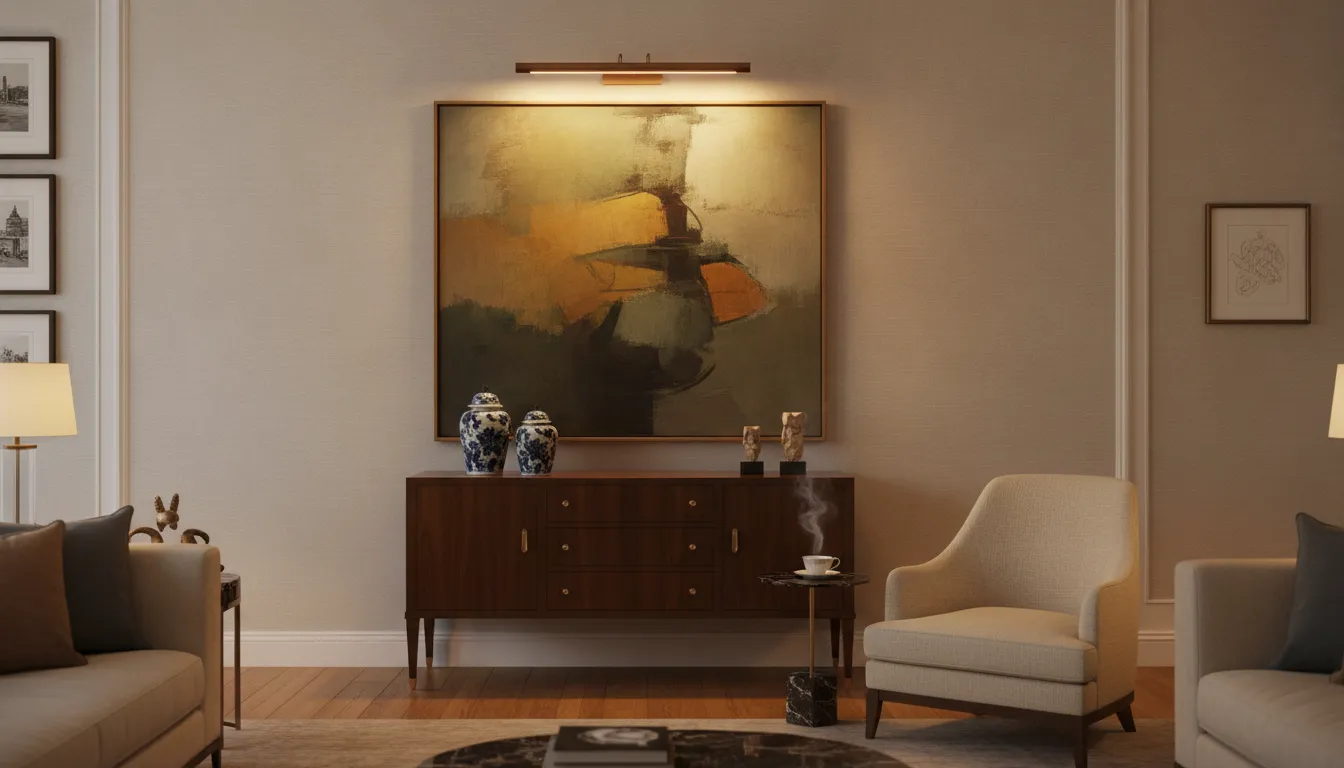
- Filter daylight: Keep direct sun from falling across sensitive surfaces.
- Control glare: Aim fixtures to illuminate the work without reflecting into the viewer’s eyes.
- Layer the room: Combine ambient, accent, and architectural light.
- Use appropriate glazing: Ask a qualified framer about UV protection and reflection control.
- Plan for change: Use adjustable fixtures so a future rotation can be lit correctly.
Lighting should make the art legible without turning the room into a showroom. A considered interior allows the collection to remain central while preserving warmth, shadow, and the sense of intimacy that makes a home different from an institution.
How Do You Protect a Collection From Humidity and Temperature Changes?
Protect art by choosing stable locations away from radiators, fireplaces, exterior doors, and heating or cooling vents, then maintaining a consistent indoor environment. Rapid shifts can stress paper, wood, paint, and other materials. Placement, framing, glazing, ventilation, and professional conservation advice work together to reduce risk without making the residence feel clinical.
Choose stable locations
Look beyond the wall itself. A work beside a frequently opened exterior door may experience changing conditions and accidental contact. A wall above a radiator or close to a vent may receive repeated heat or airflow. Delicate works should not be placed where household vibration is constant. Such as directly above heavy mechanical equipment or on a wall beside a door that is regularly slammed.
Secure mounting hardware should suit the work, frame, and wall construction. For valuable, unusually heavy, or fragile pieces, involve a qualified art handler or conservator. A professional can assess the object and the building rather than relying on a generic hanging solution. This level of care is especially important when a collection includes works on paper, textiles, antique frames, or mixed-media objects.
- Avoid extremes: Keep sensitive works away from fireplaces, radiators, vents, and exterior doors.
- Reduce vibration: Select stable walls away from repeated impact or mechanical movement.
- Use suitable materials: Ask about archival backing, glazing, and mounting methods.
- Monitor vulnerable works: Seek conservation advice when condition or medium warrants it.
- Handle deliberately: Use qualified art handlers for significant moves and installations.
Rotate as a conservation measure
Not every work needs to be displayed continuously. Yale University Library recommends creating an exhibition schedule and rotating pieces to limit prolonged exposure to light and dust. Works on paper, textiles, and particularly light-sensitive objects may benefit from shorter display periods or more controlled locations. Rotation can protect the collection while giving the rooms fresh visual energy.
Discuss your collection with an art-first designer.
When and Why Should You Rotate Works in a Residential Collection?
Rotate a residential collection when conservation needs, changing light, a new acquisition, or a fresh curatorial idea makes the existing arrangement less appropriate. A seasonal review every three to four months can be useful, but the right cadence depends on the works and the home. Rotation is thoughtful curation over time, not casual rearrangement.
Give each rotation a point of view
A seasonal arrangement might bring forward quieter works during a reflective period or create a brighter conversation in rooms used for entertaining. Another display might group works by medium, period, artist, or palette. The point is not to manufacture novelty. It is to reveal relationships that are already present in the collection and let the rooms be experienced differently.
Before moving anything, review sightlines from the entry, principal seating, and transitions between rooms. Photograph the existing arrangement, record each work’s location, and note the lighting and hardware. If a piece is fragile or difficult to handle, ask a professional art handler or conservator to advise before the move. A careful record also makes it possible to return to a successful composition.
Set a practical cadence
For many homes, a seasonal review every three to four months provides enough time to live with an arrangement while preventing the collection from becoming static. A larger whole-home rotation once or twice a year can be paired with smaller changes in a hallway, library, or study. The correct cadence is guided by the art, the architecture, and the household’s use of the space.
Collectors planning a broader commission may also find value in guidance on designing around an art collection and CW DESIGN’s bespoke interiors for art collectors. Both approaches begin with the collection as a source of meaning and structure, then develop the surrounding rooms with equal care.
Frequently Asked Questions
How do you hang fine art like a professional?
Begin with the work’s relationship to the room, then use approximately 60 inches to the artwork’s center as a starting point. Adjust for furniture, ceiling height, seating, and circulation. For a group, establish an anchor and maintain consistent spacing where appropriate. Use paper templates and evaluate the arrangement from normal viewing positions before drilling.
How high should art be hung above furniture?
Hang art close enough to the sofa, console. Or mantel that the two elements read as one composition while leaving enough air for the work to remain visually important. There is no universal gap that suits every room. Test a paper template from the principal seating and approach, then adjust for the furniture’s scale and the artwork’s weight.
What lighting is best for displaying an art collection?
Use controlled, layered lighting that shows color and texture without harsh direct sunlight or distracting glare. Adjustable accent or picture lights can work with ambient illumination, while UV-protective glazing may be appropriate for vulnerable works. A qualified framer or conservator can help match glazing and lighting choices to the medium and condition of a particular piece.
How should I choose the right frame for fine art?
Choose a frame according to the work’s material, period, scale, and relationship to the collection, rather than making every frame identical. For treasured or vulnerable works, ask a reputable framer about archival materials, backing, glazing, and mounting. The frame should protect the object and give it a coherent, timeless presence within the architecture.
Schedule a consultation to create an art-first, gallery-worthy home around your collection.
Pingback: Private Gallery Room Home Design for New York Collectors – CW DESIGN
Pingback: Curating Art for Private New York Residence – CW DESIGN
Pingback: Integrating Sculpture Into Interior Design – CW DESIGN