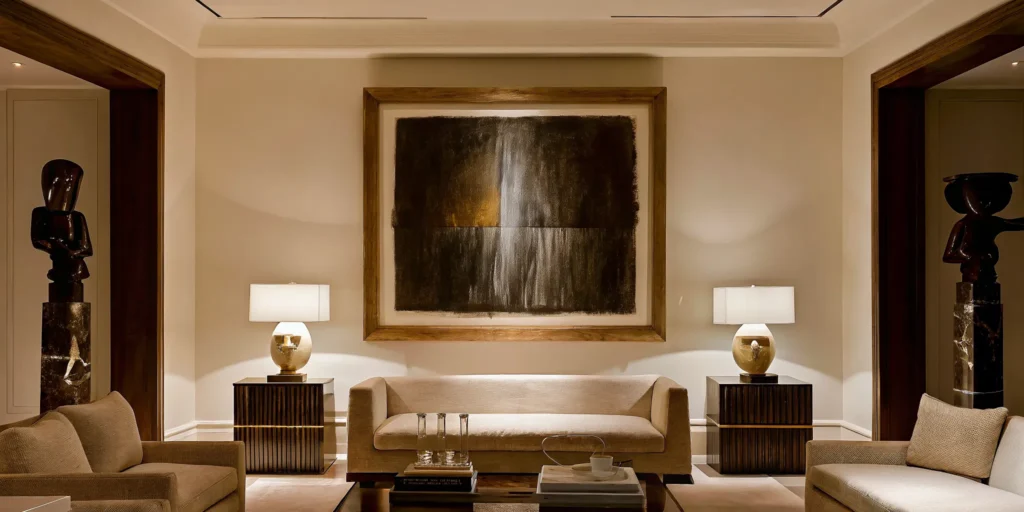
A room for a serious collection is not arranged by filling its largest wall or placing furniture first. Every sightline, pool of light, wall surface, and pause between objects shapes how the work is encountered. For collectors who regard their homes as personal museums, the interior must protect the art while giving each piece room to hold attention.
Interior design for art collectors begins with the collection itself: its scale, medium, relationships, and the atmosphere each work requires. Furniture, architecture, lighting, and circulation then support a considered dialogue between the art and the life of the room.
That approach calls for more than decorative coordination. It asks the designer to read the collection as a composition. Understand the character of the architecture and make deliberate choices about what the eye discovers first, next, and in the distance. The result is a home where art does not merely occupy the scheme, but gives the entire scheme its order.
Begin a bespoke interior design for art collectors project by sharing the character of your collection and the spaces you are considering. A considered dialogue with CW DESIGN can shape the home around the art, from the first sightline to the final finishing detail.
How Interior Design for Art Collectors Begins with the Collection
For a collector, a residence is more than a backdrop for beautiful objects. It is a personal museum, a place where works of art can be lived with, studied, and encountered in changing light and company. The design therefore begins with the collection itself. At CW DESIGN, artwork is treated as the primary design driver rather than a decorative afterthought, shaping the atmosphere, proportions, materials, and movement through the home.
This approach asks a more discerning question than whether a room looks polished. It asks how the architecture can give each work the presence it deserves while allowing the collection to feel coherent as a whole. Catherine Weinstock’s art-centric design philosophy begins with close attention to the character of the pieces, the client’s connoisseurship, and the lived experience of the rooms.
A considered relationship between collection and architecture
Walls, openings, ceiling heights, thresholds, and volumes become active parts of the composition. A painting may command a quiet axis, while a sculpture may anchor a transition between rooms. Rather than filling every available surface, the scheme establishes intervals of focus and repose. This restraint gives important works room to speak and lets the eye move naturally from one discovery to the next.
The result is not a gallery transplanted into a home. It is a bespoke environment in which art and architecture support one another. Materials and finishes are selected for their depth, tactility, and ability to remain timeless beside the collection. Color may complement a work, sharpen its presence, or provide a deliberate counterpoint, but it should never compete for attention.
Creating dialogue among individual works
A sophisticated collection is experienced as a sequence of relationships. Layouts can create dynamic interactions and meaningful dialogues between individual pieces, whether through a shared line, a considered contrast, or a pause between unlike works. Furniture participates in that conversation without overwhelming it. Its scale, silhouette, and placement help connect the art to daily life, so the rooms remain gracious and inhabitable rather than merely formal.
This level of integration benefits from multidisciplinary knowledge. With experience spanning fine arts, interior design, and furniture restoration, Catherine brings conservation-level care to the relationship between valuable objects, furnishings, and the surrounding environment. The collection remains the authority, while every architectural and decorative decision is made to deepen its presence.
Lighting for Art Collectors: How Do You Illuminate Art to Flatter and Preserve It?
Lighting in an art-filled residence must do two things at once: reveal the work with clarity and protect it from unnecessary exposure. The most successful scheme is not simply brighter. It is more discerning, allowing color, texture, scale, and finish to be read as the artist intended while preserving the atmosphere of the room.
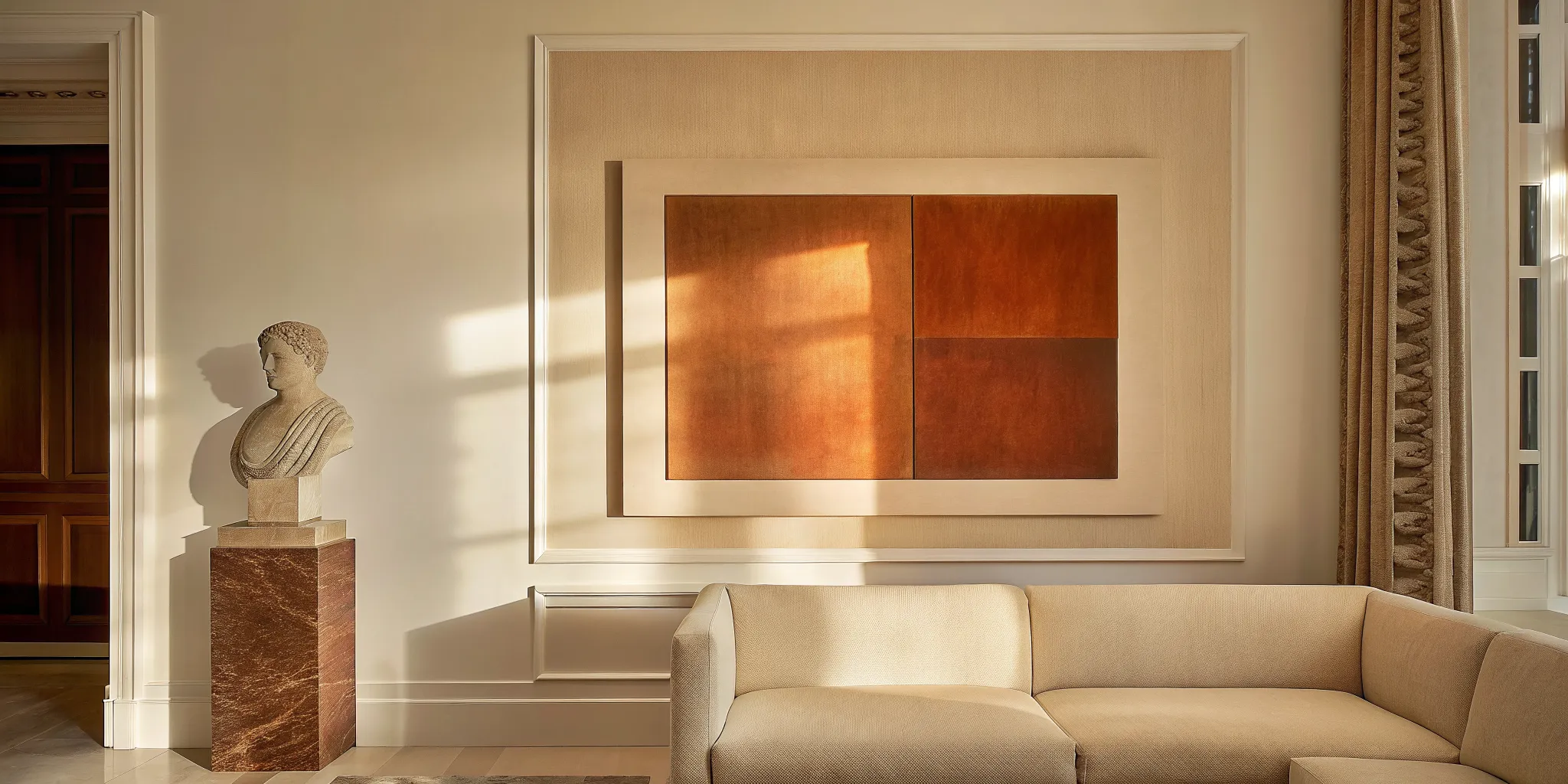
A layered lighting system for appreciation and control
A considered composition begins with layers. Ambient illumination establishes a calm, even foundation without competing with the collection. Focused light then directs attention toward individual works, while discreet architectural sources shape circulation areas and adjacent surfaces. This hierarchy gives each piece its proper presence and allows the eye to move through the room without glare or visual fatigue.
Psychophysical research into the appreciation of Renaissance paintings demonstrates that illumination affects how viewers perceive color and detail. Making the quality of light an essential part of the viewing experience. See the study on optimal illumination for appreciating Renaissance paintings for the academic basis of this principle. In practice, fixtures should be selected and positioned in relation to the artwork. Its surface, its frame, and the viewer’s approach, rather than applied as a generic ceiling plan.
LED systems offer considerable flexibility, but their performance depends on the spectrum of the illuminant. Research on spectral image processing and CIE LED illuminants for museum lighting points to the value of tailored light when visual fidelity matters. Modern paints and saturated colors may respond differently under different sources, so the light should be evaluated against the actual collection. A conservation-minded designer considers how faithfully the source renders the work, not merely how elegant the fitting appears.
Managing daylight and long-term exposure
Daylight brings an irreplaceable softness and connection to the architecture, yet it must be moderated where sensitive works are displayed. Window orientation, glazing, shades, and the placement of art all influence the balance between natural atmosphere and preservation. Research on museum daylighting underscores the importance of assessing daylight adequacy rather than treating it as a fixed benefit. In a private residence, responsive shades and carefully coordinated electric light can maintain the character of the room as conditions change.
Light damage is cumulative, which is why preservation cannot be separated from appreciation. A tailored lighting plan respects the collection’s materials, colors, and textures while giving the room the quiet radiance expected of a personal museum. The result is illumination that serves both connoisseurship and stewardship, allowing the art to command attention without asking it to endure careless exposure.
Sightlines, Scale, and Placement: Letting Art Lead the Eye Through the Home
Artwork should reveal itself in stages, not appear as an afterthought once the furniture has been arranged. A considered plan studies the views created from the entry, primary circulation routes, and places where one pauses to sit. From each position, a painting, sculpture, or grouping can establish a visual destination, create a moment of discovery, or draw the eye toward an architectural volume. Sightlines are therefore part of the composition of the home, allowing the collection to be experienced naturally as residents and guests move through it. This architectural approach is central to bespoke interior design for art collections.
Eye-Level and Focal Distances
Placement begins with the experience of the person, rather than a fixed rule applied to every wall. A work hung too high can feel detached from the room and difficult to contemplate. At eye level, it can enter a more intimate relationship with the viewer. While a lower position may be appropriate when the work is meant to converse with a nearby sofa, console, or other furnishings. The correct height depends on the scale of the piece, the viewing distance, and how the room is used.
Seating arrangements deserve particular attention. A painting visible from a chair should have enough breathing room to hold its presence without being interrupted by a lamp, door swing, or competing object. In a passage, the sequence of works can be composed as a measured progression. With deliberate hanging used to make a specific statement rather than simply fill available wall space. Carefully chosen placement and statement pieces can create visual impact without making the collection feel theatrical or crowded (source on deliberate hanging).
Scale must be considered in relation to both wall and furniture. A small work on a vast uninterrupted surface may lose its authority, while an oversized piece can overwhelm a delicate architectural detail or compress a quiet room. When reviewing placement on site, experienced designers weigh each of these factors:
- Distance from the work to cornice, doorway, fireplace, and moldings
- Scale of the piece against the wall and surrounding furniture
- Viewing distance from seating, entries, and primary circulation routes
- Proximity to competing objects, lamps, and door swings
- How the work reads from the approaches where residents and guests pause
Professional placement considers these relationships alongside the room’s volumes and surfaces, treating architecture as an active frame for the collection (architectural context for art placement).
The result is not a home where every view competes for attention. It is a sequence of calibrated encounters, with focal works receiving the space and stillness they require, and quieter pieces enriching secondary views. In this way, art leads the eye through the residence while remaining in dialogue with its architecture and daily life.
Furniture and Fine Art in Conversation: Can a Room Be Designed Around Both?
Furniture should give a collection a setting without competing for its authority. In an art-focused interior, the architectural elements provide a quiet backbone: proportion, material, and volume establish the room’s character so that each work can be seen with clarity. The aim is not neutrality for its own sake, but a considered complement in which furniture, architecture, and fine art share a coherent visual language.
This is where bespoke furniture becomes more than a functional requirement. A table, cabinet, or seating group can be developed around the collection’s scale, palette. And spatial needs, creating a bridge between the art and the rituals of daily life. The result is a room that feels inhabited without becoming visually crowded. Furniture supports the experience of the collection, guiding movement and framing moments of attention while allowing each significant piece to retain its presence.
Layering textures around a canvas
Texture introduces depth without relying on visual noise. Against a restrained wall, the grain of a finely made cabinet, the softness of upholstery. Or the subtle irregularity of an artisan-crafted surface can draw out qualities in a canvas without mimicking it. Contrast can be equally powerful when it is intentional: a quiet, tactile piece may sharpen the impact of a vivid painting. A more expressive form may instead belong beside work with a related rhythm or material sensibility.
| Approach | What it looks like | When it works |
|---|---|---|
| Quiet complement | Neutral forms, restrained materials, and soft finishes that let the art lead | Abstract or color-rich canvases that need breathing room |
| Deliberate contrast | Bold silhouettes, tactile textures, or expressive pieces that echo the collection | Minimal works in spacious rooms where a single strong form can hold its own |
| Custom bridge | Bespoke furniture conceived around the collection’s scale, palette, and daily use | Whole-home commissions where art and living should feel unified |
That balance depends on the collection and the room, not on a fixed formula. A multidisciplinary understanding of fine arts, interior design. And furniture restoration allows the designer to consider both the aesthetic dialogue and the care required by the objects within it. CW DESIGN’s collaborations with global artisans, including Patrick Naggar and Gallery Fumi, reflect this commitment to furniture and fixtures conceived as part of a larger composition. Explore the bespoke interiors in the CW DESIGN projects portfolio to see how art, craftsmanship, and architecture can be brought into conversation.
Wall Curation and Pedestal Placement: How Can Display Read as Intentional?
A considered collection should never appear to have been distributed across available wall space. Each work needs a relationship to the architecture, the pieces around it, and the way the eye moves through the room. Grouping like items together can establish a coherent visual or conceptual narrative, whether the connection is medium, period, palette, subject, or provenance. The result is not uniformity, but a sense of conversation between works.
Spacing creates the rhythm of that conversation. Works that belong together may be given enough breathing room to remain individually legible. While a tighter arrangement can create the presence of a salon-style composition when the collection and architecture support it. Scale and proximity must be judged in relation to doorways, moldings, furnishings, and neighboring works. A large painting held too close to a cornice can feel compressed; a small drawing isolated on an expansive wall may lose its intended intimacy. Deliberate hanging gives specific works the authority to make a statement rather than asking every piece to compete equally.
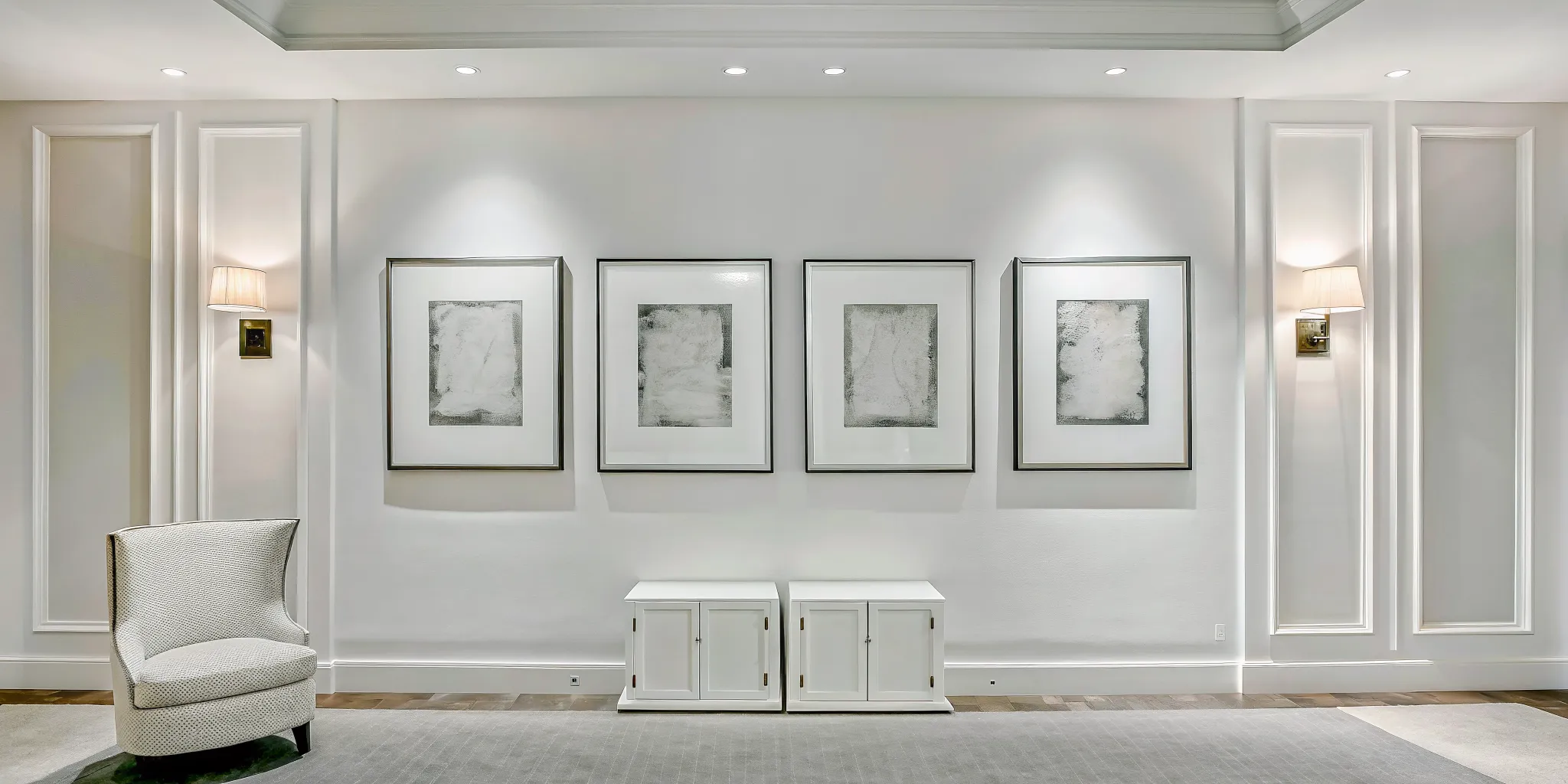
How interior design for art collectors stages sculpture on a pedestal
Sculpture requires a different kind of curation because it is experienced through volume, shadow, and movement around the object. A pedestal should provide a stable visual and physical foundation without becoming the primary event. Its material, proportion, and finish should support the work’s character while remaining quiet enough to preserve its presence.
Placement should be tested from the principal approaches to the room, not only from a single frontal viewpoint. The right height allows the sculpture to be encountered naturally, with its significant profiles and details visible at the intended sightlines. A pedestal near a passage may create a moment of discovery, while one aligned with a broader axis can establish a formal focal point. In either case, circulation must remain generous and the piece protected from accidental contact.
Curation also benefits from periodic restraint. Editing a collection once a year can keep the display fresh, preserve its impact, and reveal which works have become visually overfamiliar. Rotating pieces is not a concession to trend; it is a way of giving the collection renewed attention while allowing the architecture and furnishings to be read anew.
Talk to CW DESIGN about staging your collection with a conservation-minded plan for lighting, placement, and evolving curation. An on-site conversation can turn a treasured group of works into the calm, composed heart of the home.
Frequently Asked Questions
How do you display fine art in a home interior?
Begin with the collection, then determine how each work should be experienced within the architecture. Consider scale, viewing distance, natural and artificial light, surrounding finishes, and the relationship between adjacent pieces. Paintings may require generous breathing room, while sculpture can anchor a passage, niche, or carefully selected pedestal. The aim is a composed setting in which the art remains prominent without making the room feel like a showroom.
What is the importance of sightlines in art-focused interior design?
Sightlines control what the eye encounters as one moves through the home. A considered view can reveal a painting from an entry, frame sculpture through a doorway, or create a gradual sequence between rooms. Reviewing these perspectives on site helps place artwork at meaningful visual moments and prevents furniture, lighting, or architectural features from interrupting the intended experience.
How does professional lighting enhance an art collection at home?
Professional lighting balances presentation with preservation. Adjustable, carefully positioned illumination can reveal texture, color, and dimensionality while reducing glare and unnecessary exposure. Daylight, fixture placement, beam spread, and the sensitivity of individual works should be considered together, rather than relying on a uniform lighting scheme throughout the home.
Should furniture be arranged to complement or contrast with art pieces?
There is no single formula. Furniture may echo an artwork’s material language, proportion, or palette, or provide a measured contrast that gives it greater presence. The strongest rooms allow both elements to converse. Bespoke forms, refined finishes, and intentional spacing can connect the collection to daily life without competing with it.
What role does wall placement play in gallery-style home design?
Wall placement establishes rhythm, hierarchy, and the conditions for close looking. Group related works with a clear logic, reserve prominent walls for pieces that deserve emphasis, and avoid filling every available surface. A well-edited arrangement gives each work sufficient presence while allowing the collection to read as part of the home’s larger architectural composition.
Ready to Begin a Bespoke Art-Centered Interior?
A considered design can give your collection the attention, atmosphere, and dialogue it deserves while allowing the rooms to remain deeply livable. To get started on a bespoke interior design for art collectors project, contact us through the inquiry page. Share the character of your collection and the spaces you are considering, and begin a thoughtful conversation about shaping the home around the art.
Pingback: How to Light Artwork in a Luxury Home – CW DESIGN
Pingback: Flexible Display Planning for a Rotating Private Art Collection – CW DESIGN
Pingback: Natural Light and Contemporary Art in the Home – CW DESIGN
Pingback: Choosing Wall Finishes for a Contemporary Art Collection – CW DESIGN
Pingback: Designing Circulation Around Art in an Open-Plan Home – CW DESIGN