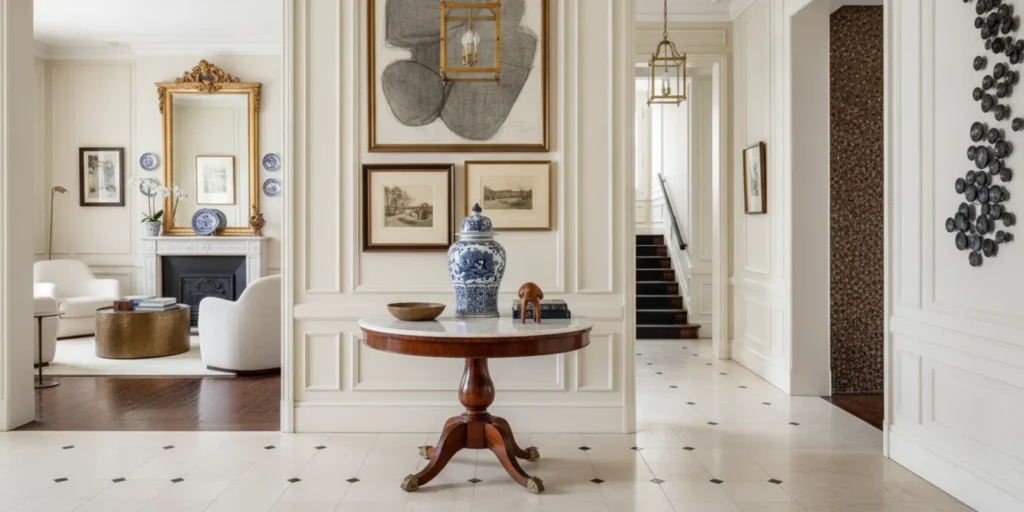
Maximalist interior design is not simply the act of adding more. In a home shaped by art and collecting, it is the thoughtful arrangement of many meaningful elements so they read as a coherent whole. The collection leads; color, furniture, lighting, and architecture support it. The result can feel expressive and layered while remaining calm, elegant, and deeply personal.
Discuss your residential project
What makes maximalist interior design feel considered?
A room with many objects can still have visual order. Considered maximalism depends on relationships: between a painting and the wall around it, between a large piece and nearby furniture, and between the room’s strongest colors and quieter surfaces. Each choice should reinforce the character of the home rather than compete for attention.
This is different from filling every surface. A collected interior needs intervals of rest. Empty wall, a clear tabletop, or an uninterrupted path gives the eye a place to pause. Restraint is not the opposite of abundance; it is what helps abundance become legible.
Begin with the works and objects that matter most. A home’s design can take its cues from the art already in the collection, rather than treating it as a final layer. CW DESIGN describes an approach that puts art at the start of the conversation; learn more about the design approach and interior design for art collectors.
How should you begin with the collection?
Make a working inventory before moving furniture or choosing finishes. It need not be a formal catalogue. Record each work’s dimensions, medium, frame, orientation, and any particular display or conservation considerations already known to you. Note which pieces are essential to daily life, which might be rotated, and which need a particular kind of wall or view.
- Identify the anchors. Select a few works or objects that will set the tone for the rooms they occupy.
- Notice relationships. Group pieces by scale, color, subject, period, or a visual tension that feels meaningful, rather than forcing everything into one theme.
- Record practical needs. Note dimensions, weight, framing, and the conditions each piece requires. For specialist conservation concerns, consult an appropriate conservator.
- Keep flexibility. A collection changes. Avoid a plan that only works if every piece remains in one fixed position.
Photograph the works in their current settings and make a simple list of rooms, openings, and prominent sightlines. This gives you a starting point for discussing how the collection might interact with the architecture. A designer’s art collection design brief can help organize the decisions and priorities.
How can color support a layered interior?
Color can connect a room without making every surface match. Look at the collection for recurring notes: perhaps a warm red appears in several works, or a deep green links a painting to a textile. These references can inform a wall, upholstery, or an accent, but they do not need to be repeated literally. A single quiet surface can make a vivid work feel more present.
Test color in the actual room and at different times of day. The color of a work can shift beside a bright window, under evening lamps, or against a neighboring material. Before committing, consider the view from the entry and adjoining rooms. A sequence of spaces can feel varied while retaining a subtle connection.
Use contrast with intention. A pale background can give a dark painting definition; a saturated wall may make a quieter work feel more intimate. Neither is a universal rule. The artwork’s scale, palette, frame, and relationship to the room should guide the choice.
Which furniture and objects belong in the composition?
Furniture is not a backdrop to be selected independently. Its scale and silhouette affect how a work is seen and how people move through the room. A substantial painting may need a clear field around it; a group of smaller works can relate to a console, chair, or bookcase when their proportions are considered together.
Choose objects for their meaning, material, or form, not only because a surface seems empty. A treasured ceramic, a book, or a sculptural piece may contribute a different scale and texture. But each added element should earn its place. If several objects have similar visual weight, editing or regrouping them may restore clarity.
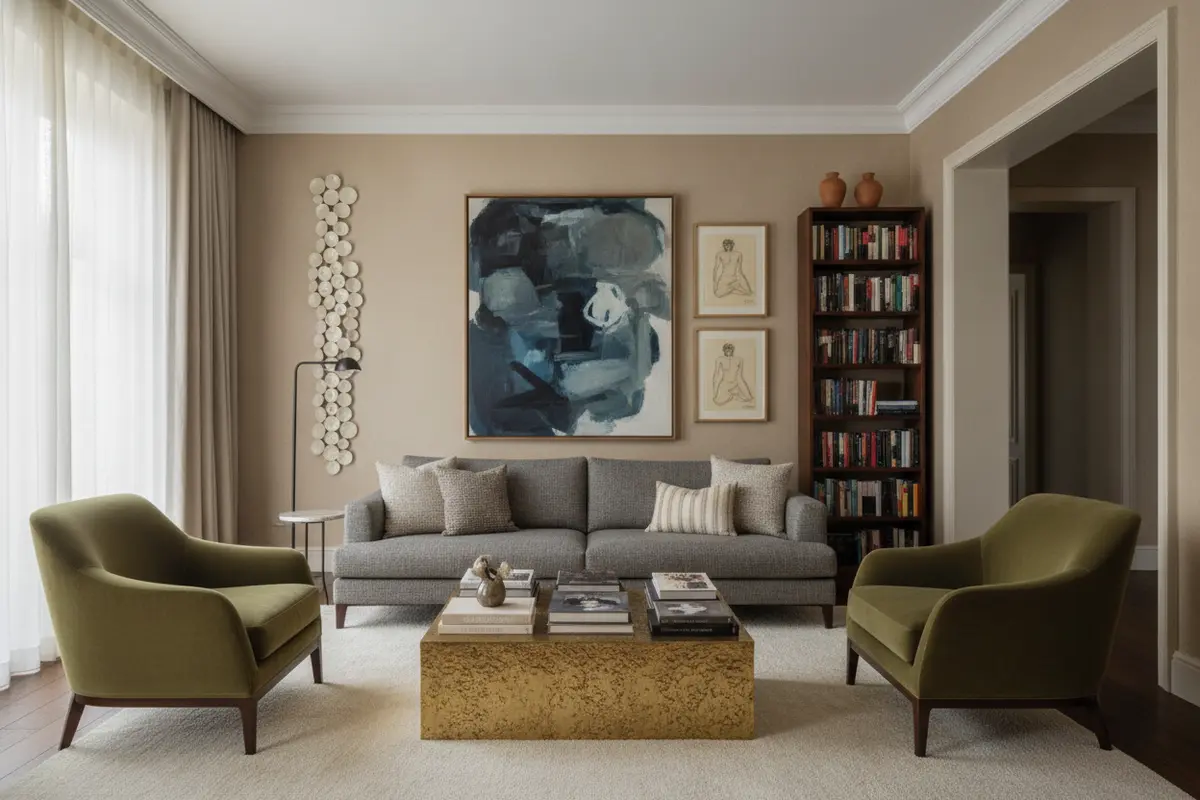
Furniture with age or personal history can also hold a layered room together. Restoration may preserve character while helping a piece sit comfortably within a new composition. Explore what furniture restoration involves when a valued piece needs considered attention.
How do the options for displaying a collection compare?
There is no single arrangement for every home. Use this comparison to clarify what each approach offers before making a plan. The right choice depends on the pieces, architecture, and how the household uses each space.
| Display approach | Works well when | Consider before choosing |
|---|---|---|
| One anchor work | A large or especially meaningful piece should hold the room’s focus | Allow it visual breathing room and check its position from key viewpoints |
| Salon-style grouping | Several works have a meaningful relationship and can be composed together | Plan the overall outline, spacing, and relative scale before hanging |
| Art across connected rooms | A collection should unfold through the home rather than gather in one gallery-like space | Consider sightlines, transitions, and a varied rhythm between rooms |
| Rotating display | The collection is larger than the available wall area or changes over time | Plan safe storage and a consistent method for updating the arrangement |
How should circulation and sightlines shape the plan?
A work should be encountered naturally, not placed where it obstructs everyday life. Walk the routes people actually take: from the entry to the living area, around seating, and toward windows or adjoining rooms. Notice what is visible from a doorway and what becomes a discovery only after entering.
Try a proposed arrangement with paper templates or removable markers before hanging. Mark the outer dimensions of frames and note nearby furniture. This simple test helps reveal whether a grouping overwhelms a narrow wall, conflicts with a door swing, or disappears behind a lamp. For sculpture, include the viewing distance and the space needed to move around it.
Think in layers of attention. A strong focal work can establish a room, while smaller pieces enrich its edges and adjacent spaces. Not every wall needs to carry equal visual intensity. A pause between dense compositions lets the collection unfold at a measured pace.
What role do light and materials play?
Light changes how art and materials are perceived. Observe daylight across the room and note glare, shadows, and the way views shift during the day. For lighting decisions, consider how a fixture will illuminate a work without creating distracting reflections. Specialist advice may be needed when a piece has particular conservation requirements.
Materials can also create coherence. Wood, stone, metal, textiles, and painted surfaces each bring their own texture and reflectance. Repeating one material in small, deliberate ways may connect otherwise different objects. A mix of finishes can feel rich, but a repeated undertone or craft detail helps it remain composed.
Custom elements may be useful when the architecture or collection calls for a precise fit. Bespoke cabinetry, a carefully proportioned display surface, or considered hardware can integrate art and function without making the room feel generic. Review bespoke furniture design as one way to think about pieces made for a particular residence.
What common mistakes make maximalism feel crowded?
- Adding before editing. Begin with the pieces you value and build around them, instead of treating every available surface as an invitation.
- Ignoring scale. A small work can be lost on a broad wall, while a large work can dominate a tight passage. Consider the viewing distance and neighboring elements.
- Making every wall compete. A home needs visual pauses as much as strong compositions.
- Choosing a palette before looking at the art. Let the collection inform color, then test the relationship in the room itself.
- Overlooking use. A beautiful arrangement still needs comfortable seating, clear circulation, and surfaces that serve daily life.
Editing is not a rejection of collecting. It is a way to give each selected piece a more distinct presence. Some works may be better suited to another room or a later rotation. A home can hold many layers without displaying everything at once.
What is a practical sequence for planning the room?
- Understand the space in person. Observe its proportions, openings, natural light, and how people use it. Photographs are useful records, but they do not replace experiencing the room.
- Map the collection. Gather dimensions and identify anchor works, related groups, and display considerations.
- Set priorities. Decide what the room needs to do and what the collection should make possible there.
- Explore layouts. Test art, furniture, and circulation together using sketches, measured plans, or temporary templates.
- Refine color and materials. Evaluate them beside the works and in the actual light of the room.
- Review the whole home. Check how the room connects to adjacent spaces and whether the sequence feels balanced.
- Install and reassess. Once pieces are placed, step back from several viewpoints. Make adjustments to spacing, light, and supporting objects.
For a whole-home commission, the decisions are connected across rooms and often need to be considered together. CW DESIGN’s luxury residential interior design work and Brooklyn townhouse project offer further context for a residence planned as a cohesive environment.
How can you test the arrangement before installation?
Use a measured plan to compare more than one composition. Start by drawing the wall, openings, trim, and nearby furniture to scale. Add rectangles for the art, then shift the group as a unit before refining individual spacing. This makes it easier to compare an anchor-centered arrangement with a tighter cluster without repeatedly moving heavy pieces.
For a salon grouping, first define its outside boundary. A loose arc, a compact rectangle, or an irregular contour can each work, but the group should have an intentional shape. Then consider the gaps between frames: consistent spacing can create a quiet structure, while carefully varied spacing may suit a more organic collection. The key is to choose a logic and apply it across the grouping.
Evaluate the plan from the positions that matter: the doorway, principal seating, and the path through the room. A layout that looks balanced straight on may feel crowded from the side or compete with a view beyond. If one work disappears at normal viewing distance, try changing its neighbors or placing it where it can be seen more closely.
Finally, test how the arrangement relates to the rest of the home. A strong composition in one room may need a quieter approach in the next. Comparing the rooms together helps prevent every wall from demanding attention and makes a whole-home collection feel curated rather than accumulated.
How can a collection unfold across an entire home?
When a collection is extensive, begin with a home-wide map rather than assigning every work to the nearest available wall. List the main spaces and note each one’s role: arrival, gathering, dining, retreat, study, or passage. Then identify where the collection can be encountered at different distances and levels of attention. A large work may anchor a principal room, while smaller or more intimate pieces can reward closer viewing elsewhere.
Consider transitions as carefully as rooms. A view through a doorway can connect two works through color or shape, even when they are not on the same wall. Conversely, a change in mood may be welcome between a lively gathering room and a quieter private space. The collection does not need a single visual theme; a measured sequence can hold contrast without forcing uniformity.
Make a provisional placement schedule. Assign each anchor piece first, then identify secondary works that support those choices. Leave some locations unresolved until furniture, lighting, and circulation are understood. This prevents a favorite piece from being committed to a wall that later proves unsuitable, and gives the design room to respond to the actual architecture.
In a multi-room project, decisions about art, furnishings, and finishes are interdependent. A room-by-room list is useful, but the plan should also show sightlines, shared materials, and where visual intensity rises or eases. CW DESIGN’s residential projects offer examples of work considered across different settings.
Which decisions benefit from an on-site review?
Room proportions, changing light, circulation, and the relationship between objects are difficult to judge from a list alone. An in-person review makes it possible to understand how a work meets its wall, how adjoining rooms relate, and whether a proposed arrangement suits the household’s actual patterns.
Catherine Weinstock’s multidisciplinary training spans interior design, furniture restoration, and fine arts, with study in Europe. That breadth can inform the consideration of artwork, architecture, furnishings, and craft as connected parts of one residential project. Learn more about Catherine Weinstock and CW DESIGN.
For practical guidance on preventing light-related damage to collections, the Smithsonian’s guidance on light and museum objects explains that light exposure can harm collection materials and that damage is cumulative. This supports a cautious approach: evaluate daylight and fixtures for each work, and seek conservation advice where the material or condition calls for it.
Begin a conversation about your home
Frequently Asked Questions
Does maximalist interior design mean displaying every artwork?
No. A thoughtful display may feature selected works and rotate others. Leaving room around important pieces can make a collection feel more present, not less abundant.
Can a maximalist room still feel calm?
Yes. Clear circulation, visual pauses, considered groupings, and a restrained relationship between color and materials can bring calm to a room with many layers.
Should the art or the furniture be chosen first?
For a collection-led home, begin by understanding the art and how it should be experienced. Furniture and finishes can then be chosen in relation to the works, architecture, and daily use.
How can I test a gallery wall before hanging it?
Measure each work, map the grouping on paper, and use temporary templates to assess its outline and spacing on the wall. Check it from the main entry and seating positions before installation.
Maximalism is most enduring when it expresses a particular collection and way of living. Begin with what matters, compose with care, and let each room offer a thoughtful balance of discovery and repose.