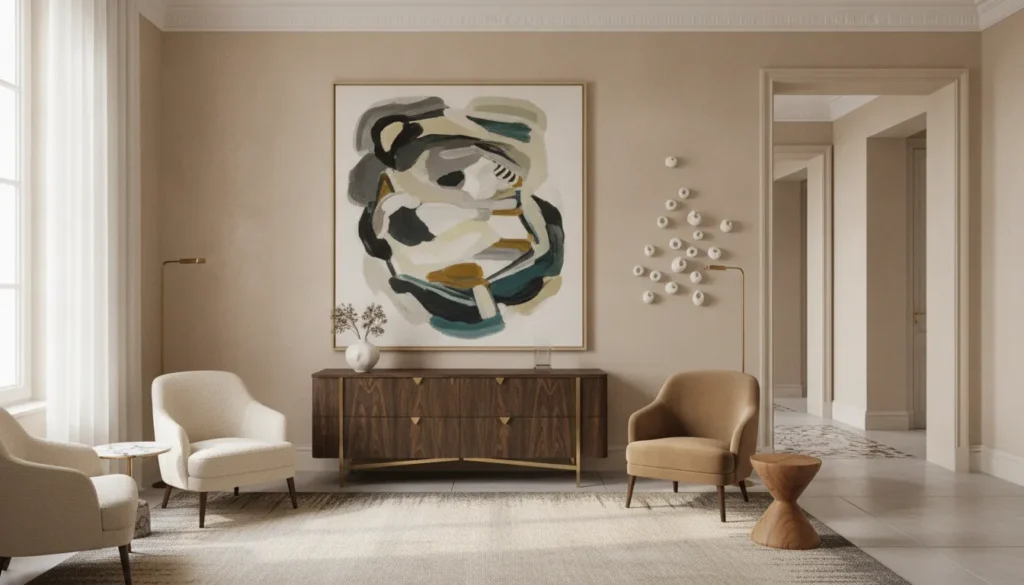
For an art collector, a home is not a neutral container waiting for decoration. Its architecture, circulation, light, materials, and furnishings should create the conditions for the collection to be seen, lived with, and understood over time.
Bespoke interior design for art collectors begins with the artwork itself, treating the collection as the foundation of the residence rather than an afterthought. The result is a curated environment where each room supports the character of the pieces and creates thoughtful dialogue between them.
This collection-first perspective calls for more than selecting complementary colors or museum-like display methods. It requires an in-person reading of the space, a precise understanding of the collector’s priorities, and a disciplined eye for what should remain quiet. CW DESIGN’s art-first interior design philosophy offers a useful starting point for understanding how those decisions become a timeless, sophisticated interior.
Request an engagement consultation
What Bespoke Interior Design for Art Collectors Really Means
For serious collectors, the home is not a neutral container waiting to be decorated. The collection establishes the first set of questions: Which works should lead the eye? How should color, scale, light, and movement unfold from room to room? In CW DESIGN’s bespoke interior design philosophy, artwork is the starting point rather than a finishing layer added after furniture and finishes have been selected.
That distinction defines bespoke interior design for art collectors. The objective is not to create a fashionable backdrop or reproduce a recognizable look. It is to develop an interior with the specificity of a private collection and the character of the people who live with it. Each decision, from the architecture of a room to the placement of a single object, should support a considered relationship between the space and the art.
The collection leads the design conversation
A collection-first practice begins by understanding the works themselves. A painting may call for visual quiet around its edges, while a sculpture may need circulation, changing sightlines, or a stronger architectural setting. Works from different periods and cultures may also need to coexist without being flattened into a single decorative scheme. The design responds to those tensions through proportion, material, lighting, and spatial sequence.
This is a dialogue between architecture and art, not a competition between them. The room should give each piece enough presence to be experienced fully, while the larger interior creates dynamic interactions between works. That principle has a long history in art-centered interiors, where the arrangement of a space can shape how a collection is understood. The result is an environment that feels composed and livable, rather than arranged as a showroom.
Tailoring requires a multidisciplinary eye
CW DESIGN brings together training in Interior Design, Furniture Restoration, and Fine Arts. That combination matters when an interior must be both visually coherent and materially precise. An understanding of restoration brings sensitivity to age, construction, patina, and craftsmanship. Fine Arts training supports a close reading of composition, context, and artistic intent. Interior design gives those observations a physical framework through circulation, furnishings, finishes, and light.
The aesthetic remains subtle, elegant, sophisticated, and curated. It does not depend on trend-driven gestures or standardized packages. A boutique, tailored studio can instead refine the project around the collection, the architecture, and the daily rituals of its owners. Bespoke means that the finished interior could not simply be transferred to another home because its proportions, materials, and relationships have been developed for this particular place and these particular works.
How a Collection-First Commission Is Structured from First Meeting to Final Installation
A collection-first commission is a sustained collaboration, not a sequence of interchangeable decorating decisions. Each phase builds on the last, allowing the architecture, furnishings, and artwork to develop as a coherent whole. The process is deliberately attentive because an art-oriented home requires both creative judgment and dependable long-term management.
-
1. An in-person understanding of the space
The work begins with a meeting and an on-site visit. Catherine must experience the space in person, observing its proportions, natural light, circulation, architectural character, and relationship to the surrounding setting. As she explains, she has to go to a place “to get a feel for it.” This direct understanding establishes the conditions in which the collection will be lived with and seen, rather than reducing the project to plans or photographs. It also makes clear whether the commission is suited to a whole-home, deeply considered engagement.
-
2. A collection and whole-home brief
Next, the team studies the client’s artwork, antiques, existing furnishings, and intentions for the home. The brief considers how individual pieces should relate to one another, where they can have presence, and how rooms should support the daily life of the collector. The result is a broader design framework for the entire residence, not an isolated treatment for a single room. Decisions about architecture, materials, lighting, furniture, and installation are coordinated around the collection from the outset.
-
3. Detailed design, sourcing, and coordination
With the direction established, the commission moves through design development, specialist sourcing, fabrication, and coordination with architects, craftspeople, galleries, and contractors as needed. This is where a tailored concept becomes a precise interior. Finishes and furnishings are assessed for their contribution to the collection and the atmosphere of the home. Every interface matters, from the placement of a painting to the way custom elements meet the architecture.
-
4. A measured, multi-year realization
Whole-home commissions can unfold over a year or a year and a half, and some continue as the residence and collection evolve. That timeline allows complex decisions to be made carefully rather than rushed into a short-lived result. CW DESIGN intentionally accepts a limited number of large projects, prioritizing quality over quantity and preserving the focus required by each engagement. The work is suited to collectors seeking a lasting, curated environment, not a rapid stylistic refresh.
-
5. Installation and long-term stewardship
Final installation brings the plan into physical reality. Artwork, furniture, lighting, and accessories are positioned in relation to the architecture and to one another, with close attention to scale, sightlines, balance, and finish. Meticulous project management continues through this stage so that details are resolved and the completed home feels intentional. The finished residence is not simply complete; it is prepared to accommodate the collector’s life and future additions with the same care.
This structured approach gives a collection-first commission its particular depth: the home is developed as a unified, evolving setting for art, rather than assembled room by room.
The Role of Custom Fabrication in a Collection-Forward Interior
Custom fabrication gives a collection-forward interior its connective tissue. A room should not feel like a series of valuable objects placed side by side. Furniture, materials, architectural details, and artwork need to participate in a considered visual conversation, with each element supporting the collection’s presence.
That often means looking beyond standard selections. Deep sourcing can uncover unique, artisan-made materials whose scale, texture, and provenance are appropriate to the setting. A hand-finished surface may establish a quiet tonal bridge between two works. A bespoke cabinet can provide necessary storage while maintaining the visual calm around a painting. A seating piece can introduce shape and comfort without becoming a competing focal point. The objective is not novelty for its own sake, but cohesion that feels inevitable once the room is complete.
Artisan collaboration brings specificity to the room
CW DESIGN’s global artisan collaborations are a meaningful differentiator in this process. Working with makers and galleries such as Francesco Perini, Patrick Naggar, and Gallery Fumi expands the vocabulary available to a project. These relationships can bring forward pieces and materials that are less predictable than mass-produced furnishings, while preserving the discernment expected in a serious collector’s home. The work is selected for its relationship to the architecture and the collection, not simply because it is distinctive.
Collaboration also allows fabrication to respond to the particulars of a space. Proportion, sightlines, circulation, and the placement of existing works can all inform a commission. A console may be shaped to preserve a view toward a sculpture. A table may be calibrated to an intimate salon, while a wall treatment creates a measured backdrop for works on paper. This level of attention is especially valuable when the home is treated as a personal museum, yet still needs to function with ease every day.
Functional art should support, not overpower
The strongest collaborative pieces are functional as well as artistic. They contribute craftsmanship and character while performing a clear role within the interior. That balance helps the collection remain central. Research on historic collector interiors likewise shows how furniture and architectural context can work together around an extensive collection rather than exist as unrelated decoration. See the New York City Landmarks Preservation Commission’s documentation for an example of that relationship.
For a closer look at how this thinking appears across completed spaces, explore CW DESIGN’s interior design portfolio. Each commission demonstrates why custom fabrication is most successful when it is precise, restrained, and inseparable from the life of the collection.
Why Bespoke Design Produces Environments That Honor the Art Rather Than Compete with It
Art should establish the atmosphere of a room before furniture, finishes, or decorative gestures enter the conversation. In a collection-first interior, every decision is measured against the work itself: its scale, palette, materiality, period, and the emotional presence it brings to the home. The result is not an empty backdrop, but a composed setting in which the art remains fully legible.
This is the distinction between a curated interior and a decoration-first scheme. Decoration-first design often begins with a look and adds art at the end. When every surface is competing for attention, even exceptional pieces can lose their authority. Bespoke design takes the opposite position. It develops a visual language that is subtle, elegant, sophisticated, and timeless, allowing the collection to lead without making the surrounding rooms feel austere or unfinished. CW DESIGN describes this aesthetic as intentionally curated rather than trend-driven.
A home designed for a serious collector should feel like a personal museum, but not a public gallery. Its rooms can hold intimate memories, daily rituals, and the changing relationships among paintings, sculpture, furniture, and architecture. Curation therefore means more than selecting beautiful objects. It means deciding what belongs together, what deserves visual pause, how one piece is encountered from another room, and where quiet is necessary. The aim is meaningful arrangement, not accumulation.
Context gives the collection greater depth
The most successful rooms also respect the historical and artistic narrative of the house. A period detail, an inherited object, or the architectural character of a space may offer essential context for a collection. Research on historic art-filled interiors shows how domestic design can preserve both the original character of a house and the cultural tastes of its collector. That relationship between art and architecture is not incidental. It gives each work a more resonant setting.
For this reason, bespoke interior design for art collectors requires restraint as well as imagination. Materials, lighting, proportions, and circulation should support the experience of looking. The design should feel inevitable, as though the rooms were composed around the collection rather than decorated over it. Explore CW DESIGN’s design approach to see how a collection-first philosophy turns refinement into a form of respect.
How CW DESIGN Works with Collectors to Develop the Collection-First Brief
The first conversation is not a styling exercise. It is an act of looking closely at the collection, the architecture, the way the rooms are used, and the relationships the collector wants to create between individual works. CW DESIGN approaches the designer’s role as curator, bringing professional judgment to the balance between personal meaning and the larger composition of the home. The result is a brief with a point of view, not a catalogue of fashionable finishes.
That perspective is central to art-first design. Paintings, sculpture, antiques, and objects are considered alongside circulation, proportion, materiality, lighting, and the practical conditions that help preserve fine art. Lighting is planned to reveal the work without overwhelming it, while climate considerations are addressed as part of responsible stewardship. The home can then develop as an evolving personal museum, shaped by the collector’s life rather than frozen into a single decorative moment.
| Consideration | Comparison |
|---|---|
| Starting point | Collection-first: Artwork, architecture, and the collector’s way of living. Decoration-first: A current look, color story, or predetermined product mix. |
| Design role | Collection-first: Curator, interpreter, and long-term design partner. Decoration-first: Specifier of coordinated furnishings and finishes. |
| Result | Collection-first: A cohesive home that supports, preserves, and gives meaning to the collection. Decoration-first: A polished room that may feel disconnected from the art and its owner. |
A brief shaped by judgment, not a formula
Because every engagement is unique, CW DESIGN works from the particular conditions of each home and collection rather than applying a standardized package. Materials, methods, and decisions are developed in response to the quality expected, the character of the art, and the needs of the space. That tailored model reflects the reality that no two commissions ask the same questions.
This level of attention is intentionally selective. CW DESIGN maintains limited room for engagements so each commission can receive the sustained thought, detail, and curation it requires. For a collector seeking bespoke interior design for art collectors, that exclusivity is part of the value: the brief remains personal, rigorous, and capable of evolving as the collection does. To explore the wider portfolio and working process, visit the interior design portfolio.
Discuss your collection with CW DESIGN
Frequently Asked Questions
How do you design an interior space for an art collector?
Begin with the collection, the architecture, and the way each piece should be experienced. The plan considers sightlines, scale, circulation, wall proportions, furnishings, and the relationship between artworks rather than treating art as a final decorative layer. The result should feel composed and personal, with the room supporting the work without competing for attention.
What are the key elements of bespoke interior design for high-end art collectors?
The essential elements include a close understanding of the collection, site-specific space planning, carefully calibrated lighting, custom or artisan-made furnishings, and materials selected for their character and longevity. A bespoke process also accounts for how the collection may evolve, so the interior remains cohesive as new pieces enter the home.
What is the importance of lighting in interior design for art collectors?
Lighting should reveal color, texture, and detail while controlling glare and avoiding unnecessary exposure that may affect sensitive works. It must also work at several levels: focused illumination for individual pieces, ambient light for the room, and comfortable lighting for daily life. The lighting strategy should be developed alongside the art placement and architectural plan.
Should my interior design plan come before or after purchasing art?
Neither sequence is absolute. Existing works should inform the initial brief, while future acquisitions can be anticipated through flexible walls, lighting, storage, and circulation. When a significant purchase is under consideration, bringing the designer into the conversation early helps ensure that the piece belongs to the larger architectural and collection narrative.
Can I integrate a modern art collection into a traditional home design?
Yes. Contrast can create a sophisticated, timeless interior when scale, color, material, and sightlines are handled deliberately. Traditional architectural details can provide a measured setting for contemporary work, while restrained furnishings and considered placement keep the dialogue between old and new clear rather than visually unsettled.
Ready to Begin a Collection-First Commission?
A thoughtful first conversation can clarify how your collection, architecture, furnishings, and daily life might come together in a cohesive interior. CW DESIGN approaches each engagement with close attention to the character of the art and the atmosphere it should create. To get started, contact the studio to discuss your project and request an engagement consultation.
Pingback: Curating Art for Private New York Residence – CW DESIGN