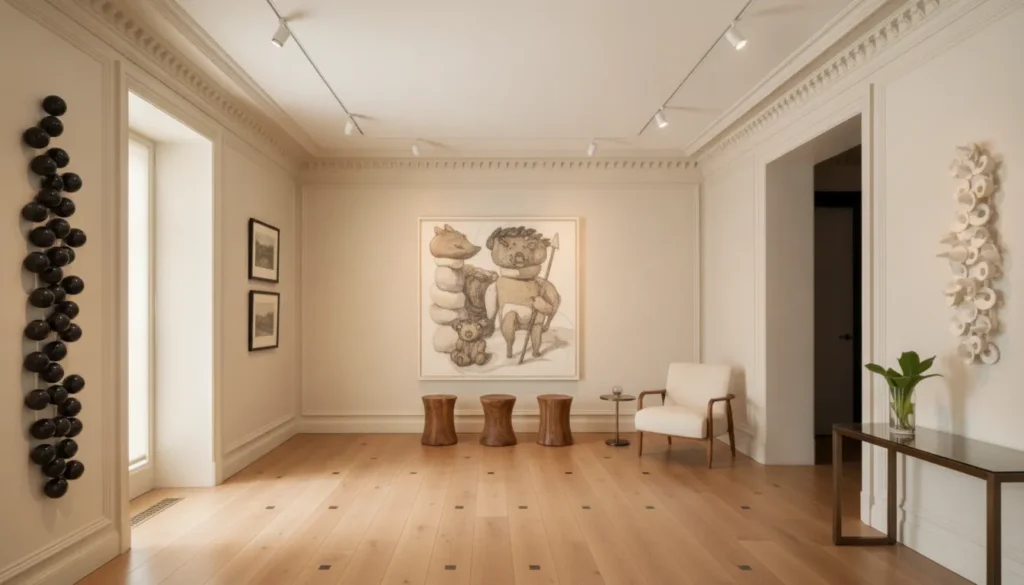
A private gallery room should do more than display beautiful objects. In a New York residence, it gives a collection its own sense of place while remaining connected to the architecture, intimacy, and rhythms of home. This collection-first approach is central to art-first interior design.
Discuss your private gallery room with CW DESIGN
The strongest private gallery room home design begins with the collection, then shapes proportion, circulation, lighting, and materials around the art. The result is neither a commercial gallery nor a storage room, but a composed setting in which each work can be experienced and lived with.
Planning begins by looking closely at the works, the room that will hold them, and the way people move through the residence. The purpose is not to make a home feel institutional. It is to give important pieces the space, attention, and continuity they need.
What Defines Private Gallery Room Home Design?
A dedicated gallery room is art-led rather than merely decorated. Its proportions, sightlines, circulation, lighting, and relationship to adjoining rooms respond to the collection and to the collector’s way of living. The room may be formal, intimate, or quietly transitional, but art remains the organizing principle.
A living room can contain significant works while remaining arranged primarily for conversation, reading, entertaining, or a view. A private gallery room gives the collection greater authority without turning the residence into a commercial exhibition space. It creates enough visual and physical space for each work to be encountered properly, while preserving warmth and welcome.
Let the collection set the priorities
Start with a few practical questions. Which works deserve sustained attention? Which pieces belong together, and which require separation? Does the collection call for a sequence of intimate encounters or a more open arrangement? The answers influence the room’s scale, furnishings, thresholds, and visual pauses.
Works also need breathing room. Viewers should be able to stand back without interrupting circulation or coming too close to a vulnerable surface. The Kansas City Art Institute’s gallery circulation guidance treats traffic flow and viewing distance as part of a successful arrangement. The room should feel composed rather than crowded.
Make the room residential
The strongest gallery rooms remain connected to daily life. A finely made chair, a small table, or a carefully placed lamp can provide a place to pause without competing with the work. Openings to adjoining rooms can make the gallery feel discovered rather than isolated. In one residence, it may be a quiet destination for study. In another, it may form a measured transition between public and private areas.
Neutrality alone is not a design philosophy. A restrained palette may support the art, but texture, material, and scale still establish the room’s character. The goal is a bespoke setting in which the collection is seen clearly and lived with naturally.
It is also useful to distinguish a gallery room from a room that simply has many pictures. Quantity does not create a gallery. A considered sequence, a place to pause, and a clear relationship between the works create the experience. The room should have enough restraint that the eye can move from one piece to the next, while still feeling generous enough for conversation and everyday use.
In a New York apartment or townhouse, the room may have an unusual proportion, a limited number of uninterrupted walls, or a strong view toward the street or garden. Those conditions are not obstacles to hide. They are part of the design brief. The best plan uses the character of the existing architecture to give the collection a distinctive setting.
What Infrastructure Does a Private Gallery Room Need?
A private gallery room needs coordinated walls, lighting, circulation, and environmental planning. The right infrastructure protects the viewing experience while keeping the room residential and connected to the building.
The room should be planned around the collection and the architecture together. Before a work is positioned, consider walls, ceiling, windows, mechanical systems, door clearances, and the route through which pieces will enter and leave. A residential gallery does not need to imitate a commercial institution. It does need infrastructure that protects the viewing experience and supports the life of the home.
Wall capacity is part of that early conversation. Large works may need carefully located reinforcement, while delicate frames require secure mounting and enough clearance from doors or busy circulation routes. The plan should also account for how a work will be carried into the room. A beautiful final arrangement is not practical if the route to it is too narrow or forces unnecessary handling.
Daylight is another design variable. Windows can bring an extraordinary quality of light, but direct sun may change the way a work is viewed and may increase exposure. Curtains, shades, glazing, and the placement of art can help the room remain visually calm across the day. These choices should be made with the collection and the building in mind rather than applied as a generic gallery formula.
Plan walls, sightlines, and circulation
Wall planning should account for each work’s dimensions, weight, framing, and intended sequence. Study the room from the approach a visitor will take, as well as from the places where residents pause or sit. Sightlines should feel intentional, with space to step back from larger works and enough separation to avoid accidental contact.
A restrained wall finish can keep attention on the collection. The right tone, sheen, and material, however, depend on the art, architecture, and natural light. The answer is not a universal white room. It is a palette chosen in relation to the pieces and the atmosphere of the residence.
Coordinate lighting and environmental conditions
Lighting should reveal texture, color, and scale without creating glare or unnecessary heat. The Smithsonian Museum Conservation Institute explains that excessive ultraviolet exposure and heat can damage paintings. Its painting-care guidance is a useful reminder to coordinate fixture positions, beam direction, dimming, daylight control, and glazing with the specific works.
Temperature and humidity fluctuations also deserve attention. They can affect canvas, wood, and paper in different ways. Begin with a project-specific review of windows, heating and cooling patterns, ventilation, and seasonal conditions. When the collection or property warrants it, coordinate with qualified conservation, lighting, and mechanical specialists. Thoughtful private gallery room home design makes these decisions part of the architecture without allowing the infrastructure to announce itself.
Should a Collection Have a Permanent or Rotating Hang?
A permanent hang suits a settled group of works, while a rotating hang suits a collection that evolves. A hybrid approach can preserve anchor pieces and make room for new relationships over time.
| Approach. | Best suited to. | Primary design consideration. |
|---|---|---|
| Permanent hang. | A coherent group with a settled relationship. | Compose proportion, sequence, and sightlines around the selected works. |
| Rotating hang. | An evolving or broad collection. | Plan flexible groupings and clear routes without losing visual calm. |
| Hybrid hang. | Anchor works with changing supporting pieces. | Keep the room’s identity while allowing the collection to develop. |
A permanent hang gives the room a settled point of view. Works are selected for their dialogue with one another, their scale within the architecture, and the way they meet the eye each time someone enters. This can create a quiet sense of permanence when the collection includes pieces with strong personal or historical significance.
It also makes the room a record of a particular moment in the collector’s life. The sequence may reflect a family history, a period of acquisition, or a group of works that has acquired meaning together. Because the arrangement is stable, small details become more legible over time. A visitor can return to the same room and notice a different relationship between familiar pieces.
A rotating hang creates a different relationship with the room. Collectors can re-contextualize individual works and discover new connections by changing their placement. The room remains recognizably itself, but its emphasis evolves. A hybrid arrangement can keep anchor works in place while a surrounding selection changes.
Design flexibility instead of improvising it
Rotation works best when it is anticipated in the initial plan. The room should accommodate changing scales, groupings, and sightlines without requiring disruptive alterations. Clear routes, considered mounting points, and furnishings that do not obstruct the walls preserve composure as the collection develops.
Flexibility can also be built into the furniture plan. Seating that can move without disturbing a primary sightline allows the room to support different viewing distances. Low pieces can preserve the visual field, while a small writing surface can support notes about a work or a future arrangement. Every element should earn its place by supporting attention, comfort, or movement.
The room’s lighting should be flexible as well. Dimming and carefully selected fixture positions can support a change in emphasis without making the space feel like a stage set. If the collection develops, the room should be able to respond with subtle adjustments rather than a complete visual reset.
For further context, see this guide to displaying a fine art collection at home. The right choice depends on the collection, the architecture, and the collector’s desired rhythm of attention. Flexibility is a means of keeping the art present, legible, and connected to the life of the home.
How Should Storage and Study Functions Be Planned?
Storage and study functions should be discreet, accessible, and planned with the collection’s handling needs in mind. They support display changes without turning the gallery into a warehouse or office.
A private gallery room is also part of the practical life of a collection. Some works will be resting, awaiting a new arrangement, or moving through the house. Storage should be considered early so crates, packing materials, and temporary furniture do not become an improvised visual layer.
Storage does not need to be conspicuous to be useful. A concealed cabinet, a dedicated closet, or an adjoining room may provide the right balance of access and discretion. The decision depends on the works, the building, and the collector’s habits. What matters is that the collection has a planned place between display and movement.
A study function can be equally quiet. Collectors may want to compare photographs, review a condition note, or think through a proposed grouping. A small desk or library-like corner can support that work without making the gallery feel administrative. The room remains a place for looking, while the supporting functions make looking more informed.
- Identify which works are displayed, resting, or likely to rotate.
- Map a discreet route for handling, packing, and moving each work.
- Place records and study functions where they support decisions without interrupting the display room.
The right storage location depends on the collection, architecture, and frequency of handling. Shelving, cabinets, and clear working surfaces can be composed as part of the interior rather than treated as warehouse equipment. Materials and construction should be selected for the specific works, with appropriate art-handling or conservation advice when needed.
A study area can support inventories, condition notes, installation references, loan paperwork, and photographs without turning the gallery into an office. It might be a quiet alcove, a library-like room, or a concealed work surface near the circulation path. Packing and unpacking also deserve sufficient clearance and a route that avoids unnecessary congestion.
How Does the Gallery Become Part of the Whole Home?
A private gallery room becomes successful when it feels purposeful but not isolated. It should connect naturally to the entry, library, dining room, sitting room, or other spaces that shape daily life.
A private gallery room should feel purposeful without becoming an isolated destination. Consider the approach from the entry, the change in light at a threshold, and the pause at the end of a corridor. The gallery is one part of a residence that gives art an especially considered presence.
Thresholds can establish continuity without making every room look alike. A material, color, wood finish, or carefully placed object may reappear near the gallery as a quiet visual thread. Elsewhere, the gallery can offer a deliberate change in atmosphere. The art remains the source of meaning, while the surrounding interior gives each work context and repose.
Whole-home planning also keeps practical transitions from becoming afterthoughts. A collector may move from a gallery to a library, dining room, or sitting room. Each threshold should feel natural, with lighting and furnishings that support the change in pace. The gallery can be more focused than the rooms around it, but it should not feel disconnected from them.
That continuity is especially important when the collection includes sculpture, furniture, or objects that occupy the room rather than hang on its walls. Clear circulation protects the pieces while allowing them to participate in the daily life of the residence. The design should make room for close attention and ordinary hospitality at the same time.
Link the room to a larger design narrative
This is why a collection-first approach extends beyond the gallery’s walls. The scale of nearby furnishings, the placement of seating, and the rhythm of circulation should allow the work to be encountered naturally during ordinary life. A residence can support close looking, conversation, entertaining, and privacy without turning every passage into an exhibit.
For collectors planning a dedicated room, the most useful question is not simply where to hang the art. It is how the gallery will participate in the daily and emotional geography of the entire residence. The broader art-first design philosophy provides the right context, while CW DESIGN projects show why art, architecture, furnishings, and lived experience should be considered together.
Explore art-first interior design for a collection-led home
Global artisan collaborations can further inform a bespoke interior when craftsmanship genuinely belongs to the client’s collection and setting. The point is not to add recognizable names for effect. It is to select materials and furnishings that deepen the relationship between the art, the architecture, and the people who live there. A private gallery becomes convincing when every choice feels considered, not when every surface competes for attention.
Contact CW DESIGN to discuss a private gallery room for your collection
Frequently Asked Questions
How much space is needed for a private gallery room?
There is no single ideal dimension. The room should provide clear sightlines, comfortable viewing distance, and circulation that protects the collection from accidental contact. The scale and number of works should determine the plan.
What lighting is best for art in a private residence?
Use a controlled scheme that reveals texture and color without directing excessive heat or ultraviolet exposure toward the work. Fixture position, dimming, daylight control, and the artwork’s materials all matter.
Should a home gallery have neutral walls?
A restrained palette often helps the art remain the visual protagonist, but there is no universal formula. Finish and tone should respond to the collection, architecture, and natural light.
Is it better to display the collection permanently or rotate it?
A permanent hang can give the room a settled identity, while rotation allows works to be re-contextualized. A hybrid plan can support both approaches over time.
Who should review climate concerns for a home gallery?
Begin with a project-specific assessment. Coordinate with appropriate conservation or building specialists when the collection, materials, or property warrants a closer review.
Contact CW DESIGN to discuss a private gallery room for your collection