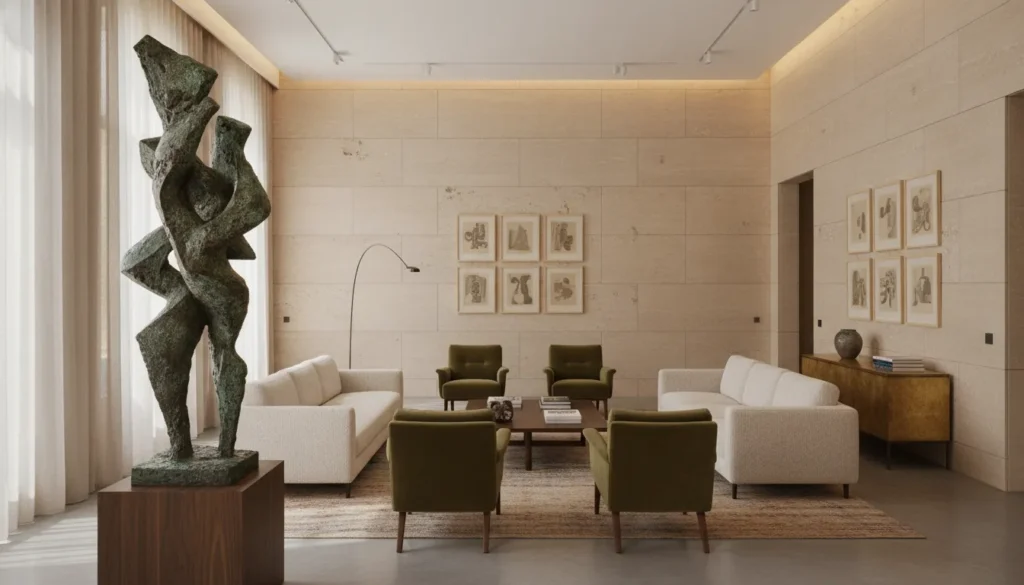
A sculpture changes a room by occupying space, not simply by hanging within it. Its volume, material, and cast shadow alter the way a collection is seen, how people move through a residence, and where the architecture seems to gather its attention.
Successful integrating sculpture into interior design begins with the work itself: consider its scale, sightlines, circulation. Then assess its relationship to natural and designed light before deciding whether it belongs on a plinth, a console, or the floor.
Discuss an art-focused interior project with CW DESIGN.
For collectors, the most considered placement is rarely an isolated decorative gesture. It is part of a larger conversation between the collection, the architecture, and daily life, allowing existing works to shape the interior from the beginning. CW DESIGN’s art-first interior design approach offers a useful foundation for that way of thinking. The first question, however, is why sculpture demands a different design conversation than painting.
Why Integrating Sculpture Into Interior Design Differs From Painting
Integrating sculpture into interior design begins with recognizing that a sculptural work does not occupy a wall in the same way a painting does. Its presence is physical and dimensional. It extends into the room, changes as one moves around it, and participates in the architecture from more than a single frontal viewpoint.
A painting establishes its principal relationship with the viewer through a bounded plane. Sculpture introduces depth, texture, and volume. The curve of a cast form, the grain of wood, and the cool restraint of metal can all become part of the room’s material conversation. The tactile irregularity of ceramic can do the same. These qualities are not simply decorative details. They influence how nearby finishes, furnishings, and open space are perceived.
Form is experienced through movement
With a painting, the designer can usually assess the primary composition from one considered sightline. A sculpture asks for a sequence of views. From the entry, it may read as a silhouette. From a seating area, its mass and surface may come forward. At close range, small changes in texture can become more important than the overall outline. Placement therefore needs to account for thresholds, circulation, and the moments when the work will be encountered in daily life.
This is particularly important when a piece has a strong three-dimensional presence. It may need breathing room rather than a crowded arrangement, or it may gain force when set against an architectural plane that clarifies its profile. A carefully chosen position can allow the eye to move around the work without making the room feel like a gallery installation. For a larger piece, the possibility of walking around it and experiencing a 360-degree view may be integral to its meaning.
Shadow and material carry the composition
Light also behaves differently around sculpture. A painting receives light across a relatively consistent surface, while a sculptural work creates its own cast shadows. Those shadows can deepen a recess, sharpen a contour, or soften the reading of an edge. Direction, intensity, and the changing character of daylight can make the same work appear more animated in one position and more static in another.
For that reason, the conversation is not limited to whether a sculpture matches the palette. Its materiality, scale, and relationship to surrounding light must be considered together. The work can serve as an eye-catching focal element, yet its narrative weight may be just as significant. Classical and contemporary sculpture can suggest permanence and artistry across generations, while a personal piece may carry memories, identity, or intellectual associations for its owner.
In a collection-led home, sculpture can become both a unifying thread and a focal point among paintings, furniture, and architecture. It may create a dialogue between works rather than stand apart as isolated decoration. Thoughtful displaying a fine art collection therefore requires attention to the sculpture’s multiple viewpoints, surfaces, shadows, and story, not only the available space.
How Do You Judge Scale and Circulation for a Sculptural Work?
Scale is not simply a matter of measuring the sculpture against an empty room. It is a question of proportion, movement, and the sequence of views a space offers. Begin with the work’s full dimensions, including its base, projecting elements, and any clearance required around it. Then consider the room’s height, width, and architectural rhythm. A sculpture can be substantial without overwhelming a generous space, while a smaller work may become unexpectedly forceful in a narrow passage or beneath a low ceiling.
Viewing distance matters just as much as physical size. Study the sculpture from the doorway, from the principal seating area, and from the routes used every day. The first sightline may reveal its silhouette, while a closer approach reveals surface, texture, or the deliberate irregularity of the form. Placement should be tested from these different positions rather than decided from a plan alone. Collectors seek the thoughtful relationships among placement, scale, lighting, and circulation that keep both an individual work and the collection visually compelling.
Allow the work to have a complete presence
For a large sculptural work, ask whether it deserves to be viewed from all sides. If the form has meaningful detail around its circumference, it may need enough clearance for visitors to walk around it and experience a 360-degree view. That does not mean leaving an arbitrary ring of empty floor. The necessary distance depends on the work, the room, and how comfortably people can move without brushing against it or interrupting the household’s daily patterns.
Furniture should support, not crowd, the sculpture. A console, sofa, table, or pair of chairs can establish a visual counterweight, but should not conceal the work’s lower edge or force circulation into an awkward detour. Check the relationship between the sculpture and doors, thresholds, stair landings, and changes in floor level. A piece placed near a threshold can create a compelling pause, yet it must remain clear of opening doors and ordinary movement. In a living room, preserve the distinction between a considered viewing route and a traffic lane.
Practical review is essential when a work is unusually heavy, fragile, top-heavy, or dependent on anchoring. Confirm the requirements with the appropriate qualified engineer, installer, conservator, or other specialist for the specific risk. An interior designer can coordinate these conversations and integrate their guidance into the composition without presenting design judgment as engineering or conservation advice.
The result should feel inevitable: the sculpture has room to breathe, the architecture frames it, and circulation allows the collection to be lived with rather than merely observed. For a broader perspective on displaying a fine art collection, consider how each work participates in the experience of the home.
Pedestal, Plinth, or Floor: What Does the Work Need?
The support is part of the composition. A sculpture placed directly on the floor has a different authority from one lifted onto a plinth, while a smaller work on a console can enter the intimate rhythm of daily life. The right decision depends on the work’s scale, material, silhouette, and relationship to the architecture around it. Thoughtful placement is essential because the support determines not only how the sculpture is seen, but also how people move past it.
Begin with the work itself. A ceramic sculpture may benefit from a quiet, elevated setting that protects its delicacy and gives its surface room to register. Metal can hold its own against a stronger architectural backdrop, while wood may invite a warmer relationship with flooring, cabinetry, or other natural materials. These are not rules, but useful prompts for testing the dialogue between object and setting.
| Approach | Effect |
|---|---|
| Floor | Grounded |
| Pedestal or plinth | Elevated |
| Console or shelf | Intimate |
| Architectural integration | Immersive |
Floor placement gives a substantial work a grounded presence. It also lets visitors walk around it and experience its full three-dimensional character. It should never become an obstacle or an accidental endpoint in a passage. Consider the principal approach, secondary sightlines, door swings, furniture edges, and the sculpture’s visual weight from seated as well as standing positions.
A plinth or pedestal creates a pause. It separates the work from surrounding furniture and can bring a smaller object into a more commanding field of view. Its proportions and finish should support the sculpture rather than compete with it. When the form, surface, or base is especially sensitive, stability and installation details deserve review by an appropriately qualified specialist.
Console or shelf placement suits works that belong to a more intimate register, but the surface should not read as storage. Give the object breathing room and consider whether adjacent books, lamps, or collected pieces create a conversation or simply crowd the silhouette. Architectural integration can be more ambitious: a niche, custom ledge, or built-in element may make the sculpture feel native to the room. CW DESIGN can coordinate bespoke furniture fabrication when a custom support, cabinetry element, or finish is the most coherent response.
The most convincing solution is usually tested in the actual room, against real sightlines and changing light. A support should make the work feel inevitable within the interior, while leaving enough flexibility for the collection to evolve.
How Should You Light Sculpture in a Residential Interior?
Lighting sculpture is an exercise in revealing form rather than simply making an object visible. Unlike a flat artwork, a three-dimensional work changes as the viewer moves around it. Light describes its volume, picks up texture, establishes a relationship with the architecture, and can make the same piece feel quiet, dramatic, weighty, or almost weightless. In a collection-led home, the lighting should support that changing perception without turning the room into a theatrical display.
Begin with the ambient light already present. Daylight can give a sculpture a nuanced, shifting presence across the day, particularly when it enters from the side and grazes a textured surface. Yet direct sun, glare, and strong contrast may be unsuitable for certain materials or finishes. Natural-light maximization is part of CW DESIGN’s documented approach, but the right amount and direction of daylight remain specific to the room, the work, and the way the space is lived in.
Layer ambient, directional, and accent light
Ambient light establishes comfortable visibility throughout the room. It should not flatten every surface or compete with the sculpture as the only source of attention. Directional light can then define the work’s mass and silhouette. A beam from above or from one side may bring out the grain of wood, the relief of ceramic, or the changing planes of stone. Reflective metal requires particular restraint: a poorly aimed source can create distracting glare, while a softer, carefully positioned light can reveal its polish and contours.
Accent lighting is most effective when it has a clear purpose. Exhibition lighting directs attention toward the artwork, and the same principle can be adapted to a residential interior. Rather than flooding every side equally, consider which features deserve emphasis and which may recede. Light can illuminate the full circumference of a work when its form is intended to be understood from all directions. It can also leave less important or less decorated areas in shadow, giving the eye a deliberate path through the composition.
Cast shadows are part of the sculpture’s presence, not a defect to eliminate automatically. A shadow on a nearby wall can extend the work into the room and create a secondary drawing that changes with the viewer’s position. The effect should be tested from principal sightlines, seating areas, and circulation paths. Too much contrast can make a passage uncomfortable or obscure delicate details, so the balance between atmosphere and legibility matters.
Plan for adjustment and preservation
Flexible electrical circuits and well-positioned outlets allow fixtures to be adjusted as a collection evolves or a sculpture is rotated. This is especially valuable in a home where new acquisitions may alter the composition. Custom lighting design can coordinate fixtures with ceilings, joinery, plinths, and architectural details instead of treating each source as an afterthought. For a broader discussion, see this guide to lighting artwork in a luxury home.
When a material or finish appears light-sensitive, unusually fragile, or vulnerable to heat, glare, or prolonged exposure, consult a qualified conservator before finalizing the scheme. The goal is not a universal lighting formula. It is a considered dialogue among light, material, form, architecture, and daily life.
How Sculpture Anchors Spatial Flow in a Collection-Forward Home
A sculpture can do more than occupy a carefully chosen corner. Its three-dimensional presence can establish a visual pause, draw the eye toward an architectural feature, or create a moment of discovery between rooms. In a collection-forward home, placement begins with the way the work will be encountered, not simply with the amount of empty floor available.
Begin with the principal sightlines. What is visible from the entrance, the end of a corridor, or a seat in the adjoining room? A sculptural work placed along one of these axes can give the home a quiet point of orientation. It may frame a threshold or invite movement toward a window, library, or more intimate sitting area. The right position is specific to the work and the architecture, so testing several placements is often more revealing than relying on a fixed decorating formula.
Thresholds are especially powerful. A piece may separate public and private zones without closing them off, or mark the transition from the formal rooms to the everyday spaces of the home. If its scale permits, viewers can move around it and experience changing profiles rather than a single front-facing composition. That circulation should remain comfortable and safe, with anchoring, weight, and condition reviewed by qualified specialists where the work or setting requires it.
Let the collection create a dialogue
One sculpture should not have to compete with every other object in the room. Consider how its material, silhouette, or visual weight speaks to nearby paintings, furniture, and architectural elements. A restrained work can provide a counterpoint to a densely composed wall, while a more commanding form might unify a sequence of rooms. The goal is a dynamic interaction and dialogue between pieces, rather than a collection of isolated displays.
This is central to designing around an art collection. Existing works can shape circulation, proportions, finishes, and the placement of furniture from the beginning. In practice, that means allowing a cherished sculpture to influence the room’s rhythm while still preserving the practical ease of daily life. Walkways should feel natural, conversation should remain possible, and the work should be encountered repeatedly without becoming visual noise.
The most successful arrangement also carries personal narrative. A sculpture can recall a place, relationship, period of collecting, or intellectual interest, making it both a conversation starter and a personal statement. Its position should support that meaning: perhaps visible during morning routines, quietly present beside a staircase, or given a fuller view in a room used for gathering. CW DESIGN’s approach integrates clients’ collections into everyday life and treats the home as a setting for evolving relationships among art, architecture, and the people who live there.
What an Art-First Designer Adds to the Process
An art-first process begins before furniture is specified or finishes are selected. It starts with the property, the collection, and the way the client wants to live with both.
An on-site visit allows the designer to understand the architecture as it is experienced. That includes the proportions of each room, the sequence from one space to the next, natural light, thresholds, and the sightlines that shape how a sculpture is encountered.
The collection is then considered as a whole, not simply as a series of objects needing individual display locations. Existing works are inventoried and understood in relation to their scale, materiality, character, and visual presence. A sculpture may need to command a quiet room, enter into dialogue with a painting, or create a moment of discovery at the end of a corridor. These decisions are property-specific. They depend on the work and on the architecture around it, rather than on a universal placement formula.
That understanding informs the interior from the beginning. Circulation must feel natural around a three-dimensional work, while furniture, doorways, ceilings, and architectural openings should support its presence rather than compete with it. A substantial piece may call for a view from multiple sides. A more intimate work may be given a considered relationship to a console, a niche, or a quieter area of the home. The aim is not to make a residence feel like a replica of a museum. It is to create a composed, lived-in setting where art remains part of daily life and where individual works can form a dynamic dialogue.
Catherine Weinstock brings an unusually integrated foundation to this work. Her practice combines interior design, furniture restoration, fine arts knowledge, art curation, and custom fabrication. She studied interior design and furniture restoration in Italy and pursued years of European study across interior design, furniture restoration, and fine arts. This multidisciplinary perspective supports more attentive conversations about placement, proportion, material, and the relationship between a work and its setting. Read more about Catherine Weinstock’s multidisciplinary training.
Where the architecture requires it, the design may include bespoke elements such as a plinth, cabinetry, finish, or other built-in support. CW DESIGN works with master artisans, European craftsmen, international galleries, and global design centers when custom craftsmanship is appropriate. The result is an interior in which the display element feels intrinsic to the residence, while the collection remains the central point of meaning.
Discuss an art-focused, on-site residential project with CW DESIGN.
Frequently Asked Questions
How do you choose the right location for a sculpture?
Begin with the work’s sightlines, dimensions, material, and relationship to circulation. A sculpture may anchor an entry, terminate a view, or create a pause within a room. Walk the space from several approaches before deciding, and keep thresholds and everyday movement clear.
Should a sculpture stand on the floor or on a plinth?
That depends on the work and the room. Floor placement can give a substantial piece architectural presence, while a plinth can establish a more deliberate viewing height and protect the visual field around it. Consider the sculpture’s scale, base, center of gravity, and how its shadow will fall before selecting a support.
How much space should be left around a sculpture?
There is no universal clearance formula. Allow enough room for the work to be seen without competing with furniture, door swings, or circulation, then test the composition from the distances people will actually use. Heavy, fragile, or unusually shaped works may require review by a qualified installation or engineering specialist.
What is the best way to light sculpture at home?
Use a combination of ambient and directional light so the form remains legible without flattening its texture or creating harsh glare. Adjustable accent fixtures are useful because the ideal angle varies with the sculpture’s surface and changing daylight. Reflective or light-sensitive materials deserve especially careful planning with a qualified lighting or conservation specialist.
Can sculpture be integrated into the architecture of a home?
Yes. A work can be considered alongside niches, shelving, stair halls, cabinetry, or other architectural elements when the space is being planned. The key is to preserve the sculpture’s presence rather than treating it as an object squeezed into a finished room. Dimensions, access, anchoring, and maintenance should be resolved before construction.
Ready to Discuss an Art-Focused Interior?
Integrating sculpture into interior design is most successful when placement, scale, lighting, and the character of the collection are considered together. A thoughtful conversation can help clarify how your works might shape an on-site residential project and its surrounding spaces.