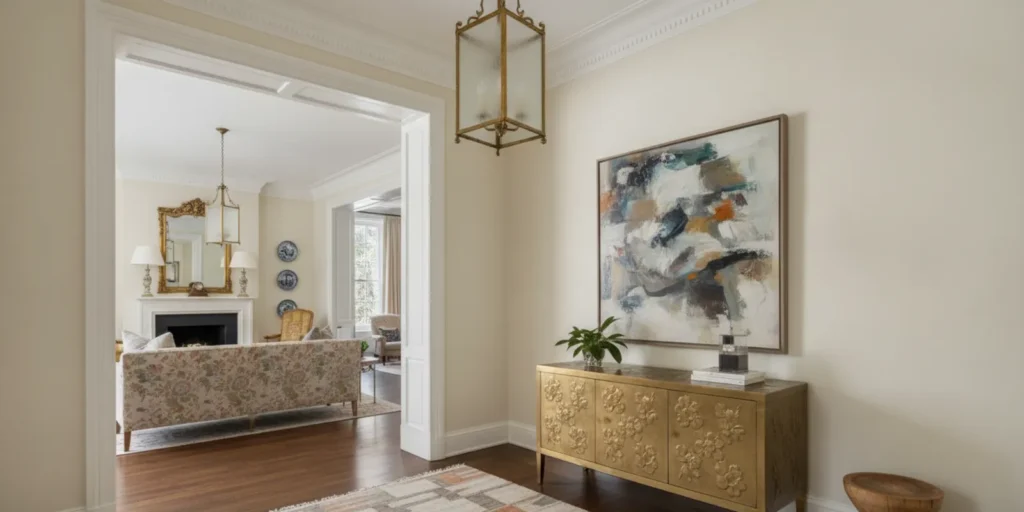
An entry rug for a collected residence has more to do than soften the first step indoors. It sets a sense of arrival, helps define the threshold and begins a visual conversation with the architecture, furnishings and art beyond it. The right choice is not simply the most striking pattern or the most durable fiber. It is the rug whose scale, texture and character feel considered in the particular home.
Discuss your residence with CW DESIGN
Why consider an entry rug for a collected residence with the whole home?
An entry is a transition, not an isolated decorative moment. From the front door, a visitor may see a stair, a passage, a living room or a work of art at the far end of a sightline. The rug is one part of that sequence. Its color and pattern can quietly connect the threshold to what follows, while its placement can help the room feel settled rather than filled.
For a collector, this relationship matters. A rug should give the eye a place to arrive without competing with a painting, sculpture or treasured object. That does not mean every surface must be neutral. A richly patterned rug can be the right choice when it has a clear relationship to the art and the rest of the interior. The question is whether the elements are in dialogue, not whether they match.
This is why it is useful to think beyond the entry itself. A home shaped around a collection depends on transitions between spaces as much as on individual rooms. CW DESIGN’s approach to interiors for art collectors begins with the collection and considers how the residence supports it. A rug selection can be one practical expression of that wider design thinking.
What should you measure before selecting the rug?
Start with the actual conditions of the threshold. Measure the clear floor area, note the door’s swing and identify the route people naturally take through the space. Include the position of nearby furniture, radiators, stairs or other fixed features. A rug that looks generous in a photograph may feel awkward if it catches a door or narrows the path.
- Map the usable floor. Measure between the walls and any fixed elements, then record the distance from the door to the next room or landing.
- Check the door clearance. Open the door fully and observe how close its lower edge comes to the floor. The rug and its support should not obstruct its movement.
- Mark the walking route. Notice where a person steps after entering and where they turn. The rug should relate to that path rather than sit as a small island beside it.
- Look from the next room. See how the rug reads from the main sightline into the entry. Its outline may be as important as its pattern.
For an irregular entry, make a simple floor plan and sketch the door, furniture and route through the space. Paper templates or removable tape can help you test an outline before making a commitment. Leave the same clearances you expect to preserve in the finished arrangement. This reveals whether a rectangle, runner or more compact form feels natural, and whether the piece interrupts a threshold or helps define one.
Measurements are a starting point, not a formula. The proportions of a historic hall, a compact apartment entry and a broad townhouse vestibule differ. CW DESIGN’s design approach considers each residence in its own setting; the way a rug sits in the architecture should be assessed in the same spirit.
How should the rug’s size and shape relate to the entry?
A rug can feel too small when it is disconnected from the doorway and the furnishings around it. It can also overwhelm a narrow passage or leave too little visible floor to establish a clean edge. Consider the rug as a shape within the room: it should have enough presence to anchor the entry, while allowing the architecture to remain legible.
In a long passage, a runner may reinforce the direction of travel. In a square vestibule, a broader rectangle can give the arrival point more composure. A round rug may suit a curved stair or a circular arrangement, but the form should respond to the room rather than introduce a shape without purpose. In each case, compare the outline with doorways, floorboards and furniture legs.
Also decide what the rug should meet. It might sit beneath the front portion of a console, or remain separate so its perimeter can be seen. Either can work; the choice should be consistent with how the furniture is used and how much visual weight the entry needs. If a rug edge falls at an awkward point in a doorway, the change may make the passage feel accidental. A measured plan helps identify such relationships early.
Consider the view from more than one position. The rug should make sense when the door opens, when someone stands inside to remove a coat and when a person looks back from the adjoining room. This is especially useful in open-plan layouts, where the entry may be visible from several areas at once. For related considerations across a full residence, see CW DESIGN’s guidance on planning a home around an art collection.
Which material and construction suit the way the entry is used?
Think honestly about the demands placed on the threshold. Is this the door used every day, or a more formal entrance? Does the home receive frequent guests? Is there a place to pause, leave outerwear or remove shoes? The answers help set priorities for texture, construction and care. No material is right for every household, and a beautiful object should also be chosen with its expected use in mind.
Examine how a rug is made and finished, not only how it looks from across the room. A low, firm surface may be easier to cross than a deep, loose pile. A textured weave can give a restrained palette depth, while a smoother surface may make a pattern read more clearly. Edges, backing and the way the rug lies flat matter in a place where people turn or carry items through.
When considering natural fibers, ask how the particular construction responds to expected use and what care it requires. For a refined or delicate piece, consider whether its placement is appropriate for the traffic it will receive. For any candidate, request the maker’s care instructions and confirm that the rug can be maintained as the household expects. The National Archives notes that textiles last longest stored away from light, which fades color and weakens fibers (National Archives guide to preserving textiles).
Use a suitable pad when appropriate for the rug and floor, and confirm that it is compatible with the surface beneath it. A pad can help the rug remain in position, but one should not assume every pad works on every floor finish. Check the floor-care guidance and the rug maker’s recommendations. A rug that shifts, curls or sits unevenly will be distracting and may complicate movement through the entry.
| Rug direction | What it can contribute | Questions to consider |
|---|---|---|
| Low-profile woven rug | A defined surface with a relatively restrained profile | Does its texture and construction suit the expected traffic and care routine? |
| Patterned flatweave | Color or motif without a high, plush surface | Does the pattern complement nearby art, and will the edges lie flat? |
| Substantial pile rug | A softer, more tactile first impression | Will the door clear it, and is its placement suitable for the entry’s use? |
| Runner | A visual line through a long passage | Does its length relate to the passage without crowding doors or turns? |
This comparison is a way to organize decisions, not a ranking. A rug should be judged in relation to the specific space, floor, collection and household. For a treasured antique or unusual construction, seek care advice appropriate to that object rather than assuming that a general routine will apply.
How can color and pattern support nearby art?
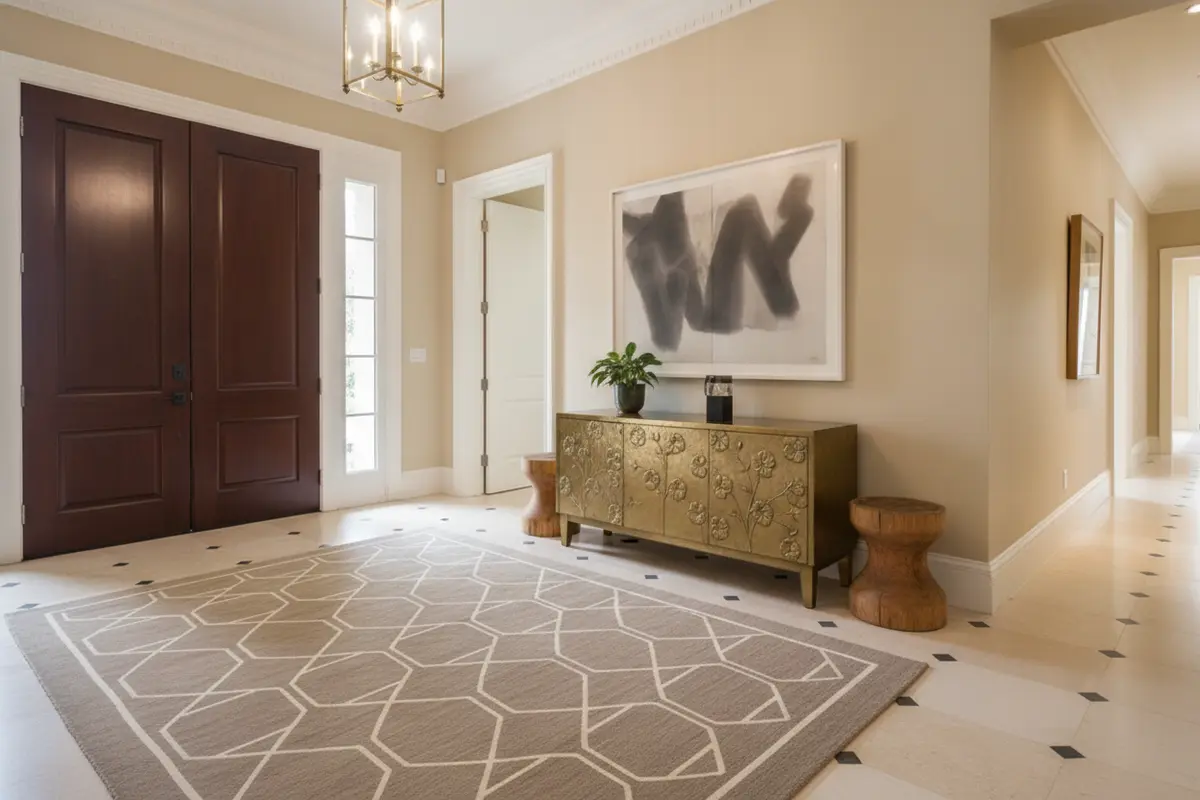
Begin by looking at what is already present: the floor, wall color, woodwork, furnishings and the artwork visible from the threshold. A rug can pick up a quiet note in a painting or echo a tone elsewhere in the home. It need not repeat an artwork’s most obvious color. Sometimes a related undertone or a contrasting field gives the composition more balance.
Consider visual weight as well as hue. A large, high-contrast motif may draw attention immediately. A smaller pattern or nuanced surface may sit more quietly beneath a strong painting. Neither is automatically preferable. The scale of the art, the distance between the rug and the artwork, and what else occupies the sightline all influence how the elements read together.
Patterns also have direction and rhythm. A border can frame the entry, while a continuous motif may lead the eye down a passage. Test whether those lines align with the room’s architecture or pull attention away from it. If the rug is distinctive, edit nearby objects with care so that each piece has room to be seen.
For a collection that includes very different periods, media or palettes, avoid making the rug carry every connection at once. A considered entry can offer a moment of calm before the eye encounters a more layered room. The collection’s arrangement and the home’s broader material language may offer better cues than a single artwork. CW DESIGN’s guide to displaying a fine art collection at home explores the value of considering works in relation to their setting.
What role do light, floor and furniture play?
Color and texture can change with the light in an entry. Observe the space at different times of day, and consider whether the rug will be seen in natural light, at night or both. A surface that appears soft and subtle in daylight may read with more contrast beneath evening lighting. If possible, review a sample or the actual rug in the room rather than relying only on a small image or showroom impression.
The floor beneath the rug is part of the composition. A rug may frame a beautiful wood floor, soften a stone surface or mark a shift between one area and another. Think about how much floor should remain visible and whether the rug’s tones complement the floor’s undertone. A strong rug-floor contrast can clarify the threshold, but it can also divide a small entry visually if the balance is not considered.
Furniture should help the arrival feel intentional. A console, bench or pedestal may sit near the rug, but avoid forcing every object onto the same footprint. The best arrangement depends on circulation and the role of each piece. Preserve a clear route, and let the rug either unite the furniture or give the entry an independent center. The collection should remain visible without becoming a series of obstacles.
Details in the wider interior matter, too. Door hardware, woodwork and adjacent finishes can guide a palette or level of formality. CW DESIGN’s portfolio includes residences where art and architecture are considered together, such as the Brooklyn townhouse and Tribeca loft. These projects offer context for thinking about a threshold as part of a larger home rather than a standalone vignette.
What sequence helps choose an entry rug for a collected residence?
- Observe the entry in use. Note the route, door movement, points of arrival and any practical constraints.
- Record the architecture. Measure the clear floor and mark doorways, fixed elements and the sightlines into adjacent spaces.
- Set the design role. Decide whether the rug should quietly ground the threshold, introduce color, or lead the eye toward another part of the home.
- Compare appropriate forms. Test a runner, rectangle or other outline in the actual floor area. Check the size from both the doorway and adjoining rooms.
- Review material and care. Match the construction to expected use, confirm care requirements and assess the rug’s support and edge treatment.
- Consider the whole composition. Look at the rug beside the floor, furniture and visible art. Adjust the arrangement if one element overwhelms the others.
- Revisit the decision on site. Check the rug in the room’s natural and evening light, with the door operating as it will in daily use.
A simple floor plan and a few candidate samples make the discussion more specific. Record why each option is being considered: proportion, surface, relationship to the art, or ease of care. That helps prevent a decision from resting on a single attractive detail while overlooking how the rug performs in the full composition.
Which decisions benefit from an on-site review?
Some questions cannot be settled well from dimensions alone. The feel of the entry, the actual view into adjacent rooms and the changing light are part of the decision. An on-site review makes it possible to understand those relationships directly. This matters especially in a historic home, an unusually shaped threshold or a residence where the entry is visible from several art-filled spaces.
Catherine Weinstock’s work brings together interior design, furniture restoration and fine arts, with European study informing a multidisciplinary practice. CW DESIGN’s background and approach are grounded in an attention to the particular home and its contents. The firm works on site rather than offering remote design; the space needs to be experienced as part of understanding it.
An entry rug may be one decision within a larger residential commission. When a whole home is being considered, the threshold can be coordinated with the collection, the architecture and the rhythm of rooms beyond it. Explore CW DESIGN’s residential projects for examples of the firm’s work across different settings.
Start a conversation about your residence
Frequently Asked Questions
Should the entry rug match the artwork?
It does not need to match. Look for a considered relationship in color, scale, rhythm or tone, and let the overall composition guide the choice. A rug can complement an artwork without repeating its dominant color or pattern.
Is a runner always best for a narrow entry?
No. A runner can emphasize a long route, but its length and width should suit the passage and the positions of doors and turns. Measure the usable floor and test the outline before settling on a form.
How can I tell whether the rug is too small?
Look at how it relates to the doorway, walking path and nearby furnishings. If it reads as an isolated patch rather than anchoring the arrival, test a larger outline. Confirm that the door still clears the rug and that circulation remains comfortable.
What should I check before ordering a rug?
Confirm its dimensions, construction, care instructions, edge finish and suitability for the floor and entry. Review door clearance and the rug’s appearance in the actual space and lighting before making a final selection.
A well-chosen entry rug welcomes the eye without insisting on attention, supporting the movement of daily life while introducing the character of the home beyond the threshold.