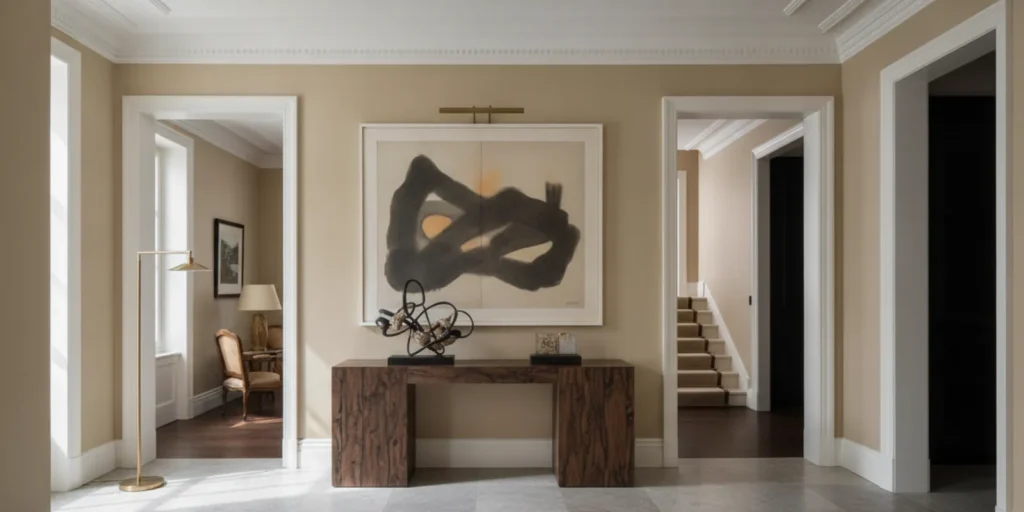
Modern luxury interiors with unexpected details feel distinctive when each contrast has a reason to be there. A vivid artwork, unusual material, or sculptural object can change a room’s character, but surprise alone does not make a home feel considered. Begin with the collection, the architecture, and the way people live. Then let a few purposeful contrasts create a residence that feels personal, composed, and enduring.
Discuss your residence and collection
What makes modern luxury interiors with unexpected details feel considered?
An unexpected detail is a point of difference that clarifies a room’s character. Contemporary art against historic millwork, a sculptural form in a quiet room, or a richly grained surface beside a smooth finish can create tension without visual disorder. The difference should have a relationship to the architecture, collection, or daily use.
Ask what the detail should do. It might draw the eye toward a painting, mark a transition between rooms, or bring warmth to a formal setting. If it has no purpose beyond calling attention to itself, it may read as decoration added for effect. A restrained composition can hold a surprising element more clearly than a room in which every surface competes.
For an art-led home, the collection is an especially useful starting point. Scale, color, medium, and relationships between works help establish a visual language. CW DESIGN’s interior design for art collectors begins with the collection rather than treating it as a finishing layer.
How should you begin with the collection?
Before choosing finishes or furniture, make a working record of the pieces that will shape the residence. Note dimensions, medium, frame, orientation, and any viewing considerations. A painting may need a longer approach; a work on paper may invite a more intimate setting; a sculpture may need to be seen from more than one side. These are design considerations, not reasons to turn a home into a public gallery.
- Record each important work’s dimensions, medium, frame, and orientation.
- Note whether it calls for a long view, close inspection, or access from several directions.
- Look for recurring colors, shapes, and materials without matching every element literally.
- Decide which works need individual presence and which can form a dialogue as a group.
- Consider how the collection may change, so the overall plan does not depend on a single fixed arrangement.
Next, study the residence. A broad wall may accommodate one large work, while a sequence of smaller pieces can give a passage a distinct rhythm. In either case, protect circulation and comfortable viewing. A compelling photograph does not show whether a doorway interrupts a composition or whether seating blocks a natural approach.
Use a simple room sketch to mark walls, openings, windows, seating, and the routes people use. Add approximate art locations and view them from the entry, principal seating, and adjoining rooms. This gives the collection a spatial context before detailed finish decisions begin. For more on this relationship, see how to design around an art collection.
Which contrasts shape modern luxury interiors with unexpected details?
Contrast may come from color, texture, form, period, or scale. It works best when one quality leads and another provides a deliberate counterpoint. Several oppositions at full intensity can leave a room unsettled. A clear hierarchy gives the eye a place to land and lets the unexpected detail feel intentional.
| Contrast | How it can work | What to review |
|---|---|---|
| Historic and contemporary | Let modern art or a sculptural form bring a new note to an older architectural setting. | Preserve architectural character and check the work’s scale against the wall and room. |
| Rough and refined | Set a tactile natural surface beside a polished or finely finished element. | Repeat a tone or material elsewhere to connect the difference to the whole. |
| Quiet and expressive | Use a composed room as a setting for one vivid work or object. | Give the focal piece visual space and limit competing accents nearby. |
| Light and dark | Use tonal difference to define a niche, passage, or place for viewing. | Observe the balance in daylight and in evening conditions. |
| Large and intimate | Place a commanding piece in dialogue with smaller works or furnishings. | Check the sequence from both close range and across the room. |
These are prompts, not formulas. A contrast that feels alive in one residence may feel forced in another. The architecture and collection should guide the choice. A pre-war Tribeca loft, for example, has a particular architectural character to consider alongside its art; another home may call for a quieter palette and a single carefully placed object.
How can materials and furnishings support the unexpected?
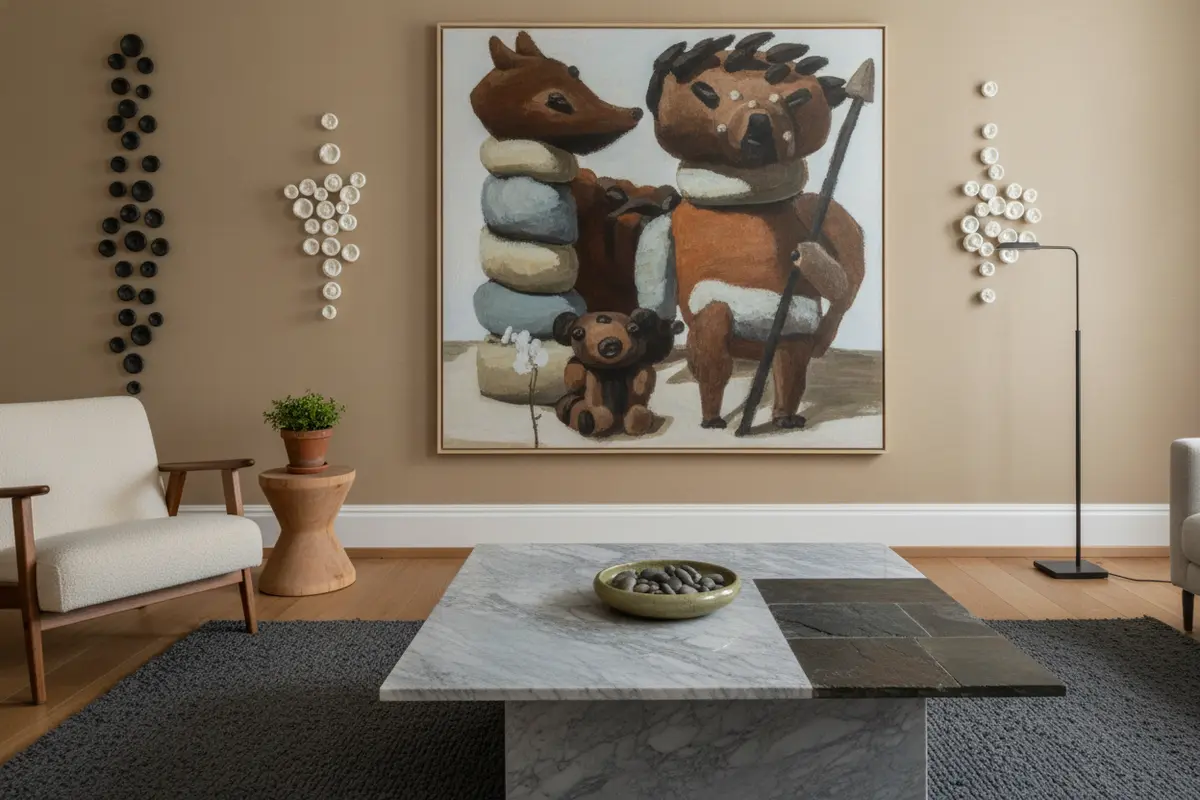
Materials give contrast a physical presence. Consider how light moves across a surface, how a finish feels to the hand, and how it meets adjoining materials. A bespoke furnishing can provide a precise proportion or function. A restored piece can retain patina and history that help a room feel individual. In both cases, the object should serve the larger composition rather than compete with the collection.
Before committing to a material, compare it beside the artwork and neighboring finishes. A small sample can appear different at a window, under evening light, or against a larger expanse. Look at the combination from the intended viewing distance, not only at close range. Also consider touch points and everyday wear: an expressive surface still needs to make sense in a lived-in home.
When a work has particular handling or preservation needs, include those in the planning conversation rather than assuming that display conditions are universal. Lighting, climate, and placement belong in the same review as color and scale, and a specialist conservation question should be raised with the people responsible for the collection.
Catherine Weinstock’s multidisciplinary training in interior design, furniture restoration, and fine arts informs attention to composition and making. The firm’s design approach considers furnishings as part of a residential plan: how people move, where they sit, what they see, and how art is encountered across the home. See also bespoke furniture design for the role of singular pieces in a broader interior.
What role do light and circulation play?
Light changes how a room and its art are read over time. Daylight shifts through the day, while evening illumination may bring forward a different color or texture. The J. Paul Getty Trust notes that light can damage art, and that the change is permanent. Observe the room at several hours before deciding that one wall is the obvious location. Consider windows, reflections, seating, and the routes through the space as part of the same decision. The Library of Congress explains that light damage to paper-based art is cumulative, so control daylight and viewing exposure.
Plan circulation as part of the composition. Keep a clear route between rooms and avoid placing furniture where it blocks a natural approach to an artwork. In an open plan, seating and objects can create relationships across the room without making every view a display. A sculpture at a threshold may make the transition memorable, while sufficient space around it allows comfortable movement.
For a residence with many works, sequence matters as much as any single view. Ask what someone sees on entering, how the collection unfolds from room to room, and where a quieter pause belongs. CW DESIGN’s guide to circulation around art in an open-plan home explores related planning questions.
How should you compare possible details?
When two ideas seem equally appealing, compare them against the same practical criteria. This keeps the decision connected to the home instead of to a passing preference. A useful review can include focal role, relation to the collection, comfort, upkeep, and how the choice reads from more than one viewpoint.
- Focal role: Does the detail guide attention or add a second competing center?
- Collection relationship: Does it support a work’s presence, scale, or color without copying it?
- Architectural fit: Does it respect the room’s proportions and existing character?
- Daily use: Can people move, sit, gather, and use the room naturally?
- Longevity: Will the choice remain meaningful if the arrangement or collection evolves?
For example, imagine a room with a restrained palette and a large painting. One proposal introduces a strongly patterned wall covering; another uses a tactile but quieter material and a sculptural side table. Compare each from the entry and the main seating area. If the wall treatment draws attention away from the painting, the quieter option may create a richer counterpoint. If the painting already has a calm field, the pattern might instead provide a useful context. The artwork and room decide; a general rule cannot.
What is a practical sequence for planning the interior?
A deliberate sequence helps protect coherence while leaving room for discoveries. For a whole residence, early decisions can affect architectural work, lighting, furnishings, and installation. Begin with the actual home and the people who use it; design for the specific place rather than an abstract style.
- Study the residence on site. Observe proportions, natural light, existing finishes, views, and the routes people use. A visit reveals conditions photographs alone cannot convey.
- Clarify the collection and priorities. Identify the works that matter most, their viewing needs, and how the collection may change.
- Establish the spatial framework. Resolve circulation, room relationships, and major furnishings before refining decorative details.
- Test visual relationships. Compare candidate colors, textures, and forms against art and architecture. Temporary placement or samples can help evaluate scale and sightlines.
- Coordinate making and installation. Confirm dimensions, access, lighting, and practical requirements before custom elements or artwork are installed.
- Review the completed composition in person. Observe the space as a whole and refine relationships that become clear only when everything is together.
These stages may overlap in a complex commission. An on-site understanding of a residence matters because proportions, light, and movement cannot be fully assessed remotely. CW DESIGN’s Brooklyn townhouse project offers an example of an existing home’s character becoming part of a considered transformation.
What common mistakes make unexpected details feel forced?
Treating every object as a focal point leaves no visual hierarchy. Selecting finishes before understanding the artwork can create avoidable conflicts. Repeating one strong accent in every room can make surprise feel formulaic. Planning a display without considering daily use can leave the home beautiful in theory but awkward to inhabit.
- Do not force a theme. Let relationships emerge from the collection, architecture, and the household’s way of living.
- Do not confuse abundance with depth. A curated selection can make each work more legible.
- Do not overlook scale. Check how furnishings, art, ceilings, and room dimensions relate from several viewpoints.
- Do not leave lighting until last. Coordinate its purpose and placement with the works and the room.
- Do not make surprise disposable. Choose details that can remain meaningful as tastes and collections develop.
A timeless interior need not be restrained in every respect. It is selective. It gives distinct objects room to speak and allows the home to feel like an authentic expression of its owners, rather than a display of passing ideas.
Begin a conversation about your residence
Frequently Asked Questions
Can a luxury interior include bold or unusual pieces?
Yes. A bold work or unusual object can sit naturally in a refined home when its scale, placement, and relationship to the architecture are considered. Give it purpose and avoid crowding it with competing focal points.
Should artwork be considered before the furniture?
When a collection is central to the project, it should inform the plan from the beginning. This does not mean every furnishing must be selected afterward; it means the works’ scale, presence, and viewing needs belong in the same design conversation.
How do you keep contrast from making a room feel busy?
Choose a clear hierarchy. Let one or two elements carry the strongest contrast, then connect them through proportion, material, or a restrained color relationship. Review the composition from everyday routes and seating positions.
Why is an on-site review important?
Light, proportion, architecture, and circulation are specific to each residence. Seeing the space in person helps the design respond to its actual conditions and allows art and furnishings to be considered in context.
Modern luxury interiors with unexpected details come from attentive choices, not surprise for its own sake. When art, architecture, materials, and daily life inform one another, the result can feel individual and quietly lasting.