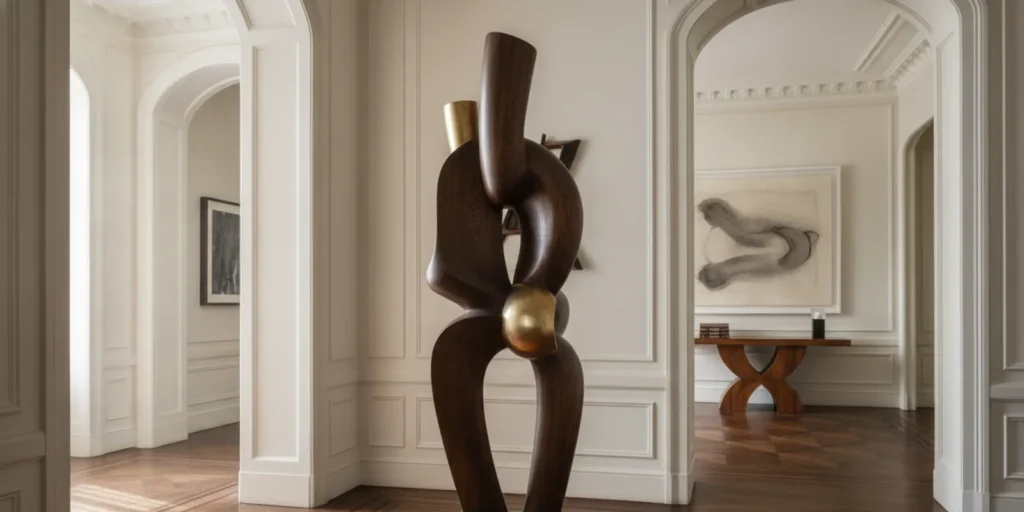
A large sculpture can shape the first impression of a home before a visitor reaches the main rooms. Planning a large sculpture residential entry means considering more than the work’s dimensions: the arrival, route through the space, sightlines, and architecture all affect whether the piece feels at home. Begin with the sculpture and the lived experience of entering, then let the design respond to both.
Discuss your residence with CW DESIGN
Why does the entry need its own sculpture plan?
An entry is both a threshold and a route. People arrive, pause, turn, greet one another, and continue into the home. A substantial work can give this sequence focus, but it must not make the transition feel cramped or uncertain. The goal is not simply to find an empty corner. It is to understand how the sculpture participates in the architecture and the movement of daily life.
Start by asking what the work contributes. Does it establish a quiet moment of arrival, create a view toward the next space, or introduce a material or form that recurs elsewhere in the collection? A clear intention helps distinguish a meaningful placement from one that merely fills available floor area.
For a broader perspective on designing around a collection, see CW DESIGN’s guide to planning around an art collection. This entry-specific decision should remain connected to the character and rhythm of the whole residence.
What should you learn from the work before choosing its position?
Record the sculpture’s actual height, width, depth, and footprint, including any base or plinth. Note the widest points, projecting elements, visual weight, material, and how the work appears from different angles. A piece with a narrow base can still have a broad silhouette. A low sculpture may command attention across a wide field of view.
Consider what the work needs around it. Some forms are most legible when seen in the round; others have a clear front or a preferred viewing angle. The material and finish also respond differently to daylight and interior illumination. This is not a reason to prescribe a lighting solution before seeing the space. It is a reason to observe the work in its intended setting and understand what the surface reveals or conceals.
If the sculpture is part of a larger collection, note how its scale and character relate to nearby works. CW DESIGN’s sculpture integration guide addresses the broader relationship between sculpture and interiors; here, the focus is the specific demands of the entry.
How can you judge scale in the entry itself?
Measure the entry as people experience it, not only as a rectangle on a plan. Record ceiling height, door swings, openings, stair edges, changes in floor level, and the clear width of the routes people use. A sculpture’s relationship to a tall doorway or stair can matter as much as its relationship to the floor area.
Use a temporary outline or a measured footprint to test the proposed location. Then stand at the exterior approach, just inside the door, and at the point where the route turns toward the next room. These viewpoints reveal whether the sculpture appears composed, overwhelms the threshold, or disappears behind a door or architectural return.
Think about proportion in several dimensions. A tall work may complement a generous ceiling but crowd a narrow passage. A broad work may anchor an open vestibule yet interrupt a direct route. The right position is the one in which the work has presence and the entry still reads clearly.
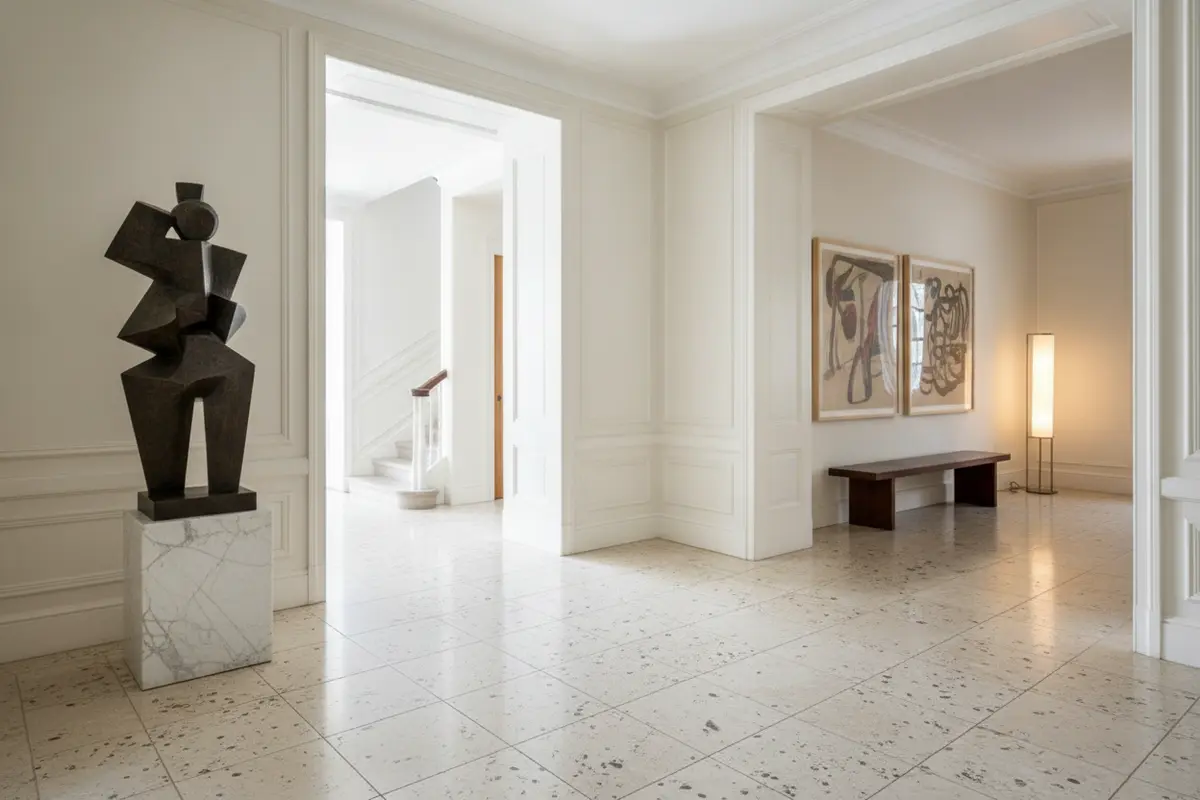
How should circulation shape the placement?
Trace the ordinary route from the door into the home. Include the movements that happen at the threshold: opening and closing the door, setting down a bag, greeting a guest, and passing another person. The sculpture should not force people to sidestep into furniture or squeeze past a fragile edge.
Also consider less frequent but foreseeable movement. A large work may need to pass through the entry during installation or later care. Check the route from the building entrance, elevator or stair, and interior doorways. Measure the narrowest point and note turns, overhead constraints, and door clearances. A beautiful final position is not practical if the work cannot reach it safely.
For public buildings and other covered facilities, the U.S. Access Board publishes accessibility standards and guidance; its accessibility resources are a useful reference when coordinating applicable access requirements. The sculpture’s placement should be reviewed against the rules that apply to the specific residence and project.
Keep the circulation plan legible. If the entry is part of an open plan, the sculpture may define a threshold without acting as a barrier. In a more enclosed foyer, it may need a position that preserves a direct passage and makes the next destination easy to read. The circulation guide for open-plan homes offers related principles for movement around art.
What sightlines make the work feel intentional?
Map the first views into the home. What does someone see from outside before the door opens fully? What becomes visible immediately upon entry? Which view unfolds as the person moves toward the next room? A sculpture can reward a direct approach, or it can reveal its form gradually through a turn.
Check whether the work competes with another strong feature, such as a framed artwork, a window, a stair, or an architectural detail. The aim is not to remove every neighboring element. It is to understand where attention naturally falls and whether the composition has a clear center of gravity.
Review the sculpture at seated and standing heights where relevant, and from the spaces that look back into the entry. A position that works from the front door may feel awkward from a living room or landing. CW DESIGN’s article on natural light and art in the home can help frame questions about changing views and daylight without assuming every entry has the same conditions.
How can the sculpture converse with the architecture?
Read the architecture before adding a new focal point. Look at the proportions of the door, ceiling, walls, floor, and adjacent openings. Notice whether the entry has a strong axis, a change in material, or a detail that already draws the eye. The sculpture can echo, balance, or gently interrupt these features, but the choice should be deliberate.
Consider the visual weight of the base and the material underfoot. A stone or metal form may feel very different against timber, tile, or a patterned surface. Nearby finishes, color, and furnishings can either give the piece room or make the entry feel crowded. Rather than selecting a decorative backdrop first, judge the sculpture in relation to the room’s actual surfaces and proportions.
A project may also involve historic details or existing architectural work that should remain part of the composition. CW DESIGN’s Brooklyn townhouse project illustrates the firm’s work with a historic residence; the relevant lesson is to consider the building as more than a neutral container for art.
Which placement approaches should you compare?
Compare a small number of measured options rather than settling on the first open spot. The table below is a starting framework. Each option must be tested against the actual sculpture, the entry’s dimensions, and the way people use the home.
| Placement approach | Potential strength | Check before deciding |
|---|---|---|
| Near the entry axis | Creates a clear focal view on arrival | Door swing, direct passage, and whether the work overwhelms the threshold |
| Beside a wall or architectural feature | Can establish a composed relationship with the room | Whether the sculpture needs views from multiple sides and has enough visual breathing room |
| At a transition toward the next room | Can guide the eye and mark a change in space | Turning clearance, pinch points, and views from both adjoining areas |
| Within a broad open foyer | May help give definition to a generous space | Whether the base, circulation paths, and sightlines remain clear from every approach |
These are not universal prescriptions. A work’s form may rule out an apparently obvious location. A site study can reveal that a quieter position gives the sculpture more presence than the center of the room.
What is a useful sequence for making the decision?
- Document the work. Measure its full dimensions and footprint. Note fragile projections, viewing orientation, material, and any installation requirements already known.
- Study the entry in person. Measure doors, openings, ceiling height, routes, and the relationship to neighboring rooms. Record views from the approach and from inside the residence.
- Mark possible positions. Test a small number of footprints and viewing angles. Keep door movement and the normal path through the home visible in each option.
- Review the architecture and collection. Decide what the sculpture should relate to, and what should remain visually distinct. Consider the next rooms so the arrival does not feel disconnected from the home.
- Resolve practical coordination. Confirm the route for moving the work into place and coordinate any required installation, protection, or lighting decisions with the appropriate project team.
- Reassess in the lived setting. Walk the route at different times and from more than one direction. A placement should work in motion as well as in a still photograph.
Because an entry is experienced bodily and spatially, a plan alone cannot answer every question. An on-site review helps reveal the feel of the threshold, the actual sequence of views, and the way a sculpture changes the room around it. The CW DESIGN approach centers the design process on the particular home and collection rather than a template.
Which decisions benefit from an on-site review?
Review the proposed position in the actual space before committing to construction or installation details. Check how people pass, whether the door clears, how the piece relates to the architecture, and what happens to the view from adjoining rooms. If the work has a complex shape, assess its silhouette from several points rather than relying on a single elevation.
On-site observation matters especially when the entry connects to a stair, a narrow corridor, or a sequence of rooms. Light shifts; reflections and shadows change; and a sculpture may appear very different from its principal approach than it does from within the home. An in-person study can also identify what must be coordinated before the work arrives.
CW DESIGN’s work includes bespoke residential environments, art integration, and furniture restoration, guided by Catherine Weinstock’s multidisciplinary training in Interior Design, Furniture Restoration, and Fine Arts. Explore the studio’s background and its residential project portfolio for further context.
Frequently Asked Questions
Should a large sculpture always be centered in an entry?
No. Centering can create a strong arrival view in a generous foyer, but it may obstruct circulation or make a smaller entry feel compressed. Test the actual footprint and sightlines before choosing a central position.
How much space should remain around a sculpture?
There is no single clearance that suits every sculpture and entry. Preserve a comfortable route for daily movement, account for doors and turns, and allow enough viewing distance for the work’s form to read. Measure the space in person rather than relying on a generic rule.
Can a sculpture be placed near the front door?
It can, if the door operates freely, the route remains clear, and the work is protected from likely impacts. Check both the door’s full swing and the path people follow as they enter and leave.
What if the entry is too small for the sculpture?
Compare alternate positions in the residence and consider whether the work belongs in a different space. The sculpture should contribute to the home without making the entry difficult to use. A site review can help evaluate realistic options.
Arrange a conversation about your project
The best placement gives a substantial sculpture room to be encountered while preserving the ease and clarity of arrival. Measure, observe, and make the decision in the context of the home as a whole.