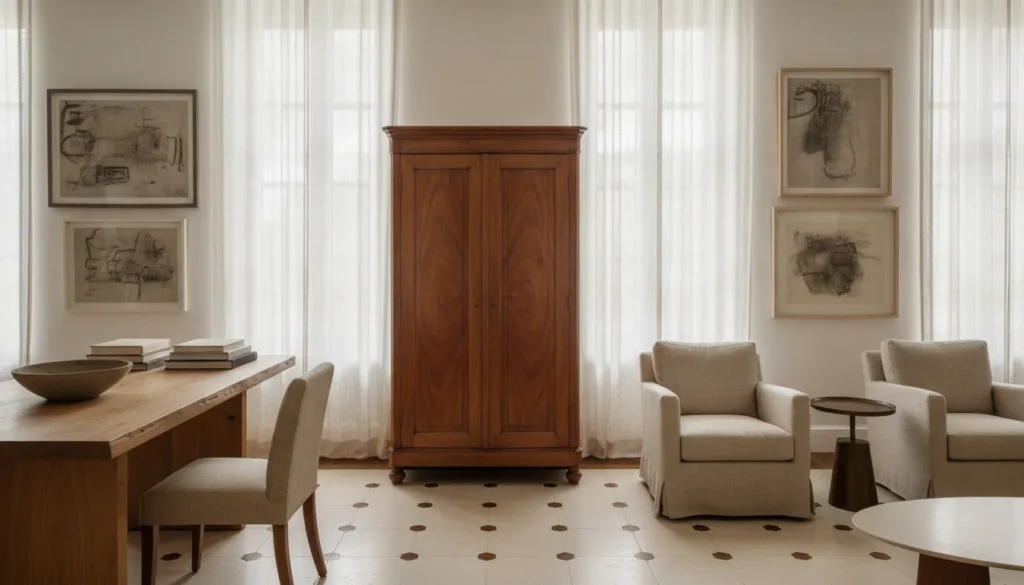
French polishing furniture is a finish decision, not a shortcut to a new surface. Thin coats of shellac are rubbed on by hand until the grain reads clearly and the surface has a quiet depth. The question is whether that finish still belongs on the piece, and in the room where it will actually be used.
A dull tabletop is not, by itself, a reason to strip it. Original finish has historical and visual value. Conservation guidance, including the National Park Service notes on furniture coatings, treats an original finish as worth keeping when it is still sound. A finish protects wood and changes how it looks. French polish is one traditional way to build or repair a shellac surface. It is not the same job as structural restoration, and it is not the same job as refinishing.
Discuss a finish with CW DESIGN
CW DESIGN treats that judgment as part of a whole-home commission. Catherine Weinstock studied furniture restoration in Europe, including formative study in Italy, alongside interior design and fine arts. The work is on site. A finish is chosen for the piece in the room, not from a catalogue of looks.
What French polishing furniture actually is
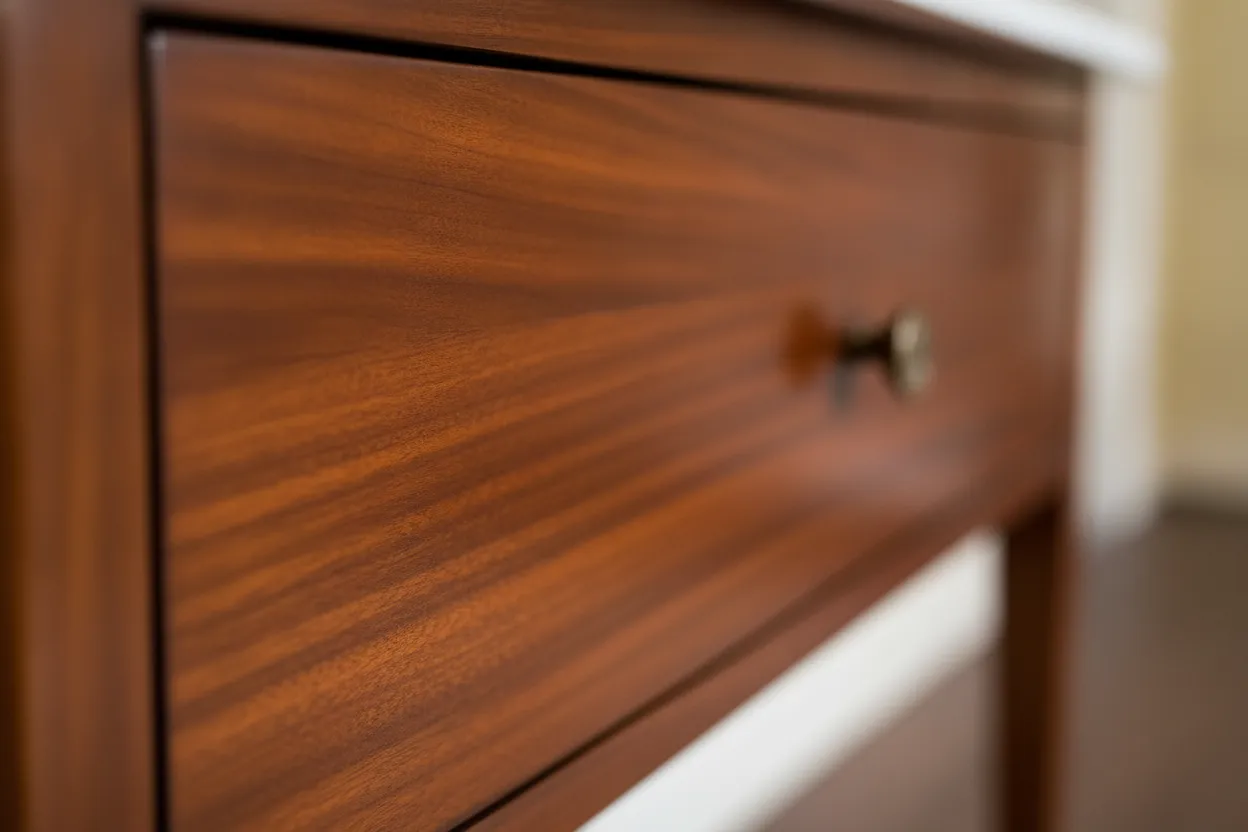
French polish is a process, not a product you buy in a tin and brush on. Shellac, a resin from the lac insect, is dissolved in alcohol. A pad, often called a rubber, lays down many very thin coats. French polish, as conservators and furniture historians describe it, is a gloss that brings out the colour of the grain. It has some resistance to heat and spills. When the film is badly damaged, it usually has to be taken back and rebuilt.
The technique became the preferred finish for fine mahogany and other expensive timbers in the nineteenth century, including furniture and musical instruments. It is slow. Makers later turned to sprayed lacquer because it was faster. The hand-rubbed surface did not disappear because it failed. It became rare because it takes time and a practiced hand.
A few points are easy to mix up:
- Shellac is the material. French polishing is one way of applying it, in many thin coats, with a lubricated pad.
- A single brushed coat of shellac is not French polish. The depth comes from the build, the grain filling, and the final clear rub.
- The surface can look glassy. On a serious piece, the aim is clarity of grain, not a plastic shine.
- Water, alcohol, and heat can cloud or mark shellac. The same softness is why a skilled person can often repair a local fault without stripping the whole piece.
Wikipedia’s account of the technique is useful on this last point. French polish is softer than many modern varnishes and lacquers, and spills or heat can leave cloudy marks. It is also simpler to repair than those harder films, because new shellac can melt into the old film.
None of this is a home tutorial. The National Park Service warns that the wrong solvent can soften a finish. Liquid and aerosol polishes often carry silicones that later fight a proper treatment. If you are unsure what is on the wood, stop. Identification comes before any cloth, wax, or alcohol.
How French polish differs from varnish, lacquer, and wax
Owners often ask for “the old finish back” when they mean four different things. The coating on the wood may be shellac, an oil varnish, a modern lacquer, a wax over bare or sealed wood, or a stack of later products. Each one fails in its own way, and each one asks for a different response.
| Finish | What it is | What it asks of the room | When it is the wrong move |
|---|---|---|---|
| French polish. | Many thin shellac coats, rubbed with a pad. | A still room. Low alcohol and heat. | Skip it on a busy table or a sound original finish. |
| Varnish. | A harder resin film, brushed or sprayed. | More daily wear. Some moisture is fine. | Skip it when shellac clarity matters more. |
| Lacquer. | A fast modern film. Usually sprayed. | Even colour. A tougher skin. | Skip it when period shellac character is the goal. |
| Wax. | A soft coat over a stable clear finish. | Gentle dusting. Rare rewaxing. | Skip it as a cure for a failed film. |
| Full refinish. | The old coating is removed and replaced. | Only when the old surface cannot stay. | Skip it when the original can still be cleaned. |
Wax is care, not a substitute for a failed film. The National Park Service says paste wax belongs on a stable clear finish such as shellac, lacquer, or varnish, and not on unfinished wood. In a furnished room, many pieces need wax only every one to four years. A display case needs it even less. That pace is a useful test. If someone is waxing every month to hide a cloudy top, the film underneath is the real problem.
Refinishing is the large decision. It removes original material. Conservation practice treats original finishes as worth maintaining because they carry historical, aesthetic, and financial value. A later owner can always add a new film. They cannot put the first one back once it has been stripped.
For the wider difference between restoration, refinishing, and reupholstery, the practical guide on what furniture restoration is is the right page. This one stays with the finish itself.
When a shellac surface is the right choice
French polishing earns its place when three things line up. The wood wants a clear finish. The room will not punish shellac. And the existing surface is already shellac, or it has failed so completely that a new shellac surface is the honest repair.
Mahogany, walnut, and other close-grained cabinet woods are the classic candidates. Open grain can be filled as the polish builds, which is part of why the process is slow. A painted, gilded, or japanned surface is a different object. Do not assume a clear pad-polish belongs there.
Use is the harder test. Shellac and a dining table that sees wine, hot plates, and children are a poor match. The same shellac can be exactly right on a writing table, a library cabinet, or a commode that is looked at more than leaned on. Alcohol is the quiet risk. A drinks trolley, a bar, or a dressing table near perfume may do better with a harder film. That can be true even when shellac would have been the period choice.
Age of the finish matters too. A nineteenth-century shellac surface that is dull, lightly crazed, and still attached is often a candidate for cleaning and a conservative revival, not a full French polish. A surface that has already been stripped, stained dark, and sprayed with a later lacquer is no longer “the original.” Polishing over that stack hides the problem. It does not solve it.
There is also a design reason, separate from conservation. In a residence built around a collection, the finish should not shout over the art. A hand-rubbed shellac surface lets grain and colour carry the piece. A thick sprayed gloss can make the same cabinet look like a prop. That is a judgment made in the room, with the light, the art, and the neighbouring furniture present.
CW DESIGN does not offer this as a remote service. Catherine will not design a space she has not visited. Finish decisions follow the same rule. The piece has to be seen where it lives.
What to decide before anyone touches the finish
A good finish conversation starts with evidence, not with a product name. Walk the piece before you name a treatment. These are the decisions that belong to the owner, with a specialist in the room.
- Name the job. Are you asking for cleaning, a local shellac repair, a full French polish, or a refinish? They are not grades of the same service.
- Say what must survive. Colour, wear at the handles, an old repair, a particular sheen. If those marks matter, say so before any solvent is opened.
- Describe real use. Who sits there, what is set down, and whether alcohol or heat is routine. A finish that fails in month three was the wrong brief, not bad luck.
- Ask what is on it now. A specialist should be willing to say “I need to test this” rather than promise a polish on sight.
- Refuse a whole-piece strip as the opening offer. Stripping is sometimes right. It should be the conclusion of an assessment, not the default.
Conservation practice is plain that cleaning and coating work can physically change an object, and that qualified help is the right call when you are unsure. That caution fits a private residence as well as a museum. The stakes are a family table or a collected cabinet, not a gallery label, but the material is just as easy to lose.
If the piece also has loose joints, a split that is moving, or missing veneer, the finish is not the first conversation. Structure comes before sheen. The New York guide to antique furniture restoration covers that assessment, and how a restored piece sits inside a commission. Read it for the process. Come back here for the coating.
If the question is whether a family piece should be restored at all, or how it should sit beside contemporary art, that is a different page. Heirloom furniture in a designed interior takes that decision. It does not choose between shellac and lacquer.
French polish inside a whole-home commission
In a CW DESIGN commission, a finish is one decision among the architecture, the art, and the way the household moves. A single revived cabinet can anchor a room. A set of mismatched new glosses can make a considered interior look assembled from parts.
That is why polish is planned with the rest of the work, not booked as a drive-by after the furniture has been chosen. Light is part of the brief. North light in a New York townhouse will show every ridge in a shellac surface. A warmer lamp will flatter the same plane. Art glass, stone, and textile sit next to the wood, and the sheen has to live with them. A mirror-bright top next to a matte painting often loses.
The same restraint shows up in what is not done. Patina at the edge of a drawer, a softened corner, a slightly thinner film where hands have rested: those are part of the object. French polishing can honour them, by keeping the work local, or erase them, by taking the surface back to bare wood and starting again. The second result can be beautiful and still be the wrong piece.
Bespoke work sometimes means a new piece rather than a revived one. When the household needs a table that can take real wear, a newly made piece with a tougher finish is often the honest answer. The antique can stay in a quieter room. Bespoke furniture design in New York is the path for that new piece. What bespoke interior design means sets the wider standard: work cut to the residence, not a look pulled from a trend.
The practice is deliberately small. CW DESIGN takes a limited number of whole-home and entire-apartment commissions, on site, for clients who want that level of judgment. A finish question is welcome inside that work. It is not a stand-alone factory service, and it is not priced from a card. Every piece and every room is different, so the scope is discussed, not quoted in public.
Two further pages help when the finish question is really a design question. A timeless interior is about materials and craft meant to last. That is the right frame for keeping a shellac surface instead of chasing a seasonal look. The studio’s approach explains how a commission is actually run, from the first visit onward.
Care after the polish, without turning it into a chore
Once a shellac surface is sound, care is mostly restraint. Dust with a soft, dry cloth. Skip spray polishes. The National Park Service flags silicone in many liquid and aerosol products because it sinks into a finish and complicates later work. If a paste wax is appropriate, it is occasional, tested in a hidden spot, and used on a stable film only.
Water rings, perfume, and a hot cup are the ordinary injuries. A fresh white mark on shellac is sometimes reversible by someone who knows the film. Scrubbing it with a home remedy is how a small cloud becomes a bare patch. Move the object off the heat, keep alcohol away from the spot, and ask before you treat it.
Covers, mats, and a trivial change of habit do more than any polish. A tray under a decanter, a pad under a lamp, and a rule about hot plates will outperform a monthly wax. Museums rewax on a scale of years, not weeks. A private residence can be a little more practical than that, and still avoid the cycle of products that slowly dull the surface they claim to feed.
Light matters over decades, not just over a dinner. Strong sun will fade some woods and can make a shellac film brittle. Curtains, UV film, and simply not parking a fine cabinet in a south window are preventive care. None of that requires a conservator. It requires noticing the room.
Talk with CW DESIGN about a piece in your home
Frequently asked questions
Is French polishing the same as refinishing?
No. French polishing builds or repairs a shellac surface with many thin coats. Refinishing removes the existing coating and replaces it. One can be part of a careful repair. The other spends original finish. If the old film is still sound, refinishing is usually the larger and less reversible step.
Can I French polish a piece myself?
You can practice the pad technique on a new board. You should not teach yourself on a family antique or a finished historic surface. The first mistakes are alcohol clouds, lifted colour, and a stripped patch that cannot be blended. Identification of the existing finish comes first, and that is a specialist’s job when the piece matters.
Does French polish work on a dining table?
Sometimes, and often no. Shellac marks under alcohol, water, and heat. A formal table that is mostly looked at can wear it well. A table that hosts wine and hot plates will show damage quickly. In that case a harder film, or a newly made table, is usually the kinder choice for both the household and the antique.
Will polish make an antique look new?
A full strip and a heavy gloss can, and that is often a loss. A restrained shellac repair should leave wear where wear belongs and keep the colour of the wood. If the goal is a factory-new shine, say that plainly. It is a different brief, and it may not be the right one for the piece.
How does CW DESIGN approach a finish?
On site, as part of a whole-home or entire-apartment commission, not as a remote touch-up and not as a priced menu. The piece is seen in its room, next to the art and the light. Structural problems are separated from finish problems. Nothing is stripped because a surface looks dull. If you want that kind of judgment, read about the studio and then start a conversation.