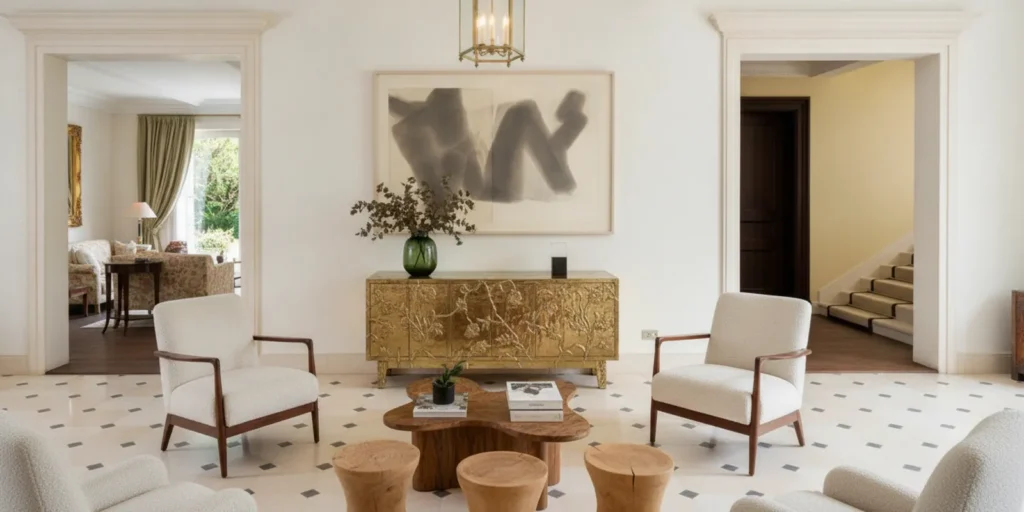
Holiday house interior design asks a residence to feel welcoming in concentrated visits and composed when the household returns in another season. For an art collector, the collection is the beginning of that conversation. Rather than treating artwork as a final layer, plan the architecture, furnishings, light, and daily rituals around the works and the people who live with them.
Discuss your residence with Catherine
What makes a holiday house a year-round collection home?
A seasonal residence has its own cadence. The house may be lively during holidays and quiet for long intervals, or it may host longer stays in different parts of the year. Its interior should not feel like a temporary arrangement assembled for one visit. The aim is a complete home: personal, comfortable, and in conversation with the collection even when the season changes.
That starts with an understanding of the residence as a whole. Consider how the entrance prepares a visitor for the rooms beyond, how public and private spaces relate, and where a pause or change of pace might be welcome. A collector may want to encounter a work immediately on arrival, discover another from a favorite chair, and pass through a sequence of works along a stair or corridor. Those are spatial experiences, not simply hanging decisions.
Catherine Weinstock brings together training in Interior Design, Furniture Restoration, and Fine Arts, shaped by European study. That multidisciplinary perspective supports an art-centric approach in which collection, architecture, and use inform one another. The result should be curated and lived in, rather than a gallery copied into a house. CW DESIGN describes its broader design approach in terms of considering the residence and its character on site.
How should the collection guide the plan?
Before choosing finishes or fixing furniture positions, make a working inventory of the collection. Record dimensions, orientation, medium, frame or base, and any known handling or display requirements. Add a note about the work’s role: a major anchor, a piece with personal meaning, an object to encounter in passing, or a work that may rotate. This information gives the design conversation real scale and helps identify which decisions need specialist advice.
- Identify anchor works. Select the pieces that should establish the character of the home or a particular room. Note the distance and vantage point from which each can be appreciated.
- Think in relationships. Grouping by artist, period, or medium is only one possibility. Contrast, dialogue, rhythm, and a deliberate interval can make a sequence more personal.
- Map movement. Sketch how people enter, pass through, sit, and gather. Consider whether a work is seen straight on, from a threshold, or from a changing angle.
- Separate fixed placements from rotations. A permanent location may call for coordinated lighting or millwork. A rotating group benefits from flexibility and a considered plan for changing the display.
- Include three-dimensional works. For sculpture, record the object’s footprint and the space needed to approach it. A sculpture is read from more than one viewpoint, so circulation is part of its setting.
A collection-first plan does not mean every work must be displayed at once. It means that what is shown, what is stored, and how rooms connect are deliberate choices. CW DESIGN’s guide to interior design for art collectors and its advice on displaying a fine art collection at home offer related perspectives on those decisions.
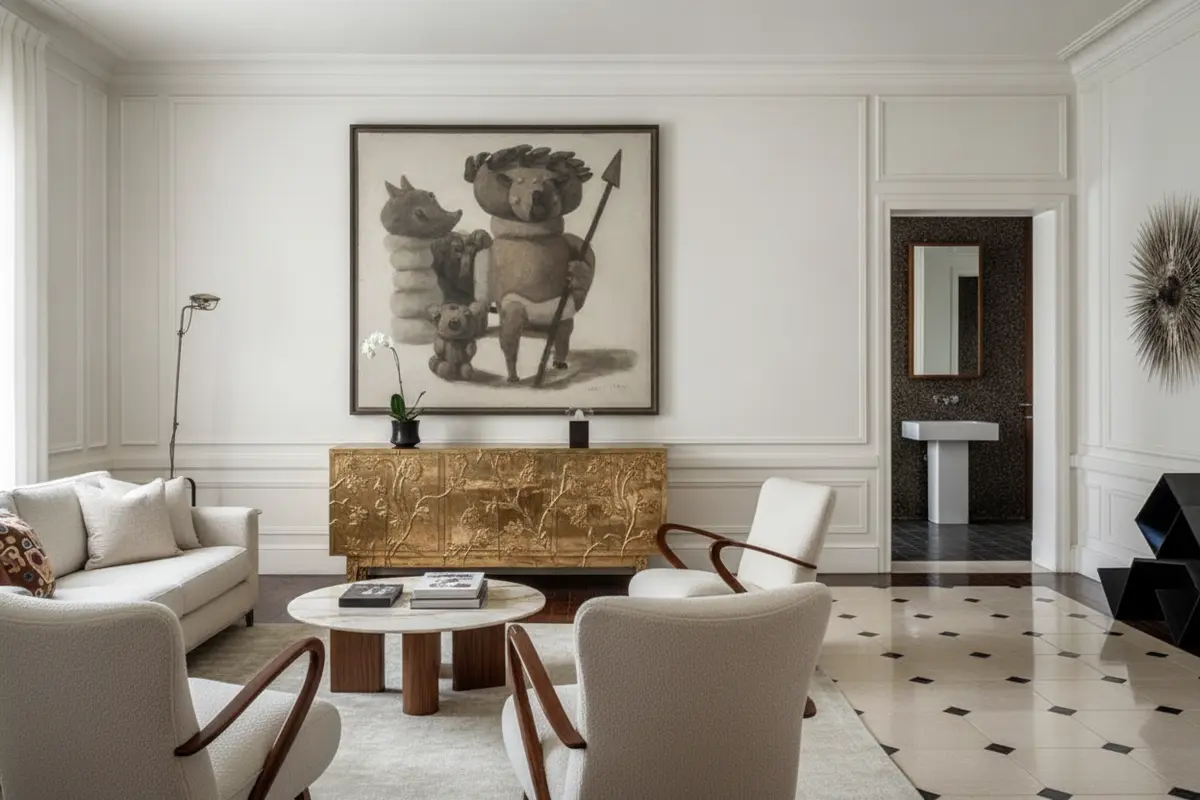
Which rooms should carry the collection?
Art need not be confined to a formal sitting room. A strong entrance can establish a first encounter; a library can invite closer attention; a dining room can offer a distinctive focal point. A passage may support a carefully paced sequence, while a private room can hold works that have a more intimate connection to the household. The right location depends on the artwork, the architecture, and what happens in the room.
Consider the experience of moving through the whole house rather than solving each room in isolation. One possible sequence begins with a focused work at the entrance, opens into a room with a broader view, then becomes quieter in a private wing. In another residence, the most meaningful work may belong where the family gathers, not where a guest sees it first. There is no formula to impose; test the sequence against the client’s habits and the character of the collection.
In a holiday residence, storage and transitions deserve attention too. Coats, luggage, entertaining pieces, and seasonal objects all need a place without crowding important sightlines. A well-planned threshold can make arrival feel effortless and protect the calm of the main rooms. The house can welcome a full gathering without turning every surface into a staging area.
Sculpture adds another dimension to planning. Consider its scale relative to a doorway, stair, or room, the visual weight around it, and how people will move past or around it. A piece that reads beautifully from an entrance may need a different relationship to seating once the room is in use. Explore considerations in integrating sculpture into interior design.
How do light and architecture affect art?
Light changes both the appearance of a room and the way an artwork is experienced. A holiday house may be visited at different times of year, when daylight enters at a different angle or lasts for a different part of the day. Observe the rooms in person at multiple times. Note direct sun, reflected glare, deep shadow, and the effect of nearby windows, glazing, and reflective surfaces. A photograph taken at one moment is not a complete picture of a room’s light.
Artwork-specific conservation needs should be confirmed with an appropriately qualified art-care professional. A designer can coordinate the room’s lighting and display conditions, but should not assume that one general rule is right for every medium or work. Once requirements are understood, ambient illumination, task light, and artwork lighting can be considered together. Beam spread, angle, color appearance, controls, and neighboring light sources all affect the result.
Review lighting from the positions that matter: standing at the doorway, sitting across the room, and moving through the space. Check whether a fitting creates glare from a usual seat or leaves an important work visually isolated. CW DESIGN’s article on lighting artwork in a luxury home and its discussion of natural light and contemporary art provide further context.
Architecture sets practical limits and opportunities. Door swings, built-ins, radiators, ceiling heights, and circulation all affect placement. In a historic property, retain and reveal character where possible while coordinating any new intervention thoughtfully. Millwork, picture rails, and lighting positions should be considered in relation to the architecture rather than added as disconnected features. A related example is integrating art into a historic townhouse renovation.
How can furnishings support both art and seasonal living?
Art may set the direction, but the residence still needs to support comfort and routine. Ask how many people gather in each room, where conversation happens, what needs to be close at hand, and what must be put away between visits. Furniture should preserve the ability to see and approach the collection while making the room useful. The relationship is reciprocal: an artwork can influence the placement and scale of seating, while a chair or table can establish a natural place from which to spend time with a work.
Material choices should respond to the property and its pattern of use. Consider touch, maintenance, patina, and how a surface relates to the artwork nearby. A quieter palette can let a varied collection coexist, while texture and carefully chosen color can give the rooms depth. The aim is not to make every room neutral or to match a painting literally. It is to create a coherent setting in which art, architecture, objects, and daily life retain their individual character.
For a residence used in more than one season, think through the changes that accompany each visit. Can a room shift from a quiet retreat to a place for guests without moving the focal work? Is there enough storage for extra tableware or textiles? Can furniture be used in more than one arrangement without obscuring a sculpture or blocking a route through the house? These questions can be answered in the plan, before an attractive but impractical arrangement becomes difficult to alter.
Existing furniture can be part of the design rather than an obstacle to it. Assess each piece for condition, scale, significance, and relationship to the collection. Some pieces may be repositioned; others may benefit from restoration or a new role. Catherine’s training in furniture restoration informs this consideration. Read more about what furniture restoration involves.
How can a plan adapt to different kinds of visits?
A useful way to test the plan is to describe two very different days in the house. For a quiet weekend, identify where someone reads, pauses with a work, or moves from the kitchen to the garden. For a larger gathering, consider where guests arrive, set down coats, circulate, and sit together. If a focal painting is visible from the entrance on both occasions, the plan may be doing its work. If extra chairs or a serving table would block the view or passage, resolve that conflict in advance through furniture placement and storage.
Imagine a residence with a major work in the dining room and a collection that includes smaller pieces along the passage. During an intimate visit, the dining room may be used for meals and long conversation. During a holiday gathering, people may move between that room and an adjoining sitting room. The designer can consider whether the table’s position preserves a clear view of the work, where additional seating belongs, and whether the corridor remains easy to pass through. The example is not a fixed layout; it shows how the same collection and architecture must serve more than one pattern of use.
Write down the needs that change and those that remain constant. A dining room may host more people at one time of year, but the artwork’s appropriate display conditions do not become less important. Access to storage may matter more on arrival days, while quiet sightlines matter in everyday use. A plan that distinguishes flexible arrangements from fixed priorities can accommodate seasonal rhythms without making the rooms feel improvised.
What should be resolved before fabrication or installation?
Some choices become harder to revise once a piece is made or installed. Before custom work proceeds, confirm the intended location, dimensions, clearances, finish, hardware, and relationship to nearby artwork. Review a drawing for proportions and use, then consider material samples in the room’s actual light. A finish that appears quiet in a small sample may read differently across a broad surface or beside a particular work.
For custom millwork, check how the piece will function as well as how it will look. Confirm storage access, door swings, edges, depth, and any relationship to lighting or artwork. If a collection may rotate, consider whether the design can accommodate changing sizes or arrangements. CW DESIGN’s custom millwork for art display page is a useful companion when thinking through that coordination.
- Understand the house on site. Review its architecture, daylight, access, views, and relationship between rooms in person.
- Document collection and use. Record key works, display considerations, likely rotations, routines, guest patterns, and storage needs.
- Develop the spatial direction. Establish circulation, focal points, viewing relationships, and the role of each room before selecting isolated details.
- Coordinate materials, lighting, and furnishings. Consider finishes, artwork illumination, furniture scale, and existing pieces as one composition.
- Review decisions before commitment. Examine drawings and samples in context, and resolve practical questions before fabrication or installation.
- Refine placement in the actual rooms. Assess sightlines, scale, and movement on site as the composition comes together.
This sequence helps prevent a common disconnect: a beautiful individual element that does not work with the collection or the house around it. CW DESIGN’s residential projects show a range of settings in which decisions belong to a larger architectural and artistic context.
How do the main planning priorities compare?
| Priority | Questions to resolve | Planning value |
|---|---|---|
| Collection | Which works anchor the home, and which may rotate? | Clarifies scale, sequence, and display flexibility. |
| Architecture | What features, constraints, and views shape placement? | Connects the display to the actual rooms and their character. |
| Light | How do daylight and layered lighting affect the experience? | Supports legibility and an appropriate atmosphere. |
| Daily and seasonal use | How do residents and guests gather, move, and store belongings? | Ensures the home remains comfortable as its use changes. |
| Furnishings and craft | Which pieces, materials, and details belong beside the art? | Builds a coherent relationship among objects, rooms, and routines. |
How can seasonal character feel personal rather than temporary?
A holiday house can acknowledge the season without making the entire interior dependent on a short-lived theme. Begin with the character of the residence and the collection, then decide which small, considered changes may mark a particular visit. Textiles, a branch arrangement, or a carefully placed object might provide seasonal expression while the underlying architecture, furnishings, and art remain in dialogue throughout the year. Keep the distinction clear: seasonal accents can enrich a home, but they should not dictate the permanent design.
Historic homes and cultural residences can offer a useful reminder that seasonal decoration can coexist with a strong sense of place. For example, Miami-Dade County’s account of holiday décor at the Deering Estate describes trees placed in different areas of the historic property. It is an example of holiday presentation in a particular estate, not a template for a private collection home. The relevant design lesson is modest: consider how any seasonal expression relates to the rooms it enters, rather than treating it as an independent layer.
For collectors, restraint can leave room for the art to remain central. A personal seasonal object may have greater meaning than a coordinated scheme repeated throughout the house. Think about how additions affect color, sightlines, and the way people use the room. When the collection is already visually varied, quieter seasonal gestures may preserve the balance; where a room is more restrained, a single expressive detail may feel at home. The point is not to follow a rule, but to make each addition belong.
Which choices can make the home feel less considered?
- Selecting finishes before understanding the collection. A palette chosen in isolation can compete with the works or constrain where they can go.
- Filling every available wall. A measured interval lets individual works register and gives a sequence greater clarity.
- Ignoring movement. An arresting placement is not successful if doors, furnishings, or daily routes continually interrupt it.
- Assuming seasonal use calls for occasional planning. A home visited in concentrated periods still deserves considered decisions about comfort, access, and continuity.
- Copying a gallery atmosphere wholesale. A private residence should express the collector’s life and architectural context, not reproduce an institutional display environment.
- Making the most visible room carry every important work. A private library or passage might offer a more meaningful relationship to a piece than the formal reception room.
- Treating lighting as a last-minute accessory. The placement and quality of light are part of the artwork’s experience and should be considered with the plan.
When is an on-site design review especially useful?
An on-site review is useful whenever a decision depends on actual scale, daylight, architecture, or movement through the residence. Plans and photographs help communicate the project, but they cannot fully convey how a room feels from its thresholds, how the light changes, or how artwork relates to surrounding spaces. This is especially important for a whole-home commission, a complex collection, a property with distinctive architectural character, or a project involving existing furnishings and restoration.
CW DESIGN works on site, visiting each space to understand its character and the client’s expectations. Catherine’s multidisciplinary training and European study inform an approach that values craftsmanship and curation. The practice is bespoke, with limited room for engagements; the relevant first step is a conversation about the residence, the collection, and the scope of the project. Learn more about Catherine Weinstock and CW DESIGN.
Arrange a conversation about your home
Frequently Asked Questions
Can a holiday house display art throughout the year?
Yes. Plan for the residence’s patterns of use, the architecture, and the needs of individual works. A whole-home arrangement can make the collection part of everyday life whether visits are brief or extended.
Should every room include artwork?
No. A considered sequence can include quieter intervals. Place a work where its relationship to architecture, use, and the other pieces is most compelling rather than filling every wall by default.
How should a collection that changes over time be accommodated?
Identify which works are likely to remain and which may rotate. Flexible display locations and a thoughtful approach to lighting can make change easier, while the permanent plan still gives the home coherence.
Can existing furniture remain part of the design?
Often, existing pieces can inform the scheme. Their condition, scale, significance, and relationship to the collection help determine whether they should be retained, restored, repositioned, or replaced.
Why is an on-site visit important?
A visit allows the designer to assess actual proportions, light, circulation, and architectural character. Those observations are central to making art-led decisions that feel appropriate to the residence.
A year-round collection home emerges from the relationship between art, architecture, and the life lived around both. Begin with the works, understand the house on site, and let each subsequent decision contribute to a coherent, timeless whole.