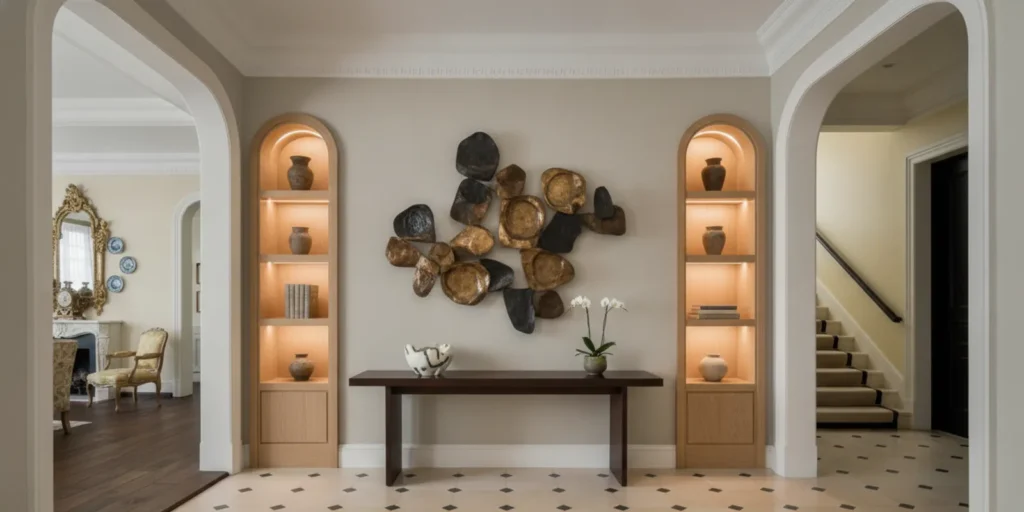
Sculpture in interior design asks for more than an attractive plinth or an empty corner. In a residential entry, the work meets people as they arrive, shapes the first view into the home, and shares space with everyday movement. Begin with the sculpture itself: its dimensions, material, visual weight, and the way it changes as you move around it. Then plan the entry so the work feels considered rather than imposed.
Discuss your residential design project
Why does the entry need its own sculpture plan?
An entry is a threshold, not simply a display area. It connects the outside world to the private rooms of a home, and it often has to accommodate coats, bags, doors, and more than one person arriving at once. A sculpture placed without considering these conditions can feel crowded, vulnerable, or disconnected from the rest of the residence.
Planning starts by asking what role the work should play. It might establish a point of focus, mark a transition, or create a quiet encounter on the way to another room. It need not announce itself from every angle. A subtle relationship between form, architecture, and collection can be more lasting than a dramatic gesture that overwhelms the entry.
This is why a collection-first approach matters. The artwork is not a finishing touch added after the room is complete. Its scale, character, and placement can inform how the entry is organized and how it relates to the larger home. For a broader perspective, see interior design for art collectors and the principles of art-first interior design.
What should you learn from the work before choosing its position?
Before settling on a location, understand the sculpture as a physical object and as part of a collection. Record its height, width, depth, and approximate footprint. For a work with an irregular or projecting form, a simple width-and-depth measurement may not describe how much room it occupies in practice. Consider the furthest points and the viewing distance at which its shape becomes legible.
- Material: Stone, metal, wood, glass, and mixed media each have a distinct presence and may call for different handling and light.
- Visual weight: A compact, dark object may feel more dominant than a taller, open framework. Judge the mass, not only the dimensions.
- Orientation: Identify the intended front, if there is one, and note whether the work has a meaningful profile or rear view.
- Condition and care: Understand any known sensitivities and consult an appropriate conservation professional where needed. Do not assume that all materials respond alike to sunlight, dust, or cleaning.
- Relationships: Think about how the work speaks to nearby art, furniture, architectural details, and the collection as a whole.
Take these observations into the actual entry. Photographs can help document the work, but they do not replace looking at its scale and presence in the room. A visit allows a designer to understand the space as it is experienced, including the changing views from the doorway and adjoining rooms.
How can you judge scale in the entry itself?
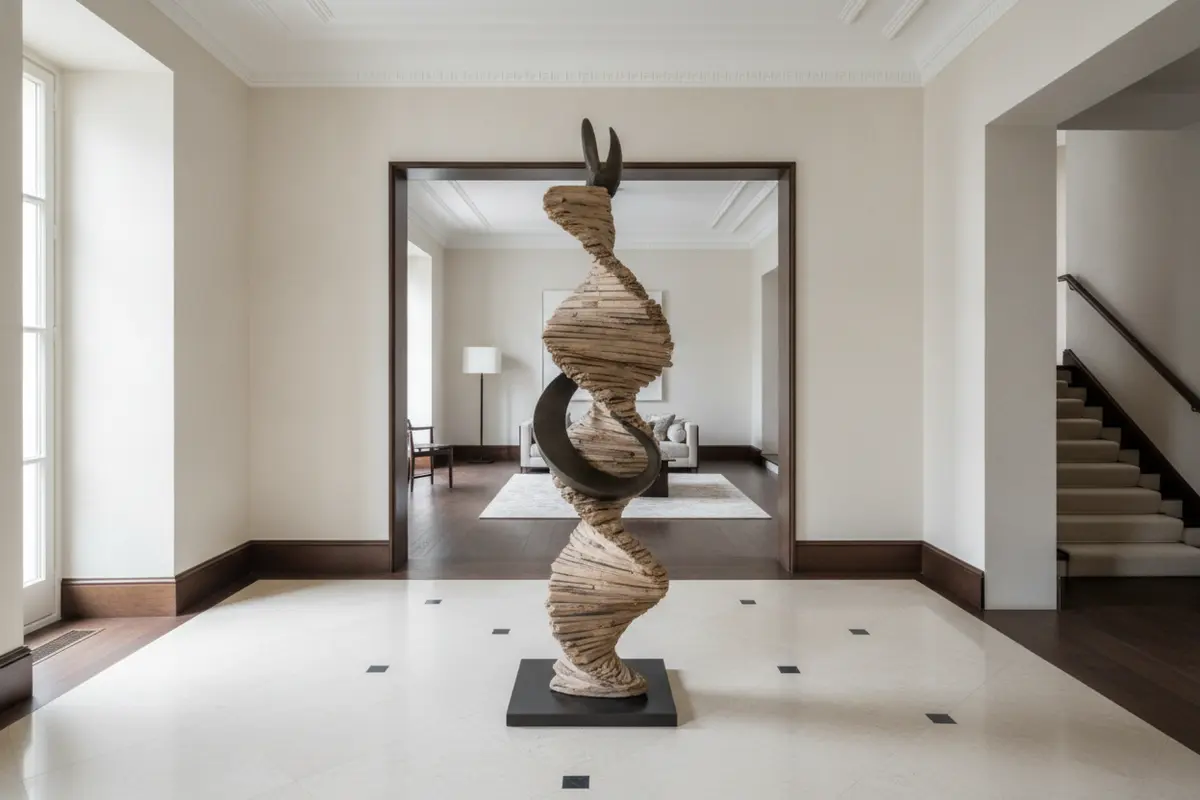
Scale is a relationship between the object and its setting. Compare the sculpture with the height and width of the entry, the door opening, nearby furniture, and the proportions of the architecture. A work that seems modest in a large gallery may dominate a narrow vestibule. Conversely, a small piece may disappear when the entry opens to a tall stair hall.
Use temporary markers to test the proposed footprint and height before committing to a base or final position. Painter’s tape can outline the footprint on the floor; a measured vertical marker can help approximate the top of a tall work. Then approach from the front door, move past the proposed location, and look back from the adjoining space. The test is not whether the object fits mathematically, but whether it has room to be seen without obstructing the room’s use.
Consider visual breathing room as well. Sculpture usually benefits from space around its outline so the eye can distinguish its form from the background. That space does not have to be empty of all other objects. It should, however, be deliberate. A console, mirror, lamp, or adjacent artwork may enrich the composition, but too many competing focal points can flatten the impact of each one.
For further guidance on the relationship between object and room, explore scale and proportion in an art-focused residence.
How should circulation shape the placement?
In an entry, a beautiful position is not successful if it makes arrival awkward. Check the natural route from the front door to the principal rooms, stairs, and coat storage. Include door swings, drawers, and the space people need to pass one another. The sculpture should not sit where a bag can strike it or where guests must turn sideways to move through.
Walk the route with the proposed footprint marked. Open the door fully. Test the entry with two people approaching or passing. Look for pinch points, not just direct contact with the sculpture. A plinth that narrows the clear path or interrupts the natural turn can make the room feel less generous, even if there is no obvious collision.
Then examine the sequence of views. Does the artwork greet a person immediately, or reveal itself after a step? Is that encounter appropriate to the work and the home’s character? There is no single correct answer. A direct view may suit a piece intended as a focal point; a more gradual view can make the transition feel composed and unhurried.
A home should function beyond the moment of arrival. Account for everyday routines, seasonal changes, and the possibility that the collection may evolve. If a new location would make the entry difficult to use, reconsider the placement rather than expecting daily life to adapt around the display.
What sightlines make the work feel intentional?
Study the sculpture from the positions people actually occupy: just outside the door, immediately inside, along the route through the entry, and from the room beyond. Each view reveals something different. A frontal view may show the intended composition, while a side view reveals depth, balance, or an unexpected relationship with the architecture.
Notice what appears behind the work. A busy doorway or a strong architectural edge can compete with its silhouette. A quieter backdrop may help a complex form read clearly. If the sculpture is open or visually delicate, it may benefit from a background that does not interrupt its outline. If it is solid and simple, the surrounding architecture might provide enough contrast.
Consider whether the work should be visible from several rooms. A sculpture seen from the entry and a nearby sitting room can create a visual thread through the residence. But visibility should not become a demand that every object be seen at once. A collection gains depth when different works are encountered in sequence.
How can light and material support the sculpture?
Observe the entry at different times of day. Natural light can reveal texture and cast shifting shadows, while direct sunlight may raise care questions for some materials. At night, the work may need a different reading. If adding or adjusting lighting, aim for a considered view of the object and its surroundings rather than an isolated beam that creates glare or distracts from the entry as a whole.
Lighting choices depend on the work, the room, and any conservation guidance. Reflective metal, polished stone, glass, and matte surfaces behave differently. Test the effect from more than one viewpoint. A light source that looks appropriate straight on may reflect uncomfortably from the door or a nearby mirror.
Materials around the sculpture also matter. A plinth or supporting surface should relate to the work without pretending to be part of it. Nearby finishes can offer contrast or continuity, but avoid treating a matching color as the only route to harmony. Texture, proportion, and the character of the home may create a more nuanced connection.
For a focused discussion of illumination, read how to light artwork in a luxury home. For works that have specific preservation needs, the American Institute for Conservation is a professional resource; seek advice appropriate to the individual object rather than applying general care assumptions.
Which placement approaches should you compare?
Compare a small number of real alternatives in the room instead of choosing from a floor plan alone. The table below is a starting framework; the best option depends on the object’s form and the entry’s architecture and circulation.
| Placement approach | What it can do | What to check | Often suits |
|---|---|---|---|
| Visible from the front door | Creates an immediate focal point | Door swing, arrival path, visual intensity | A work with a strong, legible first view |
| Set to one side of the route | Preserves a clear passage while giving the object presence | Clearance, nearby furniture, side views | An entry with a natural recess or broader edge |
| Revealed from an adjoining room | Creates a gradual visual encounter and connects spaces | Sightline, backdrop, visibility from multiple angles | A work that rewards looking and moving around it |
| Placed in a stair hall or taller volume | Uses vertical space and can relate levels of the home | Viewing distance, safe access, light, proportion | A scale and form that can hold a larger setting |
These are not prescriptions. A sculpture that reads beautifully at eye level may feel different when seen from a stair landing. A work with a compelling profile may be better positioned where it can be approached from the side. The comparison should include the actual object, not an abstract category such as “large sculpture.”
What is a useful sequence for making the decision?
- Document the work. Record dimensions, material, orientation, base requirements, condition, and any care guidance already available.
- Map the entry. Note doors, passages, stairs, storage, architectural features, and the route to the main rooms.
- Identify the desired encounter. Decide whether the work should greet, guide, or be discovered as someone moves through the home.
- Test alternatives in person. Mark footprints, walk routes, and view the sculpture from multiple positions and at different times of day.
- Review the whole composition. Consider neighboring art, furniture, finishes, light, and the visual rhythm of spaces beyond the entry.
- Confirm practical needs. Before installation, clarify handling, support, access, and any specialist advice required for the specific object.
This sequence helps prevent a common misstep: choosing a dramatic position first and trying to make the architecture and daily routine accommodate it afterward. The entry should support both the collection and the life of the home.
Which decisions benefit from an on-site review?
Some decisions are difficult to make from photographs or measurements alone. An on-site review makes it possible to experience the scale of the sculpture in the actual room, follow circulation paths, and understand how views shift between the entry and adjoining spaces. It also helps assess the relationship between the work and the home’s architectural character.
For a whole-home commission, the entry should be considered in relation to the rooms that follow. A sculpture can establish a visual note that is echoed, balanced, or deliberately contrasted elsewhere. The goal is not to repeat one motif throughout the residence, but to create a coherent sequence in which individual works retain their character.
CW DESIGN’s practice brings interior design, furniture restoration, and fine arts training together under Catherine Weinstock’s creative leadership. That multidisciplinary perspective can be relevant when a residence must accommodate a serious collection alongside architectural and practical needs. Explore the firm’s approach to residential design, its project portfolio, and the Brooklyn townhouse renovation as examples of work within the documented portfolio.
Start a conversation about your home
Frequently Asked Questions
Should a sculpture in an entry be visible as soon as the door opens?
Not necessarily. An immediate view can establish a focal point, while a gradual reveal can make arrival feel more measured. Choose the sequence that suits the work, the architecture, and the way the entry is used.
How much space should be left around an entry sculpture?
There is no universal clearance that fits every object and room. Allow enough space for safe movement, door operation, and an unobstructed view of the sculpture’s form. Test the footprint and route in the actual entry before finalizing the position.
Can a sculpture share an entry with other artwork?
Yes, if the works have room to be read individually and their relationship feels deliberate. Compare scale, visual weight, sightlines, and the character of the collection. Avoid crowding the entry with several objects competing for the same focal position.
Does every sculpture need a plinth?
No. The appropriate support depends on the object’s design, material, stability, and intended presentation. Confirm the requirements for the specific work rather than choosing a base for appearance alone.
When should a conservation professional be consulted?
Seek qualified advice when the sculpture’s condition, material, handling, display environment, or care needs are uncertain. A general design plan cannot substitute for object-specific conservation guidance.
A well-planned entry lets sculpture belong to the home’s architecture and daily life while giving the work the space and attention it deserves. Begin with the collection, test the experience in person, and let the final placement emerge from the relationship between object, room, and movement.