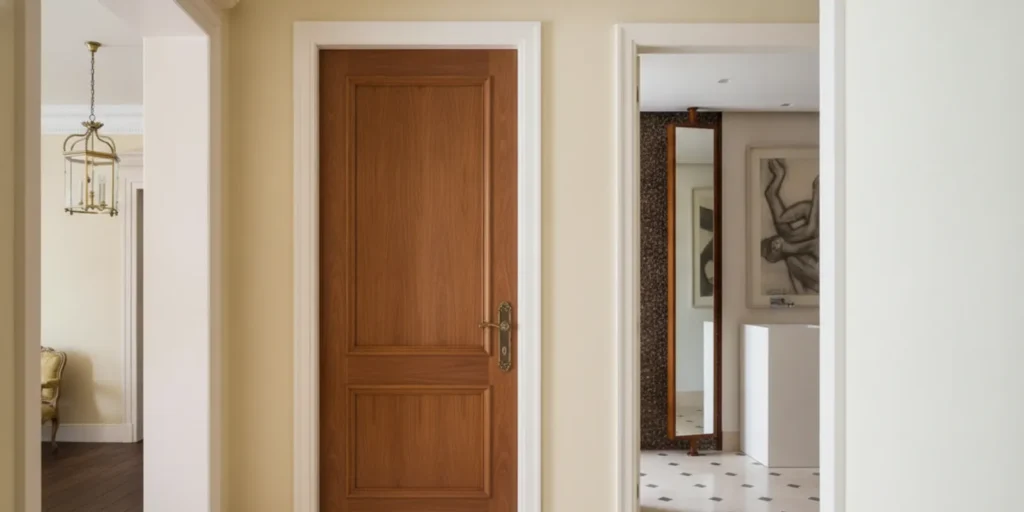
Acoustic seals for interior doors in a collected home are a small detail with a larger design context. They can close gaps where sound travels around a door, but they cannot make every door soundproof. The right choice begins with the room’s purpose, the sound path, and the door assembly—not with a product alone.
Discuss a whole-home design commission
What do acoustic seals at an interior door address?
Sound may travel through openings around a door, through the door leaf itself, or through adjoining construction. Perimeter seals are intended to close the small gaps between the leaf and frame. A bottom seal or threshold addresses the opening at floor level. These parts work as one assembly, so their effect depends on the door, frame, fit, installation, and adjacent wall.
It is useful to distinguish several goals. Speech privacy means making nearby conversation less intelligible. Noise reduction means lowering the sound heard across a boundary. Acoustic isolation is a broader building-performance goal that may involve walls, ceilings, floors, doors, and mechanical routes. A seal may help with a gap, but it cannot compensate for every weak point in a room boundary.
The US Environmental Protection Agency provides general background on noise and its effects. For a particular home, however, the practical first question is local: what sound is disturbing which activity, and where does it seem to enter?
Which rooms may benefit from a closer-fitting door?
A study, bedroom, media room, or guest suite may call for a different balance from a passage between public rooms. Consider what happens in each space, when it is occupied, and whether the issue is speech, music, television, or movement. A study used for calls may value speech privacy; a bedroom may call for a calmer environment during rest; a media room may need attention to sound moving in both directions.
Also consider how often the door is used. A rarely opened door can tolerate a different operating feel from a passage used throughout the day. An overly tight detail may undermine convenience if the door is difficult to close, the latch needs extra force, or the bottom rubs on a rug. The goal is not simply to maximize contact. It is to suit the room and its everyday use.
In a home organized around art, the door also belongs to the composition of the interior. Its position may frame a view, manage circulation, or allow one room to recede. Planning sound control alongside these relationships can keep practical details from appearing as an afterthought. CW DESIGN’s approach to considered residential design places decisions within the larger character of the home.
What should you inspect before selecting a seal?
Begin with the opening as it exists. Close and open the door as you normally would. Notice whether it meets the frame evenly, whether the latch engages without force, and whether the perimeter gap changes from one point to another. Look for daylight, rattling, scraping, or a door that swings open or shut on its own. These observations do not diagnose the cause, but they help describe the condition to a professional.
- Door leaf and frame: Record the door’s construction and condition. Note whether it is solid or hollow if known, and whether the frame is sound. A seal does not change the mass or integrity of the leaf.
- Clearances: Observe the gaps at the top, latch side, hinge side, and bottom. Inconsistent gaps can point to alignment or wear issues that should be addressed before adding sealing material.
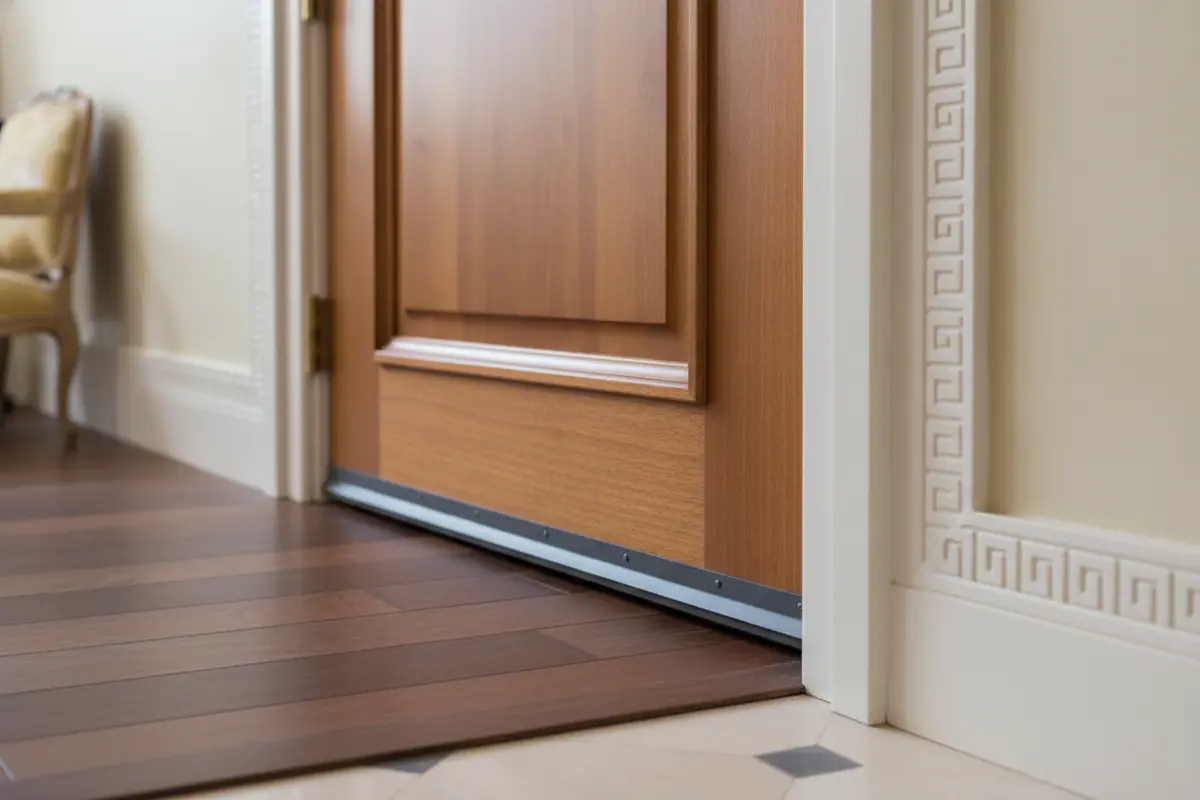
- Floor transition: Identify the surface under the door, including carpet, rugs, stone, wood, or a change in level. A bottom detail must work with that actual surface without dragging or creating an awkward threshold.
- Hinges and latch: Check whether the door is stable and closes reliably. A seal that adds resistance may affect latching, so hardware and fit belong in the same review.
- Use and access: Consider the needs of everyone who uses the opening and how frequently it is passed through. Ease of movement matters alongside the acoustic intention.
- Appearance: Identify what remains visible from key views, including the approach, adjoining rooms, and sightlines toward artwork or furnishings.
It can help to keep a brief observation record: which door is involved, the room and activity, the time the issue is most noticeable, the sound’s apparent direction, and anything visible at the opening. Do not make a performance promise based on a hand test or a phone recording. Such observations can guide a conversation, while a specialist can advise if a defined acoustic target is needed.
How do common door-sealing options compare?
The comparison below is a starting point, not a product specification. Exact performance and suitability depend on the complete door assembly, the opening, floor conditions, and installation. Have a qualified door or acoustic professional confirm the appropriate detail when performance is important.
| Detail | Where it works | Points to review |
|---|---|---|
| Perimeter compression seal | Between door leaf and frame | Needs a consistent closing surface and enough compression for comfortable latching. |
| Automatic drop seal | At the bottom of the door when closed | Retracts as the door opens; alignment and floor level are important. |
| Door sweep | Along the bottom edge, contacting the floor | May be visible and may catch on rugs or uneven flooring; confirm clearance and wear implications. |
| Threshold | At the floor transition beneath the door | Changes the floor profile and may affect circulation, access, and adjoining finishes. |
| Repair or adjustment | At hinges, latch, frame, or door alignment | May be necessary before seals can contact evenly; does not itself resolve sound through the leaf or wall. |
Think of the selection as a sequence, rather than a menu of interchangeable parts. If the door is out of alignment, first establish whether it can close properly. If the bottom gap varies because the floor rises or falls, the installer needs to understand that condition before choosing a sweep or drop seal. If the door closes well but the gap at the jamb is apparent, a perimeter detail may be more relevant than a threshold.
How can a functional detail remain visually discreet?
Start with the opening’s architectural role. A flush door, a paneled leaf, and a historic door each offer different opportunities for integrating a seal. The least visible option is not automatically the best. The detail still needs to close effectively, allow comfortable operation, and respect the character of the door.
Review the profile, finish, hinges, latch, frame, and nearby millwork together. A door that is quiet in one room may be prominent in a long passage or in a view from the living area. Look at it both open and closed. Consider the principal approach and the view from the rooms it connects. If artwork is visible through or beside the opening, the door should support that composition rather than compete with it.
In an older residence, alterations also call for care with existing fabric and any applicable approvals. A repair that preserves a valuable door may be preferable to a more intrusive change, but that decision depends on its condition and the desired result. For a wider discussion of art and architecture in a home, see CW DESIGN’s guidance on interior design for art collectors and designing around an art collection.
What can compromise the result?
A seal may not work as intended if the door does not meet the frame consistently, if the bottom detail is incompatible with the floor, or if the latch cannot hold the door closed. Too much compression can make operation uncomfortable. A sweep that rubs can catch on a rug, create wear, or interfere with movement. Frequent use can also wear sealing components, which makes proper installation and periodic inspection relevant.
There may be sound paths beyond the door. A lightweight leaf, a shared wall, a ceiling void, or a ventilation route can continue to transmit sound after visible gaps have been addressed. If a room remains intrusive, resist the urge to add more hardware without identifying the path. A qualified acoustic or building professional can assess the broader assembly and advise on measurable performance goals.
Expectations matter as much as hardware. A seal intended to reduce a noticeable leak around a door is not the same as a designed sound-isolation system. Before work begins, describe the outcome in everyday terms: for example, wanting conversations in an adjacent study to be less distracting, while retaining easy daily access. If a precise reduction is required, say so at the outset and ask how it will be assessed.
What is a useful sequence for planning the work?
- Define the concern. Identify the room, the source, when it occurs, and whether privacy or reduced disturbance matters most. Be specific about activities rather than asking for a generic “quiet door.”
- Observe the opening. Check the leaf, frame, gaps, bottom clearance, floor transition, hinges, and latch during ordinary use. Note visible light or rubbing without assuming that every gap is the only sound path.
- Confirm the assembly. Ask a qualified professional to consider the door, frame, seals, wall, and any other likely route. Clarify whether the goal is a practical improvement or a defined acoustic performance.
- Compare details in context. Review the expected contact, visibility, durability, and ease of use for each option. Include rugs, floor finishes, access needs, and how frequently the door is used.
- Coordinate the design. Consider the hardware and visible profiles alongside millwork, finishes, and sightlines. For a whole-home project, resolve the detail with the broader plan rather than treating it as isolated hardware.
- Test after installation. Confirm the door closes and latches comfortably, the seal contacts as intended, and no edge drags or catches. Revisit the original concern under similar conditions, while recognizing that a casual listening comparison is not a formal acoustic test.
A simple example shows why diagnosis matters. Imagine a study door with a visible gap at the bottom and a thick rug on one side. A sweep might contact the rug too heavily, while a drop seal could require careful alignment with the floor on the other side. If the sound is also traveling through a shared wall, either door detail may produce only a limited change. Inspecting the floor and considering the whole boundary before choosing avoids treating a visible symptom as the entire problem.
For complex renovations, doors belong in the whole-home plan. CW DESIGN’s Brooklyn townhouse project and Tribeca loft offer examples of distinct architectural contexts; they are not acoustic specifications. They illustrate why an opening should be considered in relation to the residence around it.
Which decisions benefit from an on-site review?
Measurements, floor conditions, door alignment, and sightlines are easiest to understand in the space itself. An on-site review also helps clarify whether the concern seems localized to the opening or belongs to a larger construction issue. Existing furnishings, art, circulation, and finishes all shape what a practical and visually coherent detail can be.
Catherine Weinstock’s training spans Interior Design, Furniture Restoration, and Fine Arts. That multidisciplinary perspective supports attention to both the working detail and its place in the interior. Learn more about Catherine Weinstock and CW DESIGN, or explore the firm’s residential projects.
Arrange a conversation about your residence
Frequently Asked Questions
Will an acoustic seal make an interior door soundproof?
No. Seals address gaps around a door, but sound can still travel through the leaf, frame, walls, ceiling, floor, or ventilation routes. The complete assembly determines the result.
Should I choose a door sweep or an automatic drop seal?
It depends on the door, floor, clearance, and desired appearance. A sweep contacts the floor during use; an automatic drop seal is designed to lower when the door closes. Have the opening and floor transition assessed before choosing.
Can seals be added to an existing door?
Retrofit options may be possible, but the door’s condition and alignment matter. A professional should check the leaf, frame, hinges, latch, and clearances before specifying a detail.
What if the room remains noisy after sealing the door?
The sound may be traveling through another part of the construction, or through the door leaf itself. Identify the likely path before making further changes, and consult an acoustic or building professional when a defined performance goal matters.
Will a tighter seal make a door hard to operate?
It can if the seal is over-compressed or poorly matched to the opening. Confirm that the door closes, latches, and opens comfortably after installation, and ask the installer to adjust the detail if it does not.
With careful assessment, acoustic seals can become one considered part of a residence: practical in use, appropriate to the door, and visually consistent with the home around it.