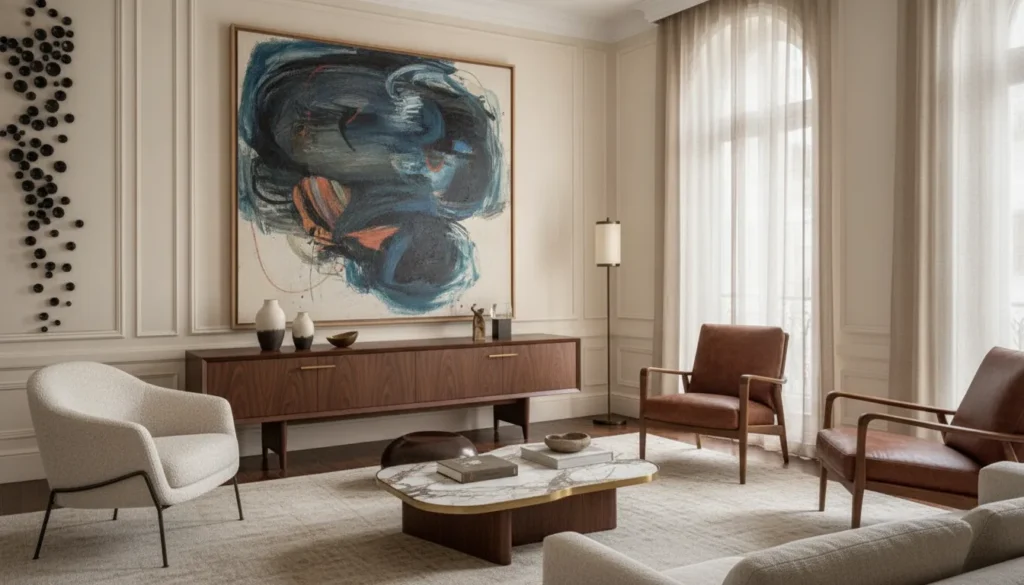
Two whole-home commissions can follow very different calendars: one may center on design and furnishing, while another also depends on architectural coordination, approvals, and renovation work.
Discuss an art-led whole-home project with CW DESIGN
The question “how long does whole home interior design take?” has no standard-duration answer. The schedule depends on the home’s scope and existing conditions, client decisions and approvals, sourcing, custom work, and whether renovation is involved.
At CW DESIGN, artwork helps organize decisions about architecture, materials, sightlines, and daily life, so a collection-first approach shapes more than the final styling. Read about our timeless interior design philosophy. Rather than rely on a generic calendar, it is more useful to understand the elements of a commission and how they influence one another. The project’s scope, conditions, and dependencies provide the clearest starting point for thinking about its timeline.
How Long Does Whole Home Interior Design Take? What Shapes the Timeline?
Scope and existing conditions
There is no single schedule for every whole-home commission. The duration depends on what the particular home requires, not on a generic label such as “interior design.” Key considerations include renovation scope, existing conditions, approvals, technical coordination, sourcing, and client decisions.
A furnishing-led project and a major renovation are not equivalent undertakings. Where renovation is involved, architectural coordination, systems upgrades, changes to the layout or structure, and regulatory review may introduce additional work and dependencies. Landmark approval may also be relevant to some properties, but it is not required for every project. CW DESIGN’s major renovation work may extend over multiple years; that is not a standard duration for all commissions.
Timing also reflects how design decisions connect. CW DESIGN begins with the art collection, considering how works relate to sightlines, architecture, materials, and daily life. That collection-first approach means the design is resolved as a whole, rather than treating rooms as unrelated tasks. The process can include discovery and concept development, coordination with architects where needed, artisan sourcing, procurement, installation, and art styling. It is not a guaranteed or strictly linear timetable: some work depends on earlier decisions, while sourcing and coordination may create further dependencies.
For a particular home, the useful question is therefore not a generic number of weeks or months, but which conditions and decisions shape its path. Scope, approvals, technical requirements, client and team coordination, and the chosen furnishings all matter. A project-specific discussion, informed by an on-site understanding of the home and its collection, is the only sound basis for considering its schedule. For the principles behind this approach, see CW DESIGN’s timeless interior design philosophy.
A Phase-by-Phase Breakdown: Brief, Design Development, Procurement, Installation
A whole-home commission moves from understanding the brief to shaping a resolved design, then coordinating its realization in the home. Those stages are connected, but design planning is not the same as physical construction. Selections and decisions made earlier inform later work, so a checkpoint for client review can help settle the direction before the design becomes more specific. For broader context on what a commission can encompass, see CW DESIGN’s guide to an interior design commission.
| Phase | What happens | What can affect the sequence |
|---|---|---|
| Brief | Clarify the home’s needs, priorities, and design direction. | Existing conditions and project scope. |
| Design development | Refine the concept into material, fixture, and furnishing choices. | Client review and decisions that guide later selections. |
| Procurement | Coordinate furnishings, finishes, fixtures, and materials. | Availability, custom work, and design changes. |
| Installation | Place selected elements and coordinate any building work. | Site readiness, construction dependencies, and delivery coordination. |
How the stages build on one another
- Brief and direction. Establish the needs and priorities that the design must address. This gives the following work a clear point of reference; the brief is a foundation, not a finished plan.
- Design development. Refine the approved direction into specific choices for materials, fixtures, furnishings, and equipment. This is where a concept becomes detailed enough to guide the next decisions. The Interior Design Institute’s overview of professional design phases describes design development as the refinement of an approved schematic through these selections.
- Procurement. Coordinate the selected furnishings, finishes, fixtures, and materials so they can be brought into the project in line with the design. Procurement depends on decisions made during development; if a selection changes, related coordination may need to change with it. Its place in the sequence is one reason a whole-home schedule cannot be reduced to the time spent on site.
- Installation and construction coordination. Bring the planned elements into the home and manage their placement so the completed result follows the design intent. Where building work is part of the project, technical drawings and written specifications guide contractors, while review during construction helps address submittals and changes. These are distinct from design planning itself, as the Institute explains in its descriptions of construction documentation and contract administration.
The sequence is a useful way to understand dependencies, not a promise that every activity happens in a rigid block. The design phases build on earlier work and become more specific over time; client review can serve as a checkpoint before proceeding. A project-specific plan accounts for which decisions must be settled before procurement or physical work can move forward.
Why Do Complex Commissions Take Longer, and Why Can That Support Quality?
A whole-home commission can involve more than selecting furnishings. When design decisions must work together across rooms, the collection, architecture, materials, and the rhythms of daily life all need to be considered as a coherent whole. CW DESIGN begins with the art and develops the interior around it, so choices in one area may inform choices elsewhere. The time involved depends on the particular home and the work it needs, not on a standard schedule.
Renovation adds dependencies that a furnishing-led project may not have. Depending on the property and scope, work can involve architectural coordination, systems upgrades, layout or structural changes, facade work, or regulatory review. Some projects may also require landmark approval, but that is not a requirement for every home. These are distinct steps to plan for, rather than reasons to assume every commission will take the same length of time. CW DESIGN describes its full-service interior design and renovation management as end-to-end, with coordination shaped by the project.
Major renovation work may extend over multiple years, while the customer knowledge base does not establish a standard duration for whole-home commissions. A longer timeline can support quality when it reflects real scope: resolving dependencies, considering decisions in context, and carrying a consistent design intent through the home. It is not automatically a sign of better work, however. Time without a clear project need does not create quality. The aim is thoughtful coordination at each stage, not slowness for its own sake.
That distinction matters in a bespoke, high-touch commission. Designing and furnishing a few rooms is not equivalent to coordinating an entire home or a major renovation. The appropriate pace follows the work required to bring the whole composition together, while respecting the home and the collection that gives it meaning.

The Role of Custom Fabrication in Extending the Timeline
When a room is shaped around a particular artwork, proportion, or architectural condition, a ready-made piece may not serve the design. Bespoke furnishings, woodwork, fixtures, or hardware can instead be commissioned from artisans. That decision introduces a dependency beyond selecting an item: the design must be defined, its specifications considered, and the work coordinated with the maker and the wider project.
Some custom pieces require months of specialized craftsmanship, but that is not a universal lead time. Timing depends on what is being made and the work involved. A bespoke element may affect related choices about the room’s materials, circulation, or collection. Its development and delivery should be considered alongside the rest of the home, not in isolation. CW DESIGN’s documented work at The Palm reflects the role artisan-made pieces can play in a considered interior.
For a whole-home commission, custom fabrication is therefore one possible schedule dependency, not a fixed stage with a predictable duration. It may overlap with other design and procurement work, while installation depends on the piece being ready and the space prepared to receive it. Discussing which elements are truly worth making to measure helps the design team plan around craftsmanship without treating a bespoke detail as an automatic delay. The aim is not to commission custom work for its own sake, but to ensure that selected pieces belong to the larger composition and can be integrated thoughtfully.
How Can You Pace Yourself Through a Long-Duration Commission?
Give the project a clear point of departure before decisions begin to accumulate. A considered brief helps the design team understand the rhythms of daily life, functional needs, personal history, and the art that should shape the home. In early planning, interior design programming may document client needs and expectations, while a site survey can record measurements and distinguish what should be kept, replaced, or cannot be changed.
- Inventory the collection. Gather artwork details, dimensions, and any known placement or conservation considerations. Note which pieces matter most and how they relate to the rooms you use every day.
- Clarify lifestyle priorities. Identify daily routines, entertaining needs, storage requirements, and spaces that need particular attention. Separate essentials from preferences that can remain open to design development.
- Agree on decision roles. Decide who will consolidate feedback and approve key choices. A clear point of contact can help the team work through design decisions without conflicting direction.
- Plan for on-site coordination. Discuss access for site visits, deliveries, trades, and installation, including any building requirements or periods when the home will be occupied. During construction, unexpected challenges can call for design solutions and coordination.
These are useful planning prompts, not a guaranteed project sequence. The extent of the survey and the information recorded will vary by home and scope. A field-survey example includes measuring the space and recording items to retain or replace; programming can also help establish client needs and expectations.
Q: How long does whole home interior design take?
A: There is no standard duration that applies to every whole-home commission. Timing depends on the scope, decisions, sourcing, site conditions, and whether construction is involved. A major renovation may extend over multiple years, so discuss the likely sequence and dependencies for the specific home rather than relying on a universal estimate.
Stay responsive at decision points, but allow thoughtful choices to be made in context. If construction is part of the work, planning should also leave room for issues that emerge on site and require a design response.
Discuss an art-led whole-home project with CW DESIGN
Frequently Asked Questions
How long does whole home interior design take?
There is no standard schedule for every home. Timing depends on scope, existing conditions, approvals, design decisions, sourcing, and whether renovation or custom work is involved.
Does interior design take as long as a whole-home remodel?
Not necessarily. Design development, procurement, and installation are distinct parts of a commission. A project that includes construction may add technical, approval, and site-coordination dependencies that a furnishing-led scope does not have.
What can extend a whole-home design schedule?
Changes to layout or systems, regulatory review where applicable, client decisions, coordination among project participants, procurement, and bespoke fabrication can all affect the sequence. Which factors apply depends on the home.
Can custom furniture affect timing?
Yes. Some commissioned pieces require months of specialized craftsmanship, though that is not a universal lead time. The schedule depends on the piece and when it can be integrated with the rest of the design.
How can homeowners prepare for a design project?
Clarify household needs, priorities, collection details, decision roles, and access for site visits or installation. A focused brief helps the project team understand what the home requires.
Continue the Conversation
A realistic schedule begins with understanding the home, its collection, and the work the commission requires. If you are considering a whole-home project, contact CW DESIGN to discuss the residence and the questions that matter to you.