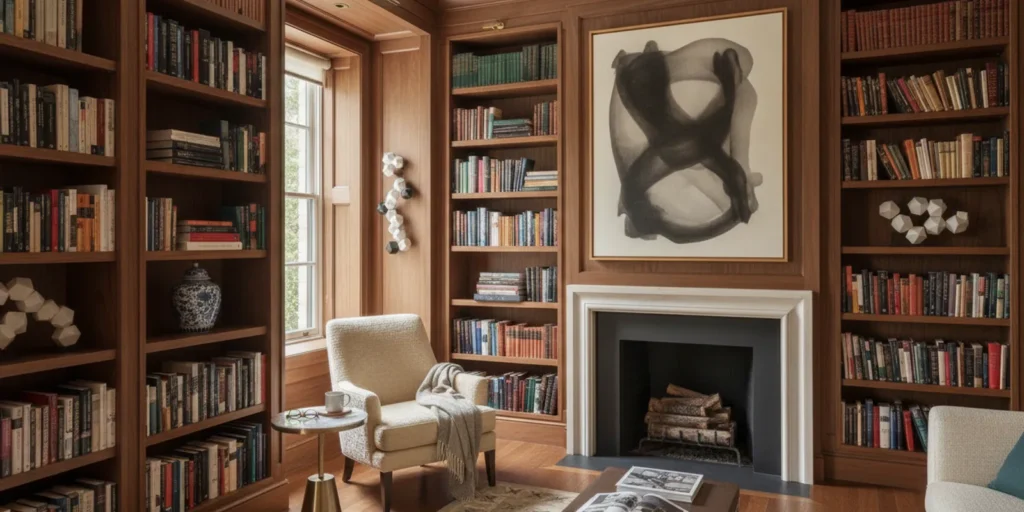
A contemporary art collector home library can hold books, selected works, and the quieter hours of a day in one room. It should invite reading and conversation without turning the walls into a display that cannot be lived with. The useful question is how those roles share the space.
Discuss your home library project
Why a contemporary art collector home library needs a daily purpose
A library often holds several kinds of attention at once. Someone may be reading, looking at a work, choosing a book, or talking with a guest. A successful plan lets those activities share the room without making it feel reserved for display.
Begin with the life the room must hold. It may be a private retreat, a place for family reading, a study, or a more social room. Then consider the collection. Books, paintings, photographs, and objects each need a different relationship to light, furniture, and movement. The answer is not to give every item equal prominence. A clear hierarchy keeps the room composed rather than crowded.
This is a narrower question than a whole-home design philosophy. The library works best when its decisions are specific to the room and still understood in relation to the residence. CW DESIGN describes its approach to art and interiors as collection-led. In a library, that principle can guide the relationship between books, artwork, and daily rituals.
What should you decide about the room before arranging it?
Start by observing the room in person at different times of day. Note its dimensions, openings, existing architectural details, and the routes people take through it. A wall that looks ideal on a plan may be interrupted by a door, glare, or a natural path across the room. Seeing those conditions early keeps shelving and furnishings from being fixed in the wrong place.
- Define the primary use. Decide what the room should do most often, and note the secondary uses that still matter.
- Take inventory. Record the books, artworks, objects, and furniture that should remain, with approximate dimensions and any known care considerations.
- Identify fixed conditions. Note windows, doors, radiators, outlets, ceiling height, and built-in features.
- Map movement. Mark the route from the entrance to seating, shelves, and adjoining spaces, and keep that access intuitive.
- Consider change. Ask whether the collection may rotate or grow, and which areas should be able to absorb that change.
A measured inventory is useful, but it does not replace seeing the room. The scale of a work against a wall, the feeling of a chair beside shelving, and the quality of light are spatial judgments. A collection-first preparation process can help make those decisions intentional before the room is resolved.
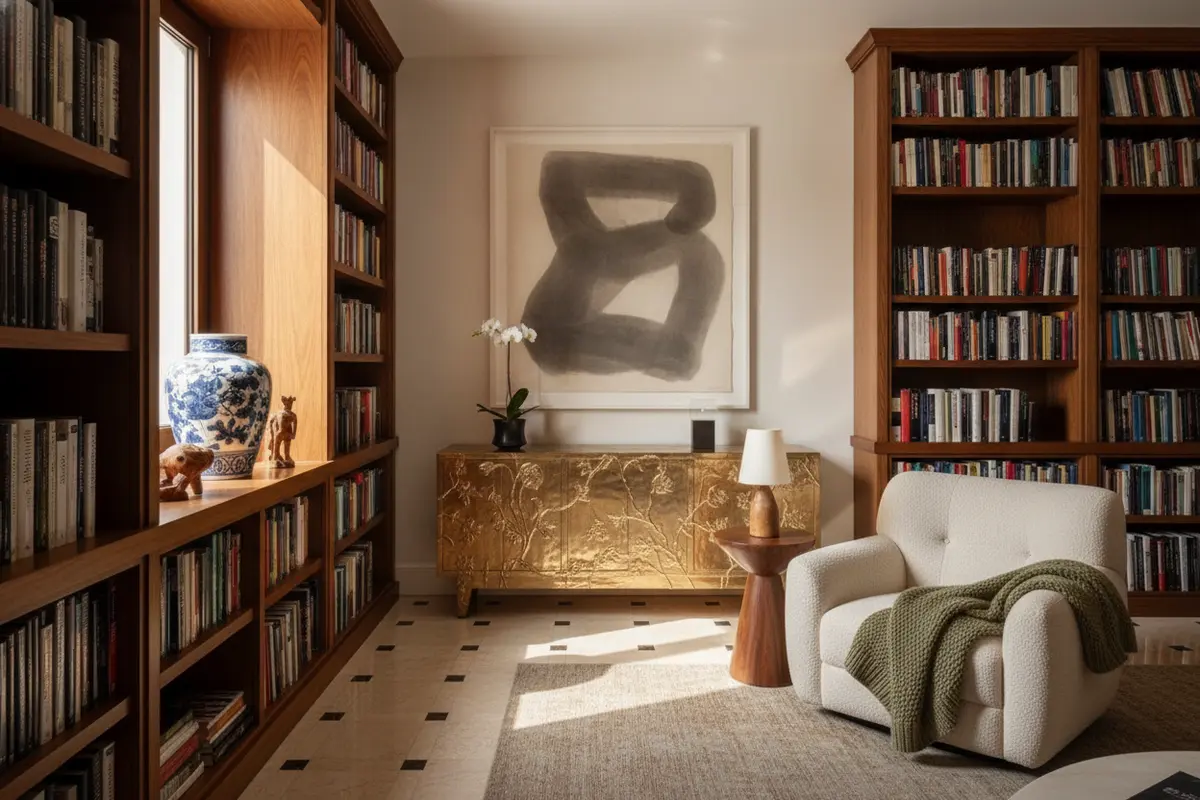
How can books and art share the room without competing?
Books provide texture and a sense of accumulated knowledge. Art can create a point of focus or a visual pause. Neither needs to occupy every wall. Consider where a person looks on entering, where they sit, and which views should unfold as they move.
Choose display locations with the actual work in mind. Size, format, frame, and visual intensity change how a piece reads beside shelving. A small work may need a quieter field around it. A large or visually assertive work may need a wall that is not broken into many objects. Do not treat every open shelf as a display ledge. Select a few places for objects, and let the other shelves serve the books.
Think of the wall and shelf arrangement as a sequence rather than a uniform grid. A meaningful artwork can anchor a seating area while books stay close at hand. Elsewhere, a concise grouping can provide a transition. For the broader relationship between a collection and its setting, see this guide to designing around an art collection.
What the Tribeca loft teaches a collector’s library
The documented Tribeca loft is a pre-war duplex, not a library, and that distinction matters. CW DESIGN’s stated aim was to let the loft’s own architecture remain the focal point. Furniture and artworks were chosen for their individual quality and for how they complemented the existing character of the space. The result was meant to feel sophisticated and comfortable for the people who live there.
That balance is the lesson for a library. Shelves can become so continuous that the room’s architecture disappears, just as a display wall can become so full that no single work can be read. In the loft, each piece had to earn its place against the architecture. In a library, each run of shelving and each artwork has to earn its place against the room’s primary use. If reading leads, the first view from the chair matters more than filling the longest wall. If looking leads, the books still need a clear, reachable order.
The Hempstead House room offers a second, narrower lesson. “Peggy’s Room” was conceived as a salon for dialogue, with sculptures, paintings, and digital art set among modernist furniture and varied materials. A collector’s library that is also used for conversation can borrow that idea of a layered setting. It should not copy a salon. The books, the chair, and the route through the room still have to work on an ordinary afternoon.
What role do shelving and storage play?
Shelving should serve the collection and the room, not simply maximize the amount of visible storage. Estimate how much book space is required now and what may reasonably be added. Then decide what should stay accessible, what can be stored discreetly, and whether any objects need a dedicated surface or an enclosed space. The Library of Congress preservation guide says upright books should stand straight and not lean. It also says books of a similar size should be shelved together so each cover is supported (Library of Congress guide to preserving books).
Built-in shelving can establish a strong architectural rhythm, but its depth, height, and placement should respond to the books and to the room’s proportions. A library that feels overfilled can make both reading and looking difficult. Leaving some breathing space can give important works and groupings greater clarity. Storage for items in use, such as a book set aside or writing supplies, can be integrated without turning every surface into a catchall.
Custom work is most useful when it solves a specific spatial or functional need. The design may include bespoke furnishings or fabrication where that need is real. The aim is a coherent room, not custom work for its own sake. CW DESIGN’s bespoke furniture perspective is a related way to consider how a piece can be shaped for a particular interior.
How should seating and lighting support a contemporary art collector home library?
Seating gives the room its invitation to stay. Place chairs around a clear use: reading alone, looking at a work, or speaking with another person. A chair needs enough space to be approached, and it should not block the books or the route through the room.
Layer the lighting so the room can change with the activity and the time of day. General light supports movement. A reading light should serve the seat without glare on the page. Light for artwork has to be considered with the work, its placement, and the daylight already in the room. One bright ceiling fixture cannot do every job.
Think in layers of light. Ambient light sets a comfortable level, task light is placed near the work, and accent light can focus attention on architecture or art. In a library, that means the reading seat, the shelves, and the selected works can each have an appropriate level instead of one even wash. See how to light artwork in a home for the artwork-specific decisions, and judge the actual exposure on site.
How can the library remain flexible as a collection changes?
A private library may evolve as books are added, artworks move, or household routines change. Plan flexibility where it is useful, rather than making the entire room provisional. Some walls or shelves can hold a more permanent arrangement. Other areas can take a changing selection without a complete redesign.
For rotating artworks, ask whether the intended locations offer suitable scale, visibility, and practical access. Keep enough open capacity for meaningful change, but do not leave the room so empty that it feels unfinished. An edited display can give a work room to be seen while the larger collection remains part of the home.
Flexibility also concerns use. A library that is sometimes used for conversation may need seating that can be drawn together. A room devoted to concentrated reading may need a more protected arrangement. The design should follow real habits rather than an imagined picture of how a library ought to look.
What should you compare before settling the plan?
Comparing a few deliberate approaches can clarify what the room needs. The table is not a ranking. It shows how each emphasis changes the experience of a collector’s library.
| Planning emphasis | Strength | Potential limitation | Best question to ask |
|---|---|---|---|
| Book-led | Supports access and orderly storage | Art can feel secondary if every surface is filled | Where can a work be seen clearly among the shelves? |
| Art-led | Creates focused moments for looking | Everyday reading needs may stay unresolved | Are the books and seating still easy to use? |
| Reading-led | Makes comfort and daily routines central | The collection’s visual relationships can be overlooked | What will a person see from each seat? |
| Integrated | Balances books, art, movement, and comfort | Hierarchy and spare space require careful choices | Which use should lead, and which should support it? |
Most collector libraries benefit from an integrated approach, but integration does not mean giving every element equal weight. A room can have a clear primary purpose and still welcome secondary uses. The Tribeca loft shows why architecture, collection, and daily life are best considered together, even when the room in question is a library rather than a loft.
What is a practical sequence for planning the room?
- Observe the space. Record dimensions, architectural conditions, daylight, and circulation in person.
- Define the room’s role. Name its primary use and the secondary activities it should support.
- Inventory the collection. Note what belongs in the room, what needs to be seen, and what may change.
- Establish priorities. Identify the works, books, and activities that should shape the first view and the main seat.
- Test relationships. Consider shelf runs, art locations, seating, and lighting together rather than as separate purchases.
- Resolve the details. Confirm clear routes, practical storage, suitable viewing, and a lighting plan before installation.
These steps are connected. Moving a chair can change a sightline. Changing a shelf depth can affect circulation. Adding a work can shift the room’s visual balance. Reviewing the plan as a whole helps avoid a decision that solves one problem and creates another.
Which decisions are best made in person?
Some questions depend on the character of the actual room. The perceived scale of a painting and the quality of daylight are difficult to judge from measurements alone. So are the transition between adjoining rooms and the comfort of a seating arrangement. Materials and finishes also read differently in changing light and beside existing objects.
For that reason, CW DESIGN’s work is grounded in visiting the space. Catherine Weinstock brings training in interior design, furniture restoration, and fine arts, with European study informing a broad appreciation of craft. That combination matters when a home must bring architecture, furnishings, and a collection into a considered relation. Learn more about Catherine Weinstock and CW DESIGN, or review the firm’s residential project portfolio.
Begin a conversation about your residence
Frequently Asked Questions
Should a home library display every artwork in the collection?
No. A more considered selection can make individual works easier to experience. The room can still suggest the wider collection through books, objects, and a few carefully chosen works.
Can a library work if it has more than one purpose?
Yes. Decide which activity should lead, then make room for secondary uses through seating, lighting, and circulation. Clear priorities help the room feel coherent when it serves more than one role.
How much flexibility should be built into a collector’s library?
Build enough flexibility for likely changes, such as a rotating display or a growing book collection, without leaving the room unresolved. Identify the areas that can adapt, and let the rest provide a stable structure.
What should be prepared before discussing a library project?
A useful start is a list of intended uses and the approximate dimensions of key works and furniture. Note which books and objects belong in the room, along with any known constraints. Those notes support a more informed conversation once the space is seen in person.
A home library can make a collection part of daily life when books, art, comfort, and movement are planned as one room. The lasting result is not a display alone. It is a place that invites both looking and living.