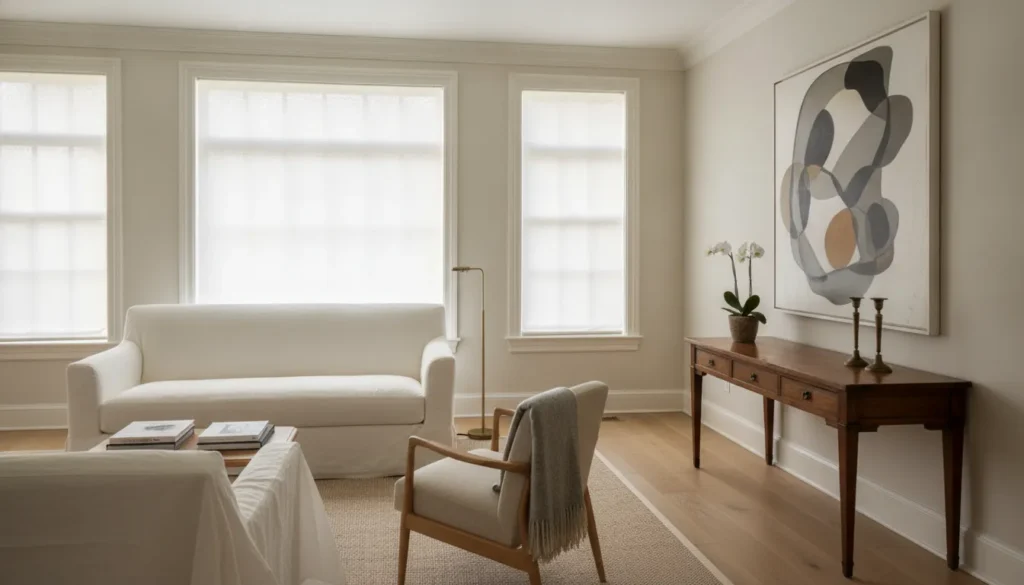
A seasonal house shutdown checklist for collectors is a written record of what stays, what travels, and what the closed house must do for the objects left inside it. The goal is not a matching look from one residence to another. It is a calm close of one house, so paintings, furniture, and rooms are not left to chance between visits.
CW DESIGN plans bespoke residential interiors for art collectors, and Catherine Weinstock works on site. She visits a house to understand its light, architecture, and collection. A shutdown is part of that same care. It is a short, serious review before the house is left, not a remote service and not a list of prices.
Discuss a seasonal house with CW DESIGN.
What a seasonal house shutdown checklist for collectors should cover
Start with the house as it will actually be used. Is this a summer place that sits quiet through winter, or a city apartment closed for a long trip? Who has keys, and who is allowed to enter a room that holds art? Write those facts down before anyone moves a frame.
Then list the collection by room. For each work, note the title or a plain description, the medium, the size, and whether it stays or leaves. A canvas, a work on paper, a sculpture, and a textile do not share the same risks. Furniture that is used every day is not the same as a piece kept only for display.
The checklist should also name the building. Note which rooms get direct sun, which ones stay damp after rain, and which ones are hard to heat. CW DESIGN’s approach begins with the character of the residence and the art, furniture, and objects that give it meaning. A closing list should do the same.
Keep the list short enough that someone else can follow it. A trusted housekeeper or property manager may be the person who locks the last door. They need clear instructions, not a design essay. Name the rooms in the order a person actually walks them, and say what done looks like in each one. A note that only says to check the art will be read differently by every person who holds a key.
If several homes are part of one life, the broader plan for how those homes relate belongs in the guide to interior design for a client with multiple residences. This page stays with the close of one house. It does not try to make a country place match a city apartment, and it does not choose a palette. It asks what this building will do to the objects left in it.
Which records to finish before anyone leaves
Photographs are the first record. Take a clear picture of each wall that holds art, then a closer picture of each work, including the frame and the hardware that holds it. Photograph furniture in place, especially pieces with a finish that can mark or crack. Date the photos and keep them with the checklist.
Write a simple inventory that matches those photos. Include where the object sits, whether it is insured at that address, and who may move it. If a work is leaving with the household, note the destination and the date it should return. If it stays, note the person who will check the room.
Condition notes matter more than a long description. A new scratch, a loose joint, a soft spot in a veneer, or a frame that no longer sits square should be written down before the house is closed. Catherine’s practice includes furniture restoration as well as interior design. A note made now is more useful than a guess made months later.
Labels should be plain and attached where they will not harm a surface. Avoid tape on paint, gilt, or veneer. A small tag on a wrapped frame, or a written list that matches numbered photos, is enough. Do not invent a catalog system the household will not keep up. The useful record is the one a person can match to a wall in five quiet minutes.
Also note loans, promises, and pieces expected back from a framer or a restorer before the house goes quiet. A work that is out of the building on closing day should not be listed as if it were still on the wall. When it returns, someone needs to know which hook it uses and whether the shade on that wall must stay down.
How to set climate, light, and the building envelope
A closed house still has weather. Sun, damp, and sharp changes in temperature are the usual risks for paintings and wood. The Canadian Conservation Institute’s environmental guidelines for paintings treat light, relative humidity, temperature, and pollution as the conditions that affect a painting in storage or on display. A seasonal house is not a museum, but the same forces are at work.
For relative humidity, CCI describes a stable target around 50 percent, with a practical band of roughly 40 to 60 percent, as kinder to canvas and wooden supports than wide swings. Damp above a very high level invites mold. Very dry air can make wood shrink and paint layers stress. The aim is a steady range the house can actually hold, not a perfect number that fails the week after you leave.
Ask whoever manages the house how heat, cooling, and any dehumidifier will run while you are away. Confirm that a power loss will be noticed. If the building cannot hold a steady climate, the most sensitive works should travel with you or move to a room that can. Do not leave a fragile work in a glass porch or an unheated wing because it looks well there in August.
Light is the other daily risk. Lower shades on walls that take direct sun. CCI also notes that ultraviolet light adds damage that filtering and careful glazing can reduce. A house that sits bright and empty for months can fade a textile or a work on paper even when the temperature feels fine. Turn off picture lights and lamps that are not needed for safety.
Close the building with the same care. Check that windows latch, that gutters are clear, and that a known leak has been looked at before the art stays behind it. A beautiful room cannot protect a painting if water is already in the wall. If a past storm left a stain, photograph it now so a later mark is not mistaken for a new failure in the roof.
Humidity monitors are worth placing in the two or three rooms that actually hold sensitive work, not in a hall that no one worries about. Ask for a reading when the house is occupied and another plan for when it is empty. A number taken on a mild afternoon does not describe a January week with the heat set back. Write down the setting you intend to leave, and the name of the person who can change it.
What should travel, and what should stay
Decide object by object. A work that is central to daily life at the other house may travel. A large painting fitted to one wall, or a sculpture sited for that room’s scale, should usually stay. Moving it for the season can cause more harm than a careful close.
Works on paper, photographs, and textiles are often the first candidates to leave a house that cannot hold steady humidity. Heavy stone or bronze may stay if it is stable, secure, and not in a path where a closed house still has foot traffic. Antique furniture with a delicate finish should stay put unless there is a clear reason to move it. Wrapping and trucking are their own risks.
If something does travel, plan the path. Measure doors, stairs, and the vehicle. Note whether glass must come off a frame. Never ask a house staff to improvise a move of a valuable work on the morning of departure. A short written sequence is kinder to the object and to the people handling it.
Pieces that stay need a reason and a caretaker. Leaving a work in place is not a plan if no one will look in. Say how often a room should be walked, and what the walker should not touch. Dusting a gilt frame or shifting a sculpture to vacuum under it can do more harm than a closed week of ordinary air.
For homes where the collection itself changes through the year, the separate guide to flexible display planning for a rotating collection covers how display can change. This checklist only decides the close. It should not become a rehang. If a work looks wrong in the room, note that for a later visit rather than solving it while the car is running.
| Object | Leave in place | Move it |
|---|---|---|
| Paintings on canvas | The room can hold a steady climate and the work is secure on its hardware. | The room overheats, goes damp, or takes strong sun for months. |
| Works on paper and textiles | Light is blocked and humidity will not swing hard. | The house will be bright, damp, or unmonitored. |
| Sculpture | It is stable, out of traffic, and suited to the room. | It can tip, sits in a leak path, or must travel with the household. |
| Antique or collected furniture | The finish and joints are sound and the piece belongs to that room. | There is an active condition problem, or the piece is needed in another home. |
How to protect each room without redesigning it
Protection should be quiet. Slipcovers, lowered shades, and a cleared surface are usually enough. Do not turn a collected room into a storage locker. CW DESIGN’s work is about living with art, not sealing it away from the house that was designed for it.
In living rooms, clear drinks, flowers, and anything that can stain or invite insects. Leave walking room around sculpture. If a fireplace will not be used, confirm the damper and screen are set as the house requires, and keep art off a flue that is known to sweat or soot.
In bedrooms and dressing rooms, empty closets of damp clothing and close drawers on delicate objects only after they are dry. A shut drawer in a humid week can trap moisture against a wood surface. Beds and upholstery need airflow more than plastic. Plastic against a finish or a textile can hold condensation.
Kitchens and baths are not display rooms, but they affect the rest of the house. Shut off or confirm appliances that can leak. Do not leave a collected piece in a bath that will not be ventilated. If the house has a library or a room planned around books and works on paper, give that room its own line on the list. Light and humidity matter there even more than in a hall.
Picture hanging hardware deserves a look before you go. A wire, hook, or cleat that is already tired should be noted, not ignored until spring. The same is true of a frame that rubs the wall. Small fixes are easier while someone is still in the house. If a work cannot be made secure that day, it should travel or move to a safer room rather than hang on a failing hook for the season.
Exterior doors, alarms, and the path from the drive to the rooms with art belong on the same pass. A closed house is still entered by cleaners, inspectors, and the occasional contractor. The checklist should say which rooms they may use and which doors should stay shut. Security is part of care for a collection, even when the design question is already settled.
What to review on site before the last lock
Catherine does not design from afar. She has to be in a place to understand it. A shutdown review deserves the same honesty. Walk the house once with the checklist in hand, in daylight, before bags are in the car.
Use a simple order so a tired hardware fitting or an open shade is not missed in the rush to leave.
- Walk each room that holds art and confirm the inventory still matches the walls.
- Check hardware, shades, and any work that will travel that day.
- Confirm heat, cooling, dehumidification, and who is called if power fails.
- Look for leaks, open windows, and exterior doors that do not latch.
- Leave one copy of the list in the house and one with the person who has keys.
Stand where the sun actually falls in late afternoon, not where it fell at noon in June. A wall that seemed safe in midsummer may take a low winter beam. The guide to natural light and contemporary art in the home is about living with that light. At closing, the question is narrower: what must be shaded while no one is home.
If a room still feels unresolved, do not invent a fix in the driveway. Note it and plan a proper visit. Whole-home work at CW DESIGN is a considered commission, not a rushed punch list. The page on what an interior design commission involves describes that pace. A shutdown should respect it.
How the checklist fits a collected home
A seasonal close is easier when the house was planned as a place to live with art, not only to visit. Rooms with sensible scale, sturdy hardware, and a clear path through the collection are simpler to leave. That planning is part of CW DESIGN’s art-centric approach: placement, light, and the life of the household come first.
If the seasonal house is also a holiday house used in more than one way, its year-round character is a different question. The article on designing a holiday house as a year-round collection home covers how such a house can hold a collection while people are in it. Use that when you are shaping the rooms. Use this checklist when you are about to lock them.
Collectors who keep more than one home still benefit from one voice across those houses. Continuity of judgment is not the same as copying a room. Catherine’s studio takes a small number of serious residential commissions and works them in person. A shutdown list is one practical expression of that care. It keeps a closed house from undoing a considered interior.
Read the list aloud with the person who will hold the keys. If they cannot tell which works stay, the list is not finished. If they cannot say who to call when the power drops, the climate plan is not finished either. Those two answers are worth more than another page of advice.
Request a conversation about the collection and the house you are about to close.
Frequently Asked Questions
Should every seasonal house follow the same shutdown checklist?
No. A beach house, a country house, and a city apartment fail in different ways. Write the list for the climate, the light, and the objects in that one house. A copied list from another residence will miss the room that actually needs care.
Can art stay in a house that is closed for months?
Often yes, if the room stays secure and the climate stays inside a steady band. Paintings are safer near a moderate, stable relative humidity than in damp cold or very dry heat. If the house cannot offer that, move the most sensitive works instead of hoping.
Who should keep the checklist?
Keep one copy with the household and one in the house for the person who has keys. Photos should sit with both. A list that lives only in an email is easy to lose on the day someone needs it.
Does CW DESIGN close a house without visiting it?
No. Catherine works on site because a house has to be seen to be understood. A checklist can guide a caretaker between visits, but it is not a substitute for being in the rooms when a design question is still open.
When should a collector start the list?
Start before the last week. Hardware, a leak, or a work that must travel all need time. A list begun on departure morning usually becomes a stack of undone notes.