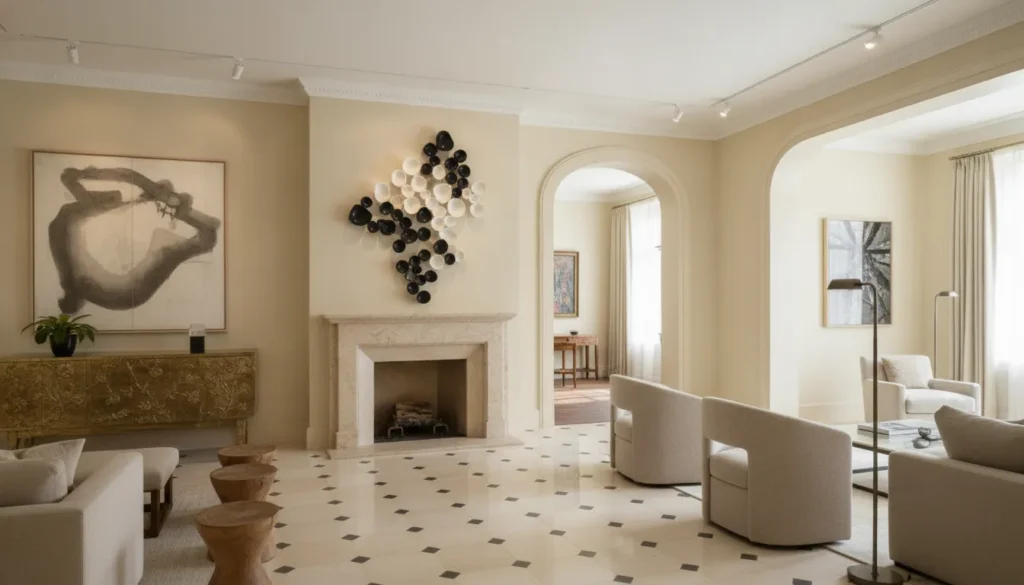
An art collection changes the way a home must be considered. In a New York residence filled with paintings, sculpture, and objects of consequence, the interior cannot be assembled first and dressed with art later. Proportion, circulation, light, materials, and craftsmanship must give the collection room to speak.
For discerning clients, interior design for art collectors new york means creating a bespoke, whole-home environment in which the collection drives every design decision. CW DESIGN begins with the art, then shapes a timeless setting that supports its presence without competing for attention.
Catherine Weinstock brings training in Interior Design, Furniture Restoration, and Fine Arts to this collection-first process. Her on-site approach considers the character of the space as carefully as the works it will hold. For a broader look at this philosophy, explore art-first interior design, then consider why an art-collector commission calls for a different standard of residential design.
Speak with CW DESIGN about an art-focused residence for your collection.
What Sets Art-Collector Interior Design Apart from Standard Residential Design
In a conventional decorating scheme, artwork may be selected after the rooms, furnishings, and finishes are established. For a serious collection, that sequence is reversed. The art gives the interior its point of departure, shaping decisions about proportion, circulation, architectural intervention, light, color, and the relationship between private life and display. The result is not a gallery placed inside a home, but a cohesive residence in which the collection belongs to the architecture.
This is the essential distinction in art-centric interior design philosophy. A collector’s home may function as a personal museum, yet it must remain intimate, comfortable, and deeply personal. Each work needs room to be seen without making the surrounding spaces feel staged. Scale, sightlines, and adjacency are considered together, so that a painting, sculpture, or object has presence while still participating in the rhythm of daily life.
The interior serves as a sophisticated backdrop
Designing around art calls for restraint. Walls, floors, upholstery, casework, and lighting should elevate the work rather than compete for attention. This does not mean creating a blank or anonymous setting. A sophisticated backdrop can have texture, warmth, and architectural character, but its gestures must be deliberate. The finest materials and furnishings support the collection through proportion and craftsmanship instead of announcing themselves as a trend.
That balance requires finesse and humility. The designer must understand when a room needs a quieter palette. When a custom element should recede, and when an intervention can create a more compelling conversation between works. The goal is a home that feels considered at every level, not an interior that asks to be admired before the art.
Collection-first thinking changes the entire brief
For this reason, interior design for art collectors in New York extends well beyond choosing attractive furniture or coordinating finishes. The collection informs the planning from the beginning. A multidisciplinary understanding of fine art, furniture restoration, and interior design helps connect conservation needs with the tactile and emotional qualities of a residence. Custom fabrication, restored furnishings, and artisan collaborations may be necessary to create a setting that feels singular rather than assembled.
The approach is also inherently timeless. Instead of pursuing a fleeting look, the design establishes an enduring framework that can honor the collection as it evolves. It respects the collector’s connoisseurship while allowing rooms to be lived in with ease.
| Consideration | Standard residential design | Interior design for art collectors |
|---|---|---|
| Starting point | Style and layout come first. | Art leads every decision from the outset. |
| Role of artwork | Art is a decorative finish. | Art shapes proportion, light, and materials. |
| Lighting | Light serves general comfort. | Light is museum-grade and calibrated to each work. |
| Conservation | Conservation is rarely planned. | Protection is built into the design. |
| Duration | Work is often a shorter refresh. | Work is a considered, whole-home commission. |
Begin a conversation about your art-focused residence with CW DESIGN.
How CW DESIGN Structures a Collection-First Commission in New York
The first conversation is about the collection, the client’s eye, and the life the home must hold. A painting, sculpture, or group of objects can establish the atmosphere, scale, and rhythm of an interior long before furnishings or finishes are selected. Catherine Weinstock begins with that individual point of view rather than imposing a decorative formula. The result is a home that feels composed around its owner, not dressed around a trend.
That inquiry begins in person. Catherine mandates an on-site visit because a residence cannot be understood from plans or photographs alone. She has said, “I will not work off site,” because she needs to experience the architecture, light, proportions, and movement through the rooms directly. In a New York apartment, townhouse, or other significant residence, this first-hand understanding informs every later decision. From placement and circulation to the relationship between a cherished work and the room around it.
From collection and vision to a coherent whole
CW DESIGN’s approach is particularly suited to clients who see their homes as personal museums, while still expecting them to be welcoming and deeply livable. Catherine’s training in Interior Design, Furniture Restoration. And Fine Arts allows her to consider the collection as both an aesthetic language and a set of physical objects with distinct requirements. Form, scale, material, and provenance are considered alongside comfort, architecture, and daily use. Each room contributes to a larger composition rather than competing for attention.
For that reason, the work is generally conceived at the scale of an entire apartment or whole home. A collection-first commission may involve renovation management, furnishings, restoration, and the careful coordination of many specialized decisions. Some projects last a year or a year and a half, particularly when they require the degree of detail and curation expected by serious collectors. This is an intentionally considered process, not a rapid exercise in surface decoration.
Craftsmanship, restoration, and collaboration
When an existing piece has character or history, furniture restoration can be as important as selecting something new. Custom fabrication may be developed to accommodate a singular artwork, an architectural condition, or a particular proportion. Artisan collaborations, including work with Gallery Fumi and other makers, bring another layer of authorship and craftsmanship to the interior. These elements are not added for spectacle. They are selected to create a quiet, cohesive environment in which the collection remains central.
Explore bespoke interior design for art collectors to see how CW DESIGN brings this collection-first sensibility into complete residential environments.
The Key Challenges of Designing Around a Significant Art Collection
A serious collection introduces responsibilities that extend well beyond choosing a wall color or selecting a frame. In New York, where architecture, daylight, circulation, and renovation constraints can vary dramatically from one residence to the next. Interior design for art collectors must unite aesthetic judgment with technical care. CW DESIGN approaches the home as a cohesive, lived-in environment in which each work can be seen, protected, and meaningfully experienced.
- Protecting works from damaging light. Lighting must reveal the character of a painting or object without accelerating deterioration. Museum-grade, UV-filtered sources can help minimize harmful exposure, while light duration also requires consideration for sensitive works. The goal is not simply dramatic illumination, but a considered lighting scheme that supports both preservation and daily enjoyment. Guidance on exhibition light duration provides useful conservation context.
- Creating balanced spacing and sightlines. A collection loses force when every wall competes for attention. Scale, form, proportion, and the relationships between rooms determine how far apart works should sit and where the eye encounters them. Careful spacing allows each piece to read clearly without making the interior feel crowded. That calibration is part of CW DESIGN’s art-centric interior design philosophy, in which the collection informs the architecture and furnishings rather than becoming an afterthought.
- Resolving adjacency, weight, and hanging engineering. Significant works may require more than a picture hook. Wall construction, substrate, hardware, weight distribution, and the relationship between adjacent pieces must be assessed before installation. In a renovation, specialized local teams may need to coordinate structural work, finishes, restoration, and final placement. The intersection of architecture, lighting, and conservation is central to a responsible collector’s home.
- Managing the environment around the collection. Paintings should be kept away from direct sunlight and exposed to stable humidity conditions. Varnish can provide a protective coating that supports the longevity and aesthetic preservation of paintings, but it is one element of a broader care strategy. Environmental conditions, maintenance, and the particular requirements of each medium should be considered together. See the Smithsonian’s guidance on caring for paintings for foundational preservation principles.
- Bringing in conservation expertise when appropriate. Significant installations deserve specialist advice before design decisions become difficult to reverse. Consulting a conservator can clarify display conditions, handling, mounting, and ongoing protection, especially when works are unusually delicate, valuable, or technically complex. The designer’s role is to coordinate that expertise with the wider room, not to substitute for it.
- Keeping the home genuinely livable. The finest result is not a sterile gallery. Seating, movement, conversation, storage, and ordinary domestic rituals must remain intuitive while the art retains its presence. Exhibition-style clarity and residential comfort can coexist when circulation and furnishings are composed around the collection. The home should feel personal and welcoming, with the discipline of a gallery and the warmth of a place meant to be lived in.
How Lighting, Spacing, and Wall Adjacency Are Calibrated to the Art
In a collection-first residence, display is not resolved by selecting attractive fixtures and placing pictures on available walls. Each decision is calibrated to the work itself, the architecture around it, and the way people move through the home. The objective is quietly exacting: the collection should be fully legible and deeply present, while the rooms remain gracious, comfortable, and lived in.
Lighting carries both an aesthetic and a conservation responsibility. The beam, intensity, angle, and duration of illumination affect how color, texture, and surface are perceived. They also affect the long-term condition of sensitive works. The Smithsonian’s guidance on light duration and artwork preservation underscores why exposure must be considered as part of the design rather than treated as an afterthought. In practice, lighting is arranged to reveal the collection without relying on harsh direct sunlight or unnecessary exposure to harmful UV rays. Fixtures and controls are selected with the medium, glazing, surface, and viewing distance in mind. A painting may need a different treatment from a work on paper, a textile, or a polished sculptural object.
Spacing establishes the visual authority of each piece. Form, scale, and spatial relationships determine whether a work reads as an intentional focal point or becomes lost among competing elements. That calculation includes the distance between artworks, the height at which they are encountered, and the relationship between a large work and nearby furniture, openings, or architectural details. A substantial canvas may require visual breathing room, while a group of smaller works may be composed as a deliberate constellation. The intervals should feel measured, never arbitrary, so the eye can move through the collection without visual fatigue.
Wall adjacency extends that calibration into the plan of the residence. Placement is considered against door swings, windows, thresholds, sightlines, and the natural circulation of the household. A work should be encountered from the appropriate approach, not interrupted by a column or made visually secondary by a competing view. Adjacencies can also create a conversation between works, materials, and rooms, allowing the collection to unfold gradually through the home rather than presenting every piece at once. This is where art, architecture, and daily movement must be resolved as one composition.
The art-focused interior design commissions in CW DESIGN’s portfolio illustrate the value of treating art as part of the home’s structure and atmosphere. For a New York residence, that level of calibration depends on an on-site reading of the space. The collection, and the qualities of light that change throughout the day. The result is not a gallery imposed on a home, but a timeless interior in which each work has the proportion, protection, and presence it deserves.
How Interior Design for Art Collectors in New York Begins
The first conversation is not a request for a style or a room-by-room wish list. It is an opportunity to understand the collection, the architecture, and the way the client wants to live among the work. At CW DESIGN, the design process begins with the client’s unique art collection and aesthetic vision. Allowing the home to develop as a coherent setting rather than a series of decorative decisions. This is the foundation of art-first interior design.
For a collector, the most useful starting point is a thoughtful inquiry. Share the character of the collection, the property under consideration, and the ambitions for the residence. The discussion may include paintings, sculpture, furniture, or works that have yet to find their proper place. It should also address the experience the home needs to offer: intimate, quietly theatrical. Highly livable, or composed to receive guests without allowing the art to become background decoration.
That conversation leads to an on-site visit. Catherine Weinstock visits each space because its proportions, natural light, circulation, materials, and atmosphere cannot be understood remotely. She has stated plainly that she must go to a place to get a feel for it and will not work off site. The visit establishes how the collection and the architecture can speak to one another, while identifying the practical conditions that will shape the commission.
The appropriate scope is generally the whole home or entire apartment, not an isolated room treated as a finished vignette. A collection-first residence requires continuity: sightlines should relate from one space to the next, furnishings should support the art, and architectural interventions should feel considered rather than imposed. Depending on the property, the work may also involve furniture restoration, custom fabrication, and collaborations with skilled artisans. You can see examples of this approach in CW DESIGN’s bespoke interior design for art collectors.
These are deliberate, long-duration commissions built around detail and curation. CW DESIGN accepts a limited number of projects, making exclusivity part of the practice’s quality-over-quantity philosophy. The result is not a quickly assembled interior, but a timeless environment that can evolve with the collector and remain generous to the art. The questions collectors most often ask next concern protection, lighting, and how a home can balance daily life with serious display.
Request a conversation with CW DESIGN about your art collection.
Frequently Asked Questions
How do you protect art in an interior design project?
Protection begins with understanding each work, its placement, and the conditions of the room. The design should account for appropriate sightlines, wall construction, spacing, and environmental stability, while keeping the home comfortable to live in. Furniture, textiles, and architectural details are selected to support the collection rather than introduce unnecessary risk or visual distraction.
What is the importance of lighting for art collectors?
Lighting is essential for both experiencing and preserving a collection. Museum-grade, UV-filtered lighting can help reduce fading while providing the clarity and control needed to appreciate color, texture, and scale. In a New York home, lighting is calibrated to the work and the room, rather than relying on a uniform scheme throughout the residence.
Should interior design compete with art displays?
No. The most successful interior acts as a sophisticated, restrained backdrop that gives the art authority. Materials, furnishings, and architectural details should create atmosphere and support the collection without becoming a competing spectacle. That balance requires finesse and humility, particularly when a home contains works with strong individual presence.
How does art-centric interior design work in New York homes?
It begins with an on-site understanding of the residence and the collection, followed by decisions about circulation, proportions, placement, lighting, furnishings, and custom details. The result should feel like a complete home, not a gallery added to a residence. For a substantial commission, the design can extend across the entire apartment or house so that living spaces and art remain in considered conversation.
Begin Your Art-Collector Interior Design in New York
When the collection is the heart of the home, the design must begin with the art. CW DESIGN brings a multidisciplinary understanding of interior design, furniture restoration, and the fine arts to every art-first commission. Creating timeless, whole-home environments in which each work is seen, protected, and given room to speak.
Because every engagement is bespoke and on-site, the conversation starts with your collection and the character of your residence. Contact CW DESIGN to discuss your art collection and begin a bespoke commission.
Pingback: Curating Art for Private New York Residence – CW DESIGN
Pingback: Scale and Proportion Art Residence: Making Art Feel at Home – CW DESIGN