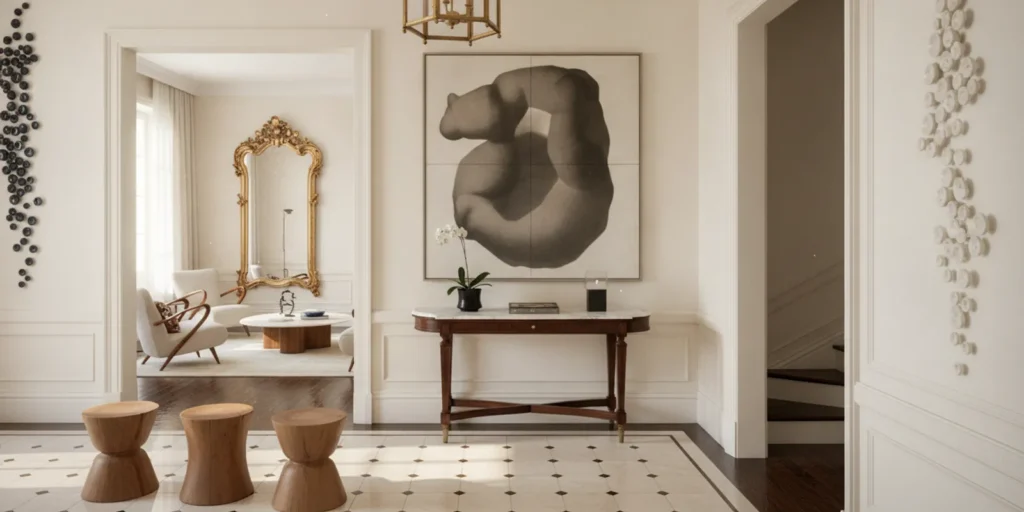
Timeless interior design is not a formula of pale walls, familiar silhouettes, or rooms untouched by change. For a collector, it begins with what already carries meaning: art, furniture, objects, architecture, and the life that unfolds around them. When those elements guide decisions about a whole residence, the result can feel individual and composed rather than tied to a passing look.
Discuss a considered residential project
What makes a home feel timeless rather than trend-led?
A lasting interior is not necessarily traditional, restrained, or neutral. Contemporary art can sit comfortably in a historic home. A vivid color can remain compelling. An unusual piece of furniture can become central to a room. The question is not whether a choice is current or classic; it is whether it has a considered relationship to the home, its occupants, and the other things that matter there.
Trend-led rooms often begin with an image of a finished look and work backward, selecting elements because they appear together in a moment. That can leave a home feeling assembled from references rather than developed from its own character. A more enduring process asks what should lead: perhaps a painting, a particular architectural feature, a treasured object, or the way family and guests use the rooms. The design then builds around that point of reference.
Colgate Magazine’s discussion of the three tenets of interior design describes the importance of thinking in context. For a collector, context includes the work itself, the wall and light around it, the architecture, and the views from adjoining spaces. This perspective helps distinguish a memorable choice from one that merely repeats a current fashion.
CW DESIGN’s approach is collection-first: art is part of the design’s foundation, not an accessory added once the furnishings are selected. The ideas in this guide to designing around an art collection show why the collection can shape the character and organization of a residence.
How can a collection establish a lasting design direction?
Begin by looking at the collection as a whole, then identify the works that should have the strongest presence in the home. Note differences in scale, medium, subject, surface, and visual intensity. A large painting may call for a clear focal wall and a measured arrangement of furniture. A sequence of smaller works might create a gradual transition between rooms. Sculpture asks different questions: where it can be approached, how it reads from several angles, and whether its placement interrupts circulation.
Do not treat this review as a color-matching exercise. A painting’s influence can come from its contrast, texture, rhythm, or emotional quality rather than a single dominant hue. A room can echo a work subtly through material, shape, or tonal balance. Equally, a quiet interior can give a vivid piece room to command attention without repeating its colors throughout the space.
Map the experience of the collection through the home. What is visible on arrival? Which works can be seen from a seated position? Where does a person pause, and where do they move through quickly? A painting that is important to its owner may deserve a meaningful view rather than the most prominent wall by default. Consider how the relationships change between the entrance, principal living areas, private rooms, and transitional spaces.
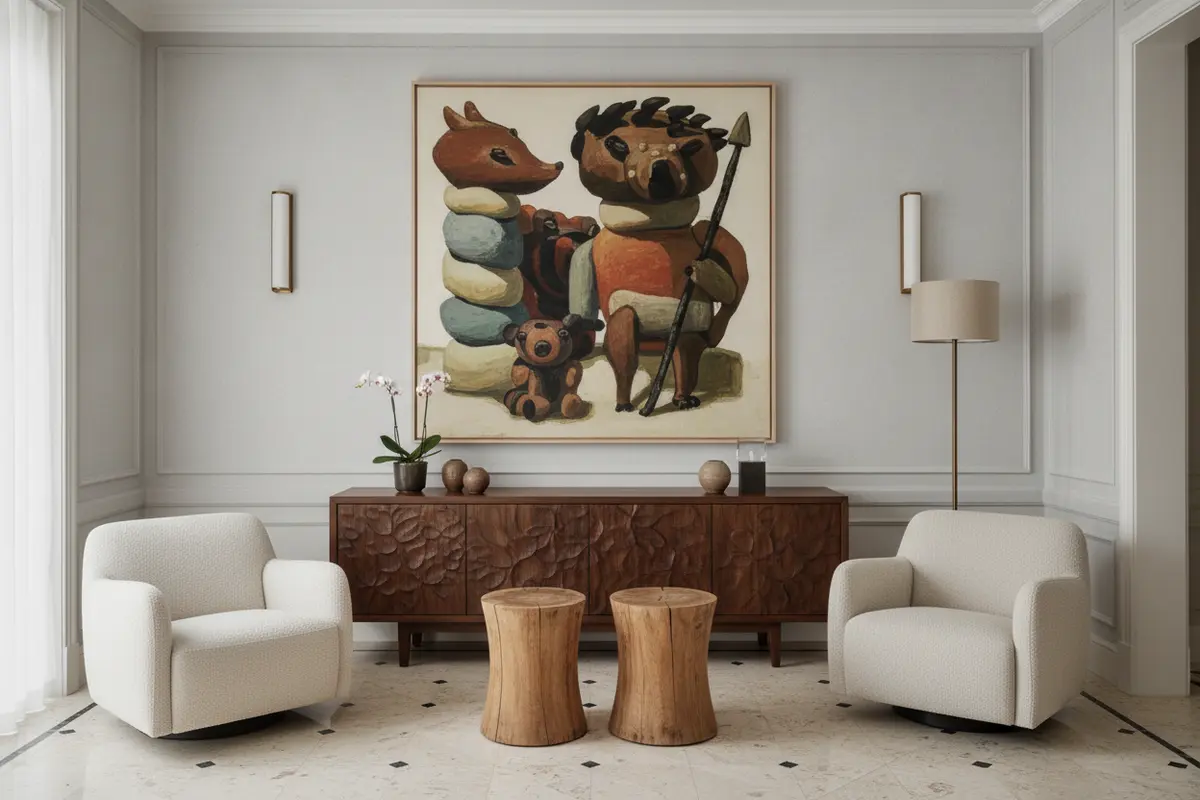
For a practical check, sketch the principal sightlines on a simple floor plan. Mark the location of significant works, doors, windows, seating, and routes between rooms. Then ask whether a person can approach the work without crossing a busy path or whether a doorway frames it unexpectedly well. This modest exercise can reveal when a display plan needs to influence furniture placement or even a broader renovation decision.
Explore how scale and proportion relate to art in a residence when a work feels either too dominant or visually lost. The goal is not to make every piece equal. It is to create a hierarchy that lets the collection be encountered with attention and allows each room to retain its own character.
Which materials and furnishings reward a longer view?
Materials with depth, integrity, and an appropriate finish often gain character through use instead of depending on novelty. Wood, stone, wool, linen, and metal can offer nuanced surfaces, but no material is automatically timeless. Its suitability depends on the room, the collection, the way the household lives, and the care the surface requires. A beautiful material used in the wrong place can feel forced; a modest one selected with care can support the whole composition.
Evaluate samples in the actual room and alongside the art. A finish can look different in morning light, late afternoon, and evening illumination. Compare it with nearby surfaces rather than judging it alone. Ask whether its texture draws attention away from a work, whether two adjacent finishes compete, and how their edges meet. Small details such as a junction between wood and stone can affect whether the overall design feels resolved.
Furnishings also need to earn their place through proportion, comfort, construction, and meaning. A sculptural chair may bring a needed counterpoint to a painting, but its scale and position still have to make sense for the room. A family piece or collectible object may carry value beyond its function; it should be integrated with care rather than forced into a matching scheme. Bespoke furniture can respond to a particular space and collection instead of imposing a standard solution.
Craftsmanship is especially visible in the details people encounter every day: the profile of an edge, a joint, a finish, a handle, or the way a door closes. Existing furniture with age or personal significance may need thoughtful repair or restoration before it can sit naturally within a new interior. Learn more about what furniture restoration involves when deciding whether a piece should be conserved, adapted, or placed elsewhere in the home.
Rather than asking whether a finish is fashionable, ask what it contributes over time. Does it improve the room’s relationship to the collection? Is it suited to daily contact? Will its surface develop a quality the household welcomes? Does it make sense beside the architecture? These questions move the decision away from novelty and toward fit, craft, and lasting use.
How do enduring choices compare with seasonal trends?
A trend is not automatically a mistake. A new color, silhouette, or material can become meaningful when it belongs to the people and place. The risk is adopting an element because it is highly visible without considering whether it serves the home. Use the comparison below to test a decision before it becomes difficult to change.
| Design decision | Enduring question | Risk to examine |
|---|---|---|
| Color | Does the palette relate to the art, architecture, and changing light? | Has a fashionable shade been repeated everywhere without being tested in the home? |
| Furniture | Are proportion, comfort, construction, and context all right for the room? | Was a recognizable silhouette chosen mainly because it is popular now? |
| Material | Does the finish suit its use, upkeep, neighboring surfaces, and the collection? | Could an unfamiliar finish dominate the room or feel out of place as the home evolves? |
| Art display | Are sightlines, spacing, light, and movement considered together? | Is art being treated as decoration after the room has already been planned? |
| Personal objects | Does each piece contribute memory, meaning, function, or craftsmanship? | Are accessories filling space simply to complete a coordinated look? |
Apply the questions to a real decision. Suppose a vivid wall color appeals to you. Before committing, place a sample beside the intended artwork and view it at different times of day. Consider whether the color clarifies the work’s presence or competes with its surface. Then look from the adjoining room: does the color create a purposeful transition, or does it interrupt the wider sequence? The answer may be to use it on one carefully chosen wall, adjust its tone, or choose another material that gives the same sense of depth.
This is a way to assess choices, not a rule that every room must be quiet. Strong color and expressive forms can be lasting when they have a reason. The aim is coherence, not restraint for its own sake. A home should feel like its owners and their collection, rather than a display of coordinated purchases.
How can the home stay personal as a collection changes?
Collections grow, rotate, and sometimes move between residences. A design that depends on one fixed arrangement may become difficult to live with when a new work arrives or an existing piece moves. Plan for some flexibility: identify more than one suitable location for selected works, keep certain walls visually calm, and avoid making every surface an exhibition space. The point is not to leave the home unfinished. It is to allow future choices without undoing the character of every room.
Think about the household’s routines alongside the art. A reception room, library, dining area, and family living room may call for different degrees of formality and different kinds of display. One room may invite close looking; another may need durable surfaces and comfortable seating for daily use. A work can be present without every room functioning like a gallery. The collection and daily life can strengthen one another when both are planned from the beginning.
For sculpture, walk the route people will actually take. Check whether it is visible at arrival, whether a person can move around it safely, and whether it blocks a view or doorway. For paintings, consider reflected light, the visual weight of nearby furniture, and whether people can sit with a comfortable view. Planning circulation around art in an open-plan home can help clarify these relationships, while thoughtful artwork lighting can support a work without making the room feel staged.
Changing a display need not mean changing the whole design. If the larger decisions are grounded in the character of the residence, a new work can be considered on its own terms. Revisit the placement, viewing distance, and surrounding objects; then adjust what is necessary rather than forcing the new piece into an old arrangement. A home with a clear point of view can evolve without losing its identity.
What sequence helps you make enduring design decisions?
A whole-home project benefits from a deliberate order. The sequence below gives each selection a context and helps prevent an early finish or furnishing choice from dictating decisions that should begin with the space and its collection.
- Take an inventory. Record important works of art, furniture, objects, architectural features, and views. Note which elements are fixed, which may move, and which pieces have particular personal significance.
- Describe how the home should work. Consider where people gather, read, dine, rest, receive guests, and move between rooms. Different spaces can support different rhythms while still belonging to one residence.
- Study the residence on site. Observe proportions, natural light, circulation, ceiling heights, and existing conditions in person. A photograph or plan can help with preparation, but experiencing the space reveals relationships that an isolated image may not show.
- Set the collection’s hierarchy. Identify which works need a focal position, which belong in a sequence, and which might be rotated. This keeps the design from treating every object as equally prominent.
- Plan room-to-room relationships. Consider views through doorways, the transition between public and private areas, and where visual quiet is needed. A whole-home composition should feel connected without making every room identical.
- Establish material direction. Compare finishes against the art and architecture. Review samples in changing light, consider touch and maintenance, and assess how materials meet one another.
- Coordinate furnishings, lighting, and practical details. Check furniture dimensions, comfort, sightlines, display needs, and how the work will be illuminated. Resolve these relationships together rather than as separate decorative tasks.
- Review before committing. Walk through the plan from the perspectives of someone entering, sitting, and moving between rooms. Test whether each choice contributes function, meaning, craftsmanship, or a needed visual relationship.
- Edit with purpose. Remove elements that add noise without helping the collection, the architecture, or daily life. Editing is not about making a home sparse; it is about letting significant things have room to be understood.
This order leaves space for discovery while asking each decision to serve the wider project. CW DESIGN’s design approach reflects the importance of understanding a residence in context. A collection-led whole-home plan can connect broad spatial decisions with the finer details of furniture and finish.
Which choices can make a timeless room feel generic?
Even thoughtful intentions can produce a room that feels anonymous if the design relies on shortcuts. Watch for these patterns during review:
- Using neutral as a substitute for considered. A quiet palette still needs depth, proportion, and a connection to the collection. Beige or white alone does not make a room enduring.
- Buying a coordinated set to finish a room quickly. A uniform group may remove the contrast and discovery that give a collector’s home its individuality. Consider the role and scale of each item instead.
- Copying a reference image without testing it against the residence. A photograph cannot show how a finish will respond to the home’s actual light, architecture, views, or daily use.
- Overfilling walls and surfaces. More objects do not automatically create a richer experience. Selective spacing can give each work presence and make a collection easier to encounter.
- Ignoring the life of furnishings. A beautiful piece still needs to suit its intended use. Comfort, access, care, and placement are part of the design, not compromises made after it.
- Making every room repeat the same statement. Continuity matters, but a residence also needs variation. Different rooms can express distinct moods while sharing materials, craftsmanship, or a visual thread.
When a room feels generic, ask what it is missing rather than adding more decoration. It may need a stronger relationship to an important work, an existing piece of furniture, the architecture, or the way the family uses the space. Often the more useful decision is to remove a distracting element or change a relationship, not to introduce another layer.
When is an on-site design review especially useful?
An on-site review is valuable when a project involves a substantial collection, complex architecture, significant existing furnishings, or a whole-home transformation. Seeing the residence directly helps reveal proportions, changing light, routes through the home, and relationships that can be difficult to judge from isolated images. It also allows the design to respond to what is actually present before choices are fixed.
This matters particularly when art and architecture need to be considered together. A painting may appear to fit on a wall in a photograph, yet the experience changes when viewed from the entrance or from a neighboring room. A furniture piece may be beautiful but alter a circulation route. A finish may look balanced in one kind of light and become too assertive in another. An in-person assessment helps these details inform a coherent plan.
Catherine Weinstock’s training spans Interior Design, Furniture Restoration, and Fine Arts, with study in Europe. That multidisciplinary background supports an approach that considers a room both as a lived environment and as a setting for objects with artistic and personal significance. See Catherine Weinstock and CW DESIGN, or explore the firm’s residential projects for examples of work across different settings.
A considered review is most useful when decisions affect one another across the residence. It can help determine how the art, furnishing plan, materials, and movement through the home should be coordinated. Rather than pursuing a succession of disconnected updates, the owner can evaluate the project as a whole and preserve the character of the collection throughout.
Begin a conversation about your residence
Frequently Asked Questions
Does timeless interior design mean avoiding color?
No. Color can be central to an enduring interior when it relates to the art, architecture, light, and people who live there. Test it in the actual space and consider how it changes through the day before settling on its use.
Can contemporary art work in a traditional residence?
Yes. The contrast can be compelling when scale, placement, lighting, and circulation are considered together. A contemporary work does not need to imitate its surroundings; it needs a thoughtful relationship to them.
Should every artwork have a dedicated wall?
Not necessarily. Some works benefit from a clear focal setting, while others belong in a sequence or in dialogue with furnishings and objects. The arrangement should let people encounter the work comfortably without making every room feel like a gallery.
How can I assess whether a design choice will last?
Ask whether it has a reason beyond current popularity, whether it suits the residence and its inhabitants, and whether its material and execution merit daily attention. No choice can be guaranteed to feel right forever, but a considered one has a stronger foundation than imitation alone.
Can a collection-led home still be comfortable for everyday life?
Yes. Planning for how people sit, gather, move, and use each room is part of integrating art successfully. Comfortable furnishings and practical circulation allow the collection to be experienced as part of a lived home.
Timelessness is personal: it grows from a residence’s particular art, objects, architecture, and daily life. When those elements are considered together, a home can evolve while remaining unmistakably itself.