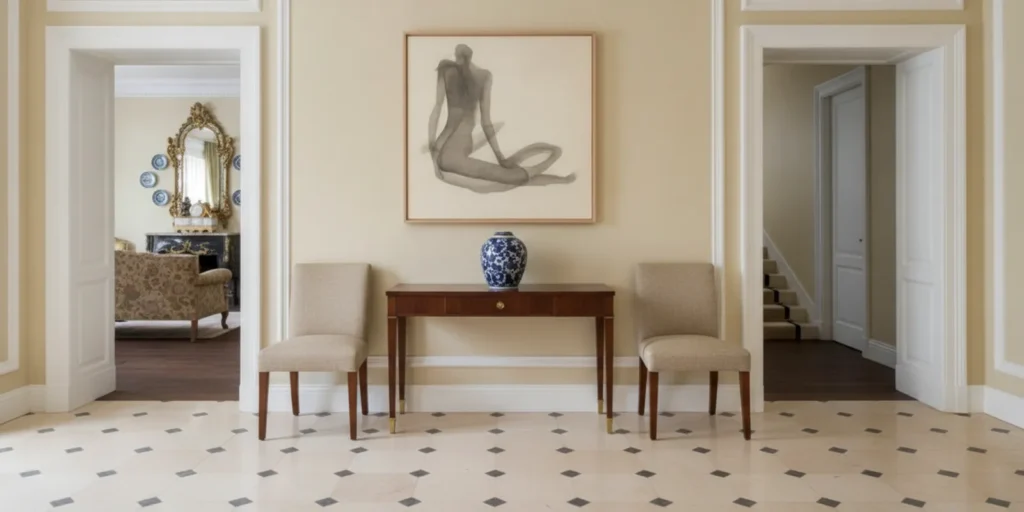
Custom millwork can give a private residence a considered architectural language while allowing art to remain the leading presence. For collectors, the question is not simply how to fill a wall, but how cabinetry, paneling, shelving and openings can support the works, the room and the rhythms of daily life. The strongest solution begins with the collection and the character of the actual home.
Discuss an on-site design project
How should custom millwork begin with the art?
Begin by understanding the works that matter most. Note their dimensions, orientation, frames, visual weight and preferred viewing distance. Consider whether they are permanent anchors, part of a changing collection, or works that need room to breathe. A large canvas, a delicate drawing and a sculptural object make different demands on the surrounding architecture.
Then consider the room in person. Existing window positions, ceiling height, doorways, natural light and circulation all affect where millwork can sit and how it will be experienced. A plan that looks persuasive in isolation may interrupt a view or make a significant work feel compressed once it is placed in the actual space. CW DESIGN’s approach to design begins with the feel and particularities of a place, rather than a remote template.
Make a simple collection inventory before discussing built elements. Include dimensions, medium, frame depth, approximate weight where known, and any display preferences. This is not a substitute for specialist installation advice. It gives the design conversation a practical starting point and helps distinguish essential requirements from aesthetic preferences. Add a note about which works may move to another room, and which are unlikely to change location. That small distinction helps the designer think about flexibility without treating every wall as a temporary display.
For each important work, record what is already known about its handling and display. Note whether the frame projects from the wall, whether a glazed surface reflects the room, and whether the work has any specific conservation instructions. The designer can then coordinate the architectural setting with the appropriate art professional rather than guessing about installation or preservation requirements.
Which millwork elements can support a collection?
Millwork is a broad term for made-to-measure architectural woodwork. In a residence, it may include wall paneling, integrated cabinets, niches, shelving, door surrounds and storage. Its value is not ornament for its own sake. Thoughtful millwork can establish rhythm, conceal everyday necessities, and provide a composed setting for art without making the home feel like a commercial gallery.
| Element | Potential role | Question to resolve |
|---|---|---|
| Wall paneling | Creates a measured architectural backdrop | Will its joints and divisions relate to the artwork’s scale? |
| Integrated storage | Contains objects and daily necessities | Can doors and hardware remain visually quiet near art? |
| Display niches | Give a sculptural object a defined setting | Are depth, visibility and safe access appropriate? |
| Open shelving | Accommodates books and selected objects | Will the display remain edited rather than compete with the collection? |
| Door surrounds | Connect adjoining spaces through repeated detail | Does the profile support the residence’s existing architecture? |
These categories can overlap, but each should have a clear purpose. A wall that must display a painting, hide equipment and store objects may need a composed combination rather than one continuous bank of cabinetry. For a deeper discussion of how architecture and art can work together, see this guide to designing a home around an art collection.
It can help to describe a wall’s priorities in order. For example, if a large painting is the anchor, the panel rhythm and cabinetry should be subordinate to its placement. If a wall also needs substantial storage, decide whether that function belongs beside the work, below it or on a neighboring surface. If the wall is a passage, the design may need to favor a clear route and an uninterrupted view over additional display. Setting this hierarchy early makes later choices about doors, open shelves and trim more coherent.

How should proportion and sightlines shape the design?
Proportion is more than matching a panel to a wall. Consider the width and height of the artwork, the margin around it, the divisions of the millwork, nearby openings and the distance from which it will be seen. A frame or panel line that falls too close to an artwork can make the composition feel pinched. A broad uninterrupted surface may offer greater calm, while a more articulated rhythm may suit a room with strong architectural character.
Review the wall from more than one position: the entry to the room, the principal seating area and the approach from adjacent spaces. The collection should be legible in ordinary movement through the home, not only from a single centered viewpoint. This is especially important in open-plan rooms, where furniture and circulation can change the way a work is encountered. See how circulation around art in an open-plan home can influence the experience of a space.
Use measured elevations and, where helpful, full-scale paper templates to test proposed positions. Mark the art outline, panel edges, cabinet doors and any adjacent switches or vents. A tape outline on the actual wall can reveal awkward conflicts before detailed fabrication decisions are made. The test should include the artwork’s frame, not just the dimensions of the canvas or paper.
For a more complete test, stand at the places where people will actually pause: beside the entry, at the principal seat and near an adjoining doorway. Notice whether a door edge or cabinet handle enters the visual field, whether a ceiling line makes the work feel crowded, and whether the composition still reads when viewed from an angle. A drawing is valuable, but it cannot replace the experience of moving through the residence. Record the questions raised by the test and resolve them before the design is treated as settled.
Which materials and finishes feel right beside art?
Material selection should serve both the work and the home’s larger character. A quiet painted finish can recede; a visible grain can add warmth and texture; a more pronounced profile can connect to historic detailing. The right choice depends on the collection, architecture, daylight and furnishings. Rather than selecting a finish because it is fashionable, compare actual samples in the room and observe how they read beside the art at different times of day.
Pay attention to sheen and contrast. A highly reflective surface may draw attention away from a work or create distracting highlights. A strong color can be compelling when it has a relationship to the art or the residence, but should not be used simply to announce the millwork. Finishes also age and gather marks differently, so consider how the surface will live with regular use.
Compare samples against more than one part of the composition. Place them beside the frame, against the floor and near an existing furnishing that will remain. Look at them in daylight and under the room’s evening illumination. A finish that seems subtle alone may become conspicuous beside a particular artwork; another may bring together woodwork, furniture and art without drawing attention to itself. This is a useful point to assess the whole palette, not just the millwork in isolation.
For antique or valuable furniture incorporated into the composition, restoration needs may differ from the requirements of built-in work. CW DESIGN’s multidisciplinary background in interior design, furniture restoration and fine arts informs a careful consideration of these relationships. Learn more about what furniture restoration involves when existing pieces are part of the design conversation.
How can millwork and lighting be coordinated?
Lighting should be considered early, not added after the millwork is complete. The position of a picture light, recessed fixture or track head can affect panel divisions, cabinetry and ceiling details. At the same time, the artwork’s medium, surface and framing matter when deciding how light should reach it. Avoid assuming that one fixture type or angle suits every work.
Natural light deserves equal attention. Windows can create changing brightness, reflections and strong contrasts across a wall. Observe how sunlight moves through the space, and consider the position of the work relative to the window and common viewing paths. For further guidance, read about lighting artwork in a luxury home.
Lighting choices for art should be made with conservation needs in mind. The National Park Service guidance on light and museum objects explains that light exposure can harm collection materials. This is a useful reminder to consider sensitivity and exposure rather than treating illumination as purely decorative; a conservator can advise on a particular work.
During design review, consider the entire lighting path: where a fitting can be placed, how it will be reached for adjustment or maintenance, and whether it creates glare from a principal seat. Check whether a proposed fixture interrupts a panel line or competes with a frame. For a work that is especially light-sensitive, use the guidance of a conservator or other qualified specialist to inform display decisions. The aim is a considered balance between visibility, atmosphere and the needs of the object, not simply maximum brightness.
What should be planned for storage and daily use?
Art-led design still has to support the ordinary functions of a home. Decide what must be stored, what should remain accessible and what can be concealed. The balance matters: too much open display can compete with art, while an undifferentiated closed wall can feel heavy or make a room less useful. Integrated storage is most successful when its purpose is clear and its visual presence is carefully judged.
Consider door swings, drawer access, cleaning and the way people move through the room. If a niche or shelf is intended for sculpture, account for its depth and the way it will be approached and seen. A valuable object should not be placed where doors, traffic or routine activity make it vulnerable. Any mounting or installation requirements for artwork should be confirmed with the appropriate art handler or specialist.
A practical way to assess storage is to list what belongs in the room, then separate items that need frequent access from those that can be concealed. Test the proposed cabinet locations against how the room is used: will an open door obstruct a route, hide a work or interrupt a seating arrangement? Are shelves intended for a deliberate selection of books and objects, or are they likely to become general-purpose storage? These questions help the built elements remain useful without allowing functional clutter to compete with the collection.
Look across the whole home, too. Repeating one detail everywhere may be less effective than allowing a few related gestures to connect rooms while preserving their individual character. CW DESIGN prioritizes whole-home and entire-apartment commissions, where a sequence of spaces can be considered together. Explore luxury residential interior design and the firm’s residential projects for more context on a collected approach.
How can you review millwork before fabrication?
Before details are fixed, bring the decisions together in a review of the room, not a collection of disconnected samples. A useful review includes the measured wall, proposed art locations, cabinet and door operation, material samples, lighting positions and the main viewing angles. Ask what each element is doing and whether it supports the collection, the architecture or daily use. If a detail has no clear role, consider whether it can be simplified.
Check the points where different trades and functions meet. A cabinet edge may need to align with a panel division; a light fitting may need a clear relationship to the artwork; a door may need room to swing without crossing a display area. Resolve such junctions while plans can still be refined. At this stage, also note any specialist information still needed from an art handler, conservator or other professional. Clear coordination reduces the chance that the finished wall asks the art, lighting or storage to accommodate a decision made in isolation.
For example, imagine a living room with one large framed work, a pair of smaller pieces and a need to conceal media equipment. Rather than giving every item equal prominence, establish the large work as the principal anchor, then determine whether the smaller works belong on an adjacent wall or within the same visual sequence. Place storage where it serves the room without dividing the main artwork awkwardly. Test the proposal from the entry and sofa before choosing the final finish. This kind of ordered decision-making is more useful than beginning with a decorative profile and trying to fit the collection around it.
What sequence helps plan custom millwork?
- Clarify the collection. Identify key works, dimensions, preferred locations and any known display constraints.
- Understand the residence. Review architecture, daylight, circulation, furniture and daily needs on site.
- Set priorities for each wall. Decide what should lead: artwork, storage, architectural rhythm, or a carefully balanced combination.
- Test proportions. Use measured drawings or temporary outlines to check spacing and sightlines from real viewing positions.
- Compare materials in context. Assess finish samples beside the artwork and existing surfaces, in changing light.
- Coordinate details. Resolve lighting, access, hardware, storage and specialist installation needs before fabrication decisions are fixed.
- Review the whole composition. Confirm that the millwork supports the collection and the residence, rather than treating either as an isolated feature.
This sequence does not make every project identical. Existing architecture, the character of the collection and the owner’s expectations will shape the decisions. A bespoke result comes from attending to those particulars, not from applying a standard panel system to every room.
For a whole-home commission, the sequence may also be repeated across connected rooms. First establish the works and architectural conditions that are unique to each space. Then look for a restrained detail, finish or proportion that can create continuity without making every room feel alike. That is particularly valuable when the collection moves between public and private areas of the home: the design can preserve a coherent character while giving each work the setting its scale and presence require.
What choices can make millwork compete with art?
- Designing the wall before understanding the work. A fixed grid may not suit the scale or framing of the collection.
- Adding detail without purpose. Profiles, moldings and finishes should reinforce a considered composition, not crowd it.
- Ignoring the room in use. A beautiful elevation may fail if circulation, doors or daily storage are overlooked.
- Choosing finish from a small sample viewed elsewhere. Light and neighboring materials can change its appearance significantly.
- Planning lighting at the end. Late coordination can compromise both the millwork and the quality of the art’s presentation.
- Treating a residence as a gallery alone. A home must remain comfortable and practical while giving the collection its due attention.
These are not reasons to avoid architectural detail. They are reasons to give each decision a clear relationship to the art, the home and the people who live there. When a wall feels too busy, step back and identify which element is competing for attention. The answer may be to quiet the finish, reduce the number of open displays or reconsider a division that cuts across the artwork’s visual field.
When is an on-site review especially useful?
An on-site review is valuable when the work is already in the home, when light changes substantially across a wall, or when existing architecture creates constraints that drawings alone cannot convey. It is also useful when furniture, art and built elements must be considered as one composition. Catherine Weinstock’s training spans interior design, furniture restoration and fine arts, with European study credentials; that breadth supports a collection-first conversation grounded in the particulars of the residence.
For a substantial whole-home or apartment commission, the aim is not simply to add millwork. It is to create an enduring setting in which architecture, furnishings and art feel resolved together. Learn more about interior design for art collectors, or contact CW DESIGN to discuss an on-site project.
During an on-site discussion, it is useful to have the collection inventory, any available room plans, photographs of adjoining spaces and notes about daily routines at hand. The visit can then consider what a drawing cannot fully communicate: how a room feels on approach, how its light changes and how the artwork relates to surrounding furnishings. For a considered residence, these observations help keep the decision-making specific to the home rather than importing a template.
Arrange a conversation about your residence
Frequently Asked Questions
Is custom millwork only for traditional interiors?
No. The form, finish and level of detail can be considered in relation to the residence, whether its architecture is historic or contemporary. The key is to make the millwork feel integral rather than applied without regard to the space.
Should millwork be designed before choosing the artwork?
For an art-led residence, it is important to understand the collection before fixing the millwork design. The works’ dimensions, framing and intended locations can shape proportions and practical requirements. If a collection is still evolving, the design should account for that reality rather than presume a single fixed arrangement.
Can cabinetry and art share the same wall?
Yes, when their roles and proportions are considered together. Storage can sit adjacent to an artwork or form part of a larger composition, but doors, hardware and visual divisions should not overwhelm the work or compromise access.
Does every artwork need dedicated lighting?
Not necessarily. Lighting depends on the work, room, daylight and desired viewing conditions. Consider conservation as well as appearance, and seek specialist advice for works with particular sensitivities.
What is the first step toward planning bespoke millwork?
Gather basic information about the collection and the residence, then arrange an on-site conversation to understand the space. A thoughtful plan can then address art, architecture, materials and daily use together.
Well-considered custom millwork does not ask the collection to adapt to the room; it gives the home a quieter, more purposeful framework in which art and daily life can belong together.
Pingback: Architectural Interior Design for Renovations