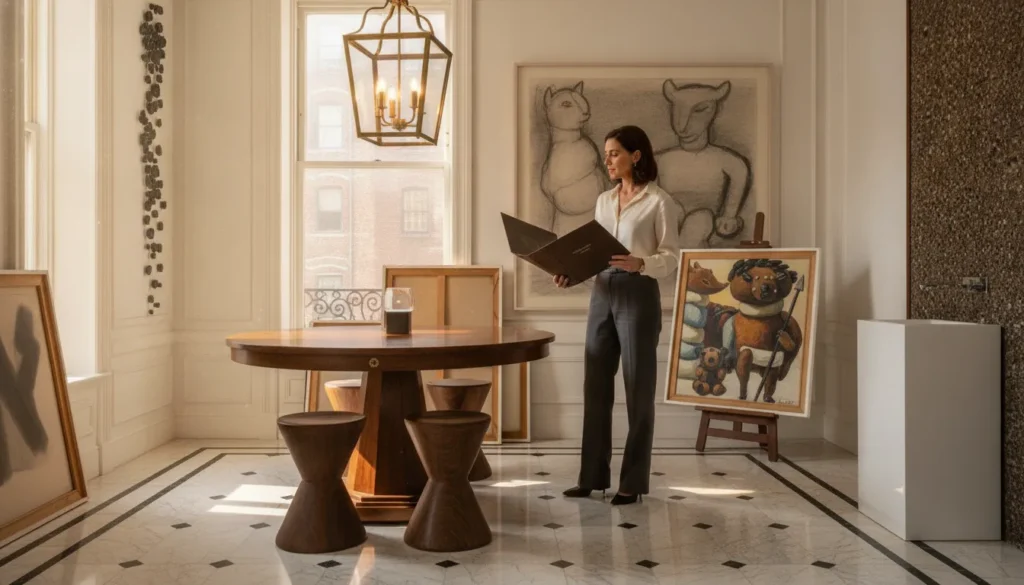
Before a substantial residence can be shaped around an art collection, the collection itself needs to be made legible.
That does not mean turning a private archive into a museum register. It means gathering the information, priorities, and personal relationships that will allow a designer to understand what must be considered before the first spatial decision is made.
Interior design starting with art collection begins with a clear record of the works, their current circumstances, and the collector’s intentions for living with them. A thoughtful inventory gives the ensuing conversation substance without replacing professional appraisal, conservation, insurance, or legal advice.
This preparation is especially valuable when a collection is moving from storage to display, expanding through new acquisitions, or entering a new home. CW DESIGN’s art-first approach treats the collection as a source of direction, while this guide focuses on the practical readiness that comes before an engagement. The first step is to define what the record should help the designer see.
Contact CW DESIGN to discuss preparing an art-focused residential project.
What Does Interior Design Starting With Art Collection Mean Before Design Begins?
Before a room is planned, a collection-first engagement begins with understanding what exists. What may be acquired, and what the collection means to the people who live with it. In practical terms, interior design starting with art collection means preparing a clear, considered record that can guide an early design conversation. It is not yet a scheme for furniture, finishes, lighting, or placement.
The preparation is especially valuable when a collector is moving into a new property, planning a significant acquisition, expanding a collection, or bringing works out of storage. A useful inventory gives the designer a view of the collection as a whole, rather than presenting isolated pieces without context. It can include personal attachments, display priorities, anticipated acquisitions, and spatial constraints, creating a more meaningful basis for discovery.
What is the purpose of the pre-engagement inventory?
Question: Is the inventory meant to determine the final design?
Answer: No. It is a conversation tool. It helps clarify which works are central, which may rotate, what requires particular attention, and how the collection may develop alongside the residence. It does not replace professional appraisal, conservation, insurance, or legal advice.
This distinction keeps the early work focused. The goal is not to turn a home into a gallery or to prescribe a display system before the designer has experienced the property. It is to make the first on-site conversation more informed. Preserving the collector’s knowledge and priorities while leaving room for the architecture, daily life, and relationships between works to be understood together. For broader context, see this broader guide to designing around an art collection.
What Should an Art Collection Inventory Include?
A useful inventory is less a formal catalogue than a clear working record for the first conversation. It gives a designer an accurate view of what exists, what may be acquired, and which works carry particular importance before an on-site engagement begins. For an approach to interior design starting with art collection, the record should make the collection legible without pretending to replace specialist advice.
- Identification: artist or maker, title or description, medium, approximate date when known, and dimensions.
- Condition and documentation: visible condition notes, provenance or other records available, restoration history, and the location of supporting documents.
- Current circumstances: present location, framing or mounting, whether the work is in storage, and any known handling sensitivities.
- Collector priorities: pieces that must be considered, works intended for rotation, display preferences, personal attachments, and possible future acquisitions.
Photographs can make the record more useful, particularly when they show the full work, frame, and any obvious condition concern. They do not need to be treated as a final visual assessment. The purpose is to support a precise conversation about the collection, its relationships, and the practical constraints of the residence.
| Record | Primary purpose | Useful before design discussions |
|---|---|---|
| Inventory | Tracks what exists and what matters to the collector. | Yes. It creates a shared starting point. |
| Appraisal | Provides a specialist opinion of value. | Only when valuation is separately required. |
| Condition report | Documents a work’s physical state. | Useful where condition needs specialist review. |
| Insurance or legal record | Supports coverage, ownership, or formal obligations. | Gather existing records. Seek qualified advice. |
Q: Does every work need a complete catalogue entry?
A: No. Begin with enough information to identify each work, understand its current circumstances, and distinguish essential priorities from pieces that may rotate or be acquired later. An incomplete entry is preferable to an invented detail. An inventory is a conversation tool, not a substitute for professional appraisal, conservation, insurance, or legal advice.
How Can You Organize the Collection for a Whole-Home Conversation?
Once the works are recorded, organize them in a way that reveals how you live with the collection. The purpose is not to prescribe rooms or settle display decisions in advance. It is to give a designer a clear view of what matters most across the residence.
Begin with priorities. Identify works that must be experienced regularly, pieces with particular personal significance, and objects that may require more deliberate handling or placement. Then note relationships: works that belong together, those that create a meaningful contrast, and pieces whose scale, medium, or history makes them part of a larger conversation. CW DESIGN’s approach seeks dynamic interactions between artworks rather than treating each work as isolated. A considered inventory makes those relationships visible.
- Core works: pieces that should shape the overall conversation.
- Related groups: works connected by artist, period, story, medium, or personal association.
- Rotation: pieces to display seasonally or exchange as the collection evolves.
- Future acquisitions: anticipated additions that may affect the home’s long-term planning.
- Daily experience: how the collection should be encountered while the residence is being lived in, not merely visited.
This organization is especially useful when preparing for a new property, a significant acquisition, or a transition from storage to display. It also acknowledges that a whole-home collection is not static. Collection-first planning can accommodate growth and rotation while integrating art into everyday life. Read more about CW DESIGN’s art-first approach and its perspective on curating art for a residence.
Q: Should every work be assigned to a room?
A: No. Record priorities and relationships first. Room assignments are better considered after the collection, architecture, and lived experience can be discussed together on site.
What Should Collectors Gather Before an On-Site Design Visit?
A considered visit begins with a clear record of the collection and the life it needs to support. Preparation does not require a polished catalogue. It gives the conversation enough substance to distinguish what is essential, what is changing, and what remains open.
- Photograph the works. Take clear photographs of each piece, including the full front, frame, and any visible condition concern. If a work is in storage, photograph its current setting as well. These images help establish the collection’s scope before the designer experiences the residence in person.
- Gather existing records. Bring available invoices, provenance or ownership documentation, certificates, artist information, dimensions, framing details, and restoration records. Do not delay the visit because a record is incomplete. Mark what is confirmed and what still needs to be located.
- Note acquisition plans. Identify works expected to arrive, pieces under consideration, and areas of the collection that may grow or rotate. A collection-first process should account for the present group without treating it as permanently fixed. CW DESIGN’s documented discovery process considers both the existing inventory and acquisition plans.
- Write down priorities and questions. Note the works that must be accommodated, pieces with particular personal significance, and any preferences about privacy, access, or how the collection is lived with. Record questions about the residence, the sequence of decisions, and what information the designer will need from other professionals.
- State constraints plainly. Include the property’s current status, anticipated move or renovation, storage concerns, access limitations, and any known sensitivities. This is especially useful for a substantial residence where the collection, architecture, and daily routines need to be considered together.
Q: Is this inventory an appraisal or conservation assessment?
A: No. It is a preparation and conversation tool for an on-site design engagement. It is not a substitute for professional appraisal, conservation, insurance, or legal advice. When a work raises a specialist question about condition, value, handling, documentation, or coverage, consult the appropriately qualified professional. The design conversation can then proceed with that guidance in view, without claiming authority it does not have.
For collectors preparing an art-led residence, this modest record can make the first meeting more precise while leaving room for discovery on site. It also creates a useful bridge to interiors for contemporary art collectors when the collection includes works with distinct practical or personal requirements.
When Is the Inventory Ready for a Collection-First Engagement?
The inventory is ready when it can support a considered conversation, not when every field is perfect. A useful record gives the designer a clear view of what exists, what may be acquired, what must remain together, and what the collection needs from the residence. It should also make visible the questions that only an on-site visit can answer.
For a substantial home, that means bringing together the works, the architecture, and the way the clients live. CW DESIGN’s discovery process considers the collection inventory and acquisition plans alongside lifestyle requirements, personal narratives, aesthetic preferences, and functional needs. The inventory is therefore a starting point for dialogue rather than a form to complete in isolation.
Signs that the record is ready
- Existing works are listed with practical identifying details and current locations.
- Priority works, personal attachments, and pieces that should remain together are noted.
- Potential acquisitions, rotation plans, and unresolved questions are clearly marked.
- Photographs and available documentation are gathered, with gaps left honestly visible.
- The residence or prospective residence is identified, including constraints that may affect the conversation.
At that point, the next step is not to solve the rooms from a spreadsheet. It is to meet in the residence and examine how the collection meets the actual place: its proportions, transitions, natural light, circulation, and daily life. CW DESIGN works on site because those qualities cannot be understood fully at a distance. The visit allows the inventory to become specific to the home, while preserving the relationships and priorities that give the collection meaning.
This preparation complements, rather than replaces, the broader guide to designing around an art collection. It also does not constitute appraisal, conservation, insurance, or legal advice. Those questions belong with the appropriate specialists.
Q: Does the collection need to be completely catalogued first?
A: No. A thoughtful, usable record is more valuable than a polished document that conceals uncertainty. Mark missing information, works in storage, anticipated acquisitions, and decisions still under consideration. The purpose is to make the first on-site conversation more informed and more useful.
Contact CW DESIGN to discuss the next step for your collection and residence.
Frequently Asked Questions
How do you inventory an art collection before an interior design engagement?
Begin with one record for each work. Note the artist or maker, title or description, medium, dimensions, condition observations, available provenance or documentation, current location, framing, display preferences, and any priority or sensitivity. Add a photograph and identify works that may be acquired, rotated, or moved from storage. The inventory should make the collection legible for a considered conversation, not turn it into an appraisal.
What photographs and records should a collector gather?
Photograph each work clearly, including its frame where relevant, and gather existing invoices, catalogues, provenance papers, condition reports, restoration records, and acquisition notes that you already have. Label files consistently so the image and record can be matched to the inventory entry. Do not create documentation simply to fill a field. Note when information is unavailable, since that is more useful than an unsupported assumption.
Is an inventory the same as an appraisal or conservation assessment?
No. An inventory is a planning and conversation tool. It does not replace professional appraisal, conservation, insurance, or legal advice. If a work raises questions about value, attribution, condition, handling, or coverage, bring the question to the appropriately qualified specialist. Do not ask the design inventory to answer it.
When should I contact an interior designer about the collection?
Begin the conversation when you are planning a new property, a substantial renovation, a significant acquisition, collection growth, or a transition from storage to display. The record does not need to be perfect. It is most useful when it captures your attachments, priorities, acquisition plans, and spatial constraints. An on-site discovery can then consider the collection alongside the way the residence will be lived in.
Begin With the Collection
A thoughtful inventory gives an art collector a clearer starting point, but the residence supplies the context no spreadsheet can capture. If you are preparing a substantial home, planning for a growing collection. Or considering how existing works should be lived with, the next step is an informed conversation on site.
CW DESIGN brings together interior design, furniture restoration, and fine arts expertise to develop bespoke environments where art and daily life can exist in dialogue. The work is consultative, considered, and shaped around the particular collection and residence.
Contact CW DESIGN to begin a conversation about your art-focused interior design project.