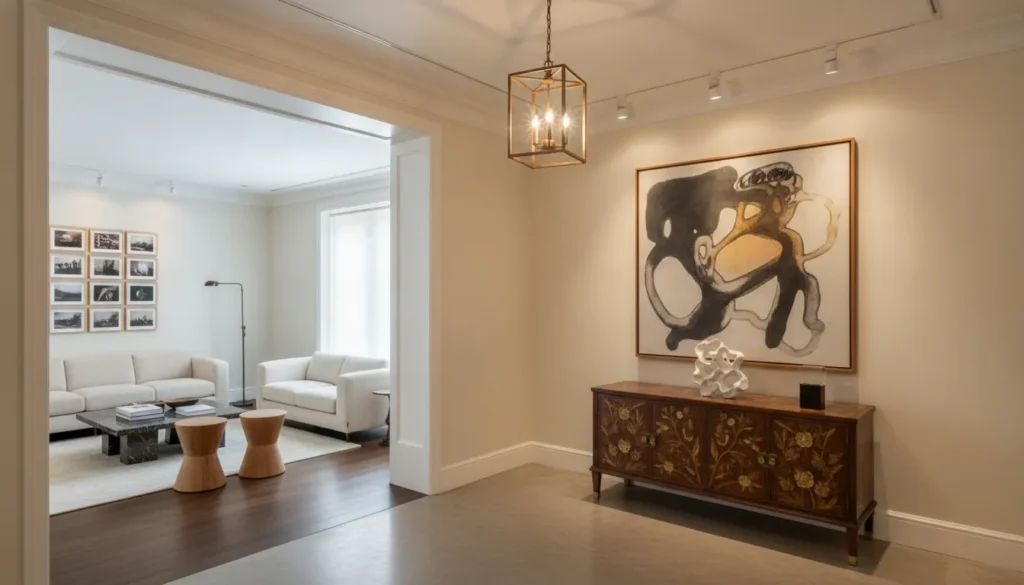
A private residence should not be treated as a neutral backdrop for art. In a considered New York home, the collection informs proportion, circulation, light, materials, and even the way rooms unfold from one another. The process begins before a single work is hung, with a close understanding of what the client owns. What they hope to acquire, and how they want to live with it.
For collectors, curating art for private new york residence means shaping an evolving collection and its setting as one coherent, personal whole, from first acquisition through final installation.
This is the distinction between selecting individual works and building a residence around connoisseurship, memory, and dialogue. A collection-first approach allows existing pieces and future acquisitions to guide the design while preserving the calm, practical experience of daily life. The first question, therefore, is not simply what to buy, but how each work belongs to the larger story of the home.
Begin a conversation with CW DESIGN about your art-centered residence
Buying Art Is Not the Same as Curating a Residence
Buying a work of art is an individual decision. Curating a residence is a longer conversation between the collection, the architecture, and the life unfolding within the rooms. The distinction matters because a residence-wide collection should feel intentional without becoming static or overly arranged.
The first question is not simply what should be acquired next. It is what the collection is saying as a whole. Existing inventory, the client’s personal narrative, aesthetic preferences, and future acquisition plans all belong in the discovery process. One work may establish a point of color, material, period, or scale. Another may create a productive contrast. The goal is to understand the relationships among the works, then give those relationships room to develop throughout the home.
This approach also recognizes that art is lived with. A New York townhouse, brownstone, loft, apartment, or estate has its own circulation patterns, proportions, light, and daily rituals. The placement of a work must support the architecture and the way people move through it. A collection may require moments of concentration, where a piece has space to be considered. As well as quieter transitions that allow the eye to move naturally from one room to the next. The residence becomes a setting for the collection, not a neutral container.
Discovery begins with what is already there
A thoughtful review of the existing collection can reveal gaps, recurring interests, and opportunities for dialogue. It can also clarify which works should anchor important spaces, which might be rotated, and where future acquisitions could belong. This is practical planning, not an attempt to force every object into immediate display. Some pieces may need a more restrained setting, while others can provide a starting point for custom furnishings, finishes, lighting, or architectural details.
Curating art for private New York residence projects therefore means planning for continuity as well as arrival. The design should accommodate the collection as it exists today while leaving room for it to grow and change. Strategic placement and carefully considered lighting can strengthen the viewing experience, but they should remain subordinate to the character of the work and the atmosphere of the home.
CW DESIGN’s bespoke design for art collectors treats this integration as part of a complete, on-site residential process. The result is not a series of decorated rooms, but a cohesive environment in which collected works, craftsmanship, and daily life remain in conversation.
| Buying an individual work | Curating a residence |
|---|---|
| Focuses on one artwork and the immediate decision. | Considers the collection, architecture, daily life, and future acquisitions together. |
| May begin with the work in isolation. | Begins with relationships among works, rooms, sightlines, scale, and light. |
| Ends when the purchase is complete. | Continues through planning, sourcing, installation, and collection growth. |
How Curating Art for a Private New York Residence Shapes the Home
For a serious collector, curating art for private new york residence is not a matter of finding a wall for each work. It is an architectural and sensory question: how should the collection meet the rooms, and how should the rooms allow the collection to be lived with every day?
That decision begins with space planning. The dimensions, orientation, and visual weight of each work inform the rhythm of the home. A painting may need a quiet wall and a longer approach, while a sculpture may require room to be encountered from several directions. In a New York apartment, loft, brownstone, or townhouse, circulation must remain gracious. Doorways, furnishings, windows, and transitions between rooms are considered in relation to the collection rather than treated as separate problems.
Scale, sightlines, and material dialogue
Strategic placement can create dialogue between pieces without making the interior feel like a crowded gallery. Sightlines are studied from the entry, principal rooms, and the places where the household naturally pauses. The goal is not uniformity. It is a sequence of discoveries, with scale and spacing giving each work the attention its character requires.
Materials are selected with the same restraint. Bespoke cabinetry, wall treatments, furnishings, and architectural details can establish a calm setting for art, while finishes and textures bring warmth to the experience of living alongside it. Custom elements should support the collection’s presence, never compete with it. Lighting is similarly integrated into the design, balancing atmosphere, practical use, and a considered viewing experience.
Discovery must happen on site
A collection-first commission depends on seeing the residence in person. Discovery includes the existing art inventory, acquisition plans, lifestyle, personal narrative, functional needs, and spatial constraints. On-site observation reveals how daylight moves through the rooms, where circulation feels natural, and which relationships between works may emerge as the plan develops. That attention is especially important when working with historic New York properties, where architecture and approvals can shape what is possible.
Catherine Weinstock’s training in Interior Design, Furniture Restoration, and Fine Arts informs this integrated perspective. Her work brings together spatial planning, art curation, custom fabrication, lighting, and installation oversight so that the finished home feels collected rather than decorated. Explore bespoke design for art collectors to see how a residence can be shaped around the works that matter to its owner.
How Galleries and Advisors Support the Acquisition Process
A thoughtful acquisition begins with clarity about the work itself and the role it will play in a larger collection. The gallery can provide context about an artist’s practice, available works, provenance materials, and the practical steps required to place a work with a collector. An art advisor may help define a collecting direction, identify opportunities, and coordinate conversations across the market. Their specialist knowledge is distinct from the work of an interior designer.
The designer’s responsibility is to understand how a prospective work will live within the residence. That means considering the architecture, natural light, circulation, sightlines, furnishings, and the dialogue between the new acquisition and pieces already owned. A work can be compelling in isolation yet require a different wall, scale, or neighboring palette to feel fully at home. The question is not simply whether a piece is desirable. It is whether it contributes to the character and continuity of the collection as it is experienced every day.
Keeping specialist roles clear
Galleries and advisors may offer expertise related to artists, market context, acquisition logistics, and documentation. Collectors should rely on appropriately qualified professionals for financial, legal, appraisal, authentication, or conservation questions. Spatial curation is another discipline. It addresses the relationship between the artwork and the rooms around it, without replacing the independent advice needed to evaluate a transaction or a work’s condition.
For a whole-home commission, these conversations should be brought into the design process at the right moment. Existing inventory and future acquisition plans can inform room proportions, wall preparation, lighting, storage, security, and the selection of materials. This is especially valuable in a New York townhouse, loft, apartment, or historic residence, where architecture and movement through the home shape how a collection is encountered.
Building a considered network
CW DESIGN’s documented access to international galleries and artisan workshops can support this broader process. Gallery Fumi and Dutko Gallery Paris are among the named examples in the firm’s materials. They should be understood as part of an international sourcing context, not as a guarantee of availability, endorsement, or a substitute for the collector’s own due diligence.
Catherine Weinstock’s training in Interior Design, Furniture Restoration, and Fine Arts, together with her early familiarity with collected art and objects, informs the conversation between acquisition and interior. The aim is a residence where each work has room to speak. While the collection remains connected to the client’s life and to the evolving architecture of the home.
The Installation Brief Before a Work Is Hung
A considered installation begins well before a frame reaches the wall. The brief brings the collection, the architecture, and daily life into the same conversation. It records what must be understood, coordinated, and resolved so that the final placement feels inevitable rather than improvised. For a serious New York residence, that preparation also creates a calm chain of communication among the client. Designer, fabricators, delivery teams, and any specialists involved with the work.
- Review condition and handling requirements. Begin with the information available about each work’s condition, framing, dimensions, weight, and handling sensitivities. The designer can coordinate with appropriate handlers or other specialists when needed, without presenting the installation process as regulated conservation. Clear instructions help determine how a work should be moved, protected, unpacked, and positioned.
- Confirm scale and sightlines. Record the wall, ceiling, furniture, and passage dimensions, then consider the work from the approach a person will actually take through the room. A large canvas may need visual breathing room, while a smaller work may belong within a more intimate sequence. Sightlines should connect rooms and allow individual pieces to retain their presence.
- Plan the light. Review daylight, glare, reflections, shadow, and the behavior of the room after dark. Lighting should support the work without flattening its atmosphere or competing with adjacent pieces. The brief should identify fixture locations, aiming, controls, and any coordination required with the architectural and electrical teams.
- Specify hardware and wall preparation. The substrate, mounting method, hanging hardware, fasteners, and clearances must suit the work and the building. In a townhouse, loft, apartment, or historic property, the team may also need to coordinate with the architect and address relevant approvals. These details are quiet, but they determine whether the installation is secure and visually disciplined.
- Coordinate security and access. Note alarm coverage, discreet security measures, elevator dimensions, stair turns, door clearances, loading restrictions, and the privacy required during delivery. A beautiful placement depends on a practical route into the residence, especially in the varied building conditions of New York.
- Schedule delivery and fabrication coordination. Full-service work may extend from concept through sourcing, fabrication coordination, installation, and completion. Align delivery windows with the readiness of the room, protective coverings, trades, lighting, and any custom elements. This sequencing prevents the collection from arriving before its setting is prepared.
- Review final placement on site. Once the work is positioned, assess it at standing and seated perspectives, in relation to neighboring pieces, furniture, circulation, and changing light. Small adjustments in height, spacing, or orientation can restore the intended dialogue across a room. For further guidance, see this approach to displaying fine art at home.
The result is not simply a safely hung object. It is a residence in which every placement supports the collection’s larger rhythm and the way the owner lives with it.
Designing for a Collection That Will Continue to Grow
A considered residence must accommodate more than the works already on the walls. It should leave room for the collection’s next chapter, whether that means a significant acquisition. A change in the client’s priorities, or a new relationship between pieces that have been lived with for years. This is one of the quiet disciplines of curating art for private New York residence projects: designing for what is present while allowing the home to remain responsive.
Make rotation part of the design
Not every work needs to be visible at once. A thoughtful rotation strategy can give paintings, sculpture, works on paper. And objects their proper moment without making the home feel like a storage facility or a gallery installation. Display surfaces, hanging systems, cabinetry, and circulation routes can be considered together so that a work may move to a different setting without disrupting the room around it.
Flexible display does not mean anonymous display. The scale, material, and architectural character of each space should continue to support the collection. A calm salon may reward a concentrated grouping, while a long passage, stair hall, or library can create a measured sequence. The goal is to preserve dialogue among works and make looking at art part of daily life, rather than reserve it for formal entertaining.
Plan for future acquisitions with care
During discovery, existing inventory and acquisition plans belong in the same conversation as lifestyle and spatial needs. Future works may alter the balance of a room, introduce a different scale, or call for a new approach to light and sightlines. Planning for that possibility can influence wall proportions, clearances, furnishings, and the placement of architectural details from the beginning.
Lighting, climate control, and security should be addressed with the appropriate specialists and with attention to the individual collection, the building, and the way the rooms are used. There is no universal prescription that suits every work or residence. A designer’s responsibility is to coordinate these considerations without allowing technical requirements to overwhelm the atmosphere of the home.
Carry one narrative through the whole residence
Continuity matters whether the commission involves a New York townhouse, brownstone, loft, apartment, or larger residence. Each property has its own proportions, history, thresholds, and natural movement. The collection can provide a unifying thread across those differences, with materials, color, furniture, and placement creating a coherent progression rather than a series of unrelated rooms.
CW DESIGN’s New York art collector interiors approach treats the home and collection as a developing whole. That perspective allows the residence to feel settled today while remaining open to the discoveries, exchanges, and acquisitions that will shape it over time.
Discuss an on-site, collection-first commission with CW DESIGN
Frequently Asked Questions
How do you select the right artists for a private residence?
Selection begins with the collector’s existing works, sensibility, and plans for the residence. The aim is not to fill empty walls, but to build a coherent dialogue among artists, periods, materials, scale, and the architecture. Galleries, advisors, studio visits, and carefully considered commissions may each play a role, depending on the collection and the project’s direction.
What is the difference between buying art and curating a residence?
Buying art focuses on an individual work. Curating a residence considers how the collection will live as a whole, including narrative, sightlines, circulation, light, furnishings, and the character of each room. It also anticipates future acquisitions, so the home can develop without losing its balance or the collector’s point of view.
Do you handle art installation and logistics?
A full-service residential design process may extend from concept and sourcing through fabrication coordination, installation, and completion. Installation planning can include placement, scale, lighting, hardware, movement through the property, and coordination with the relevant project team. The work is carried out on site, where the space and the collection can be understood together.
How should I prepare for a collection that will continue to grow?
Share both the current inventory and your acquisition intentions at the beginning. Flexible display strategies, adaptable lighting, considered storage, and clear relationships between rooms make it easier to introduce new works or rotate existing ones. The strongest plan leaves room for discovery while preserving a timeless, composed feeling throughout the residence.
How do I begin an art-centered residential project?
Begin with an on-site conversation about the collection, the property, the works you hope to acquire, and how you want to live with them. That discovery establishes the design direction and clarifies where galleries, advisors, artisans, architects, and installers may contribute. From there, the process can be shaped around the residence rather than imposed as a predetermined display scheme.
Begin a Conversation About Your Residence
For a private New York residence, an on-site conversation can bring the collection, architecture, and future direction of the home into one considered view. CW DESIGN approaches each commission with a curated, art-centric perspective, from early acquisition discussions through final installation. To discuss your residence and the possibilities for a bespoke whole-home commission, contact CW DESIGN.