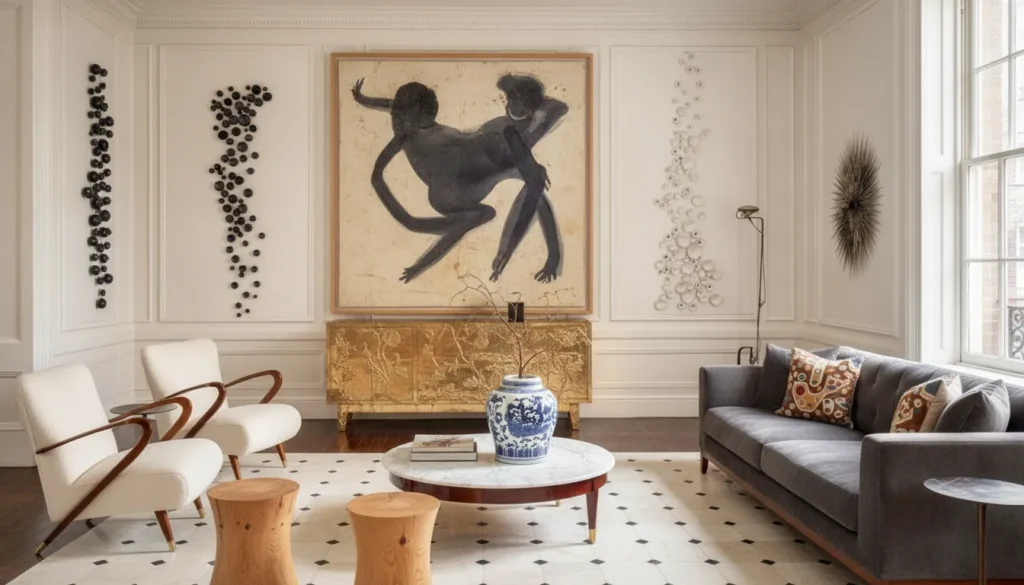
In a Brooklyn home, a significant collection does more than occupy wall space. It shapes the atmosphere, rhythm, and meaning of the rooms around it. The right art collection interior designer brooklyn understands that a townhouse, loft, or apartment must support both daily life and the distinct character of each work.
The most successful collection-led interiors begin with the artwork itself. Scale, sightlines, light, circulation, furnishings, and materials are then composed around the collection, so the home feels cohesive rather than staged. This art-first process allows important pieces to remain visually compelling while the residence functions naturally as a personal museum.
That means resisting the urge to select a style first and fit the art into it later. Instead, the design can draw connections between paintings, sculpture, furniture, textiles, and architecture, with craftsmanship chosen to complement rather than compete. CW DESIGN’s art-first interior design approach in New York places the collection at the foundation of the work, supported by bespoke details and carefully considered curation.
Discuss your collection and Brooklyn residence with CW DESIGN
Brooklyn adds another layer to that conversation. Its residential spaces carry varied architectural histories and metropolitan constraints, making the relationship between a collection and its setting especially precise. The borough’s character is the natural place to begin.
Designing for Collectors in Brooklyn: The Character of the Borough and Its Residential Spaces
Brooklyn offers an unusually rich architectural backdrop for a serious art collection. Its residential spaces can carry the formality of a historic townhouse, the openness of a converted loft. Or the layered character of a home shaped by several eras of renovation. Each setting brings its own proportions, circulation patterns, natural light, materials, and architectural details. For a collector, those conditions are not incidental. They determine how a painting is encountered from a doorway. How sculpture is experienced as one moves through a room, and where furniture can support a collection without competing with it.
A Brooklyn townhouse may offer gracious stair halls, tall windows, ornamental woodwork, and a sequence of rooms that encourages a deliberate progression from one work to the next. A converted loft may call for a different discipline: carefully placed furnishings, considered sightlines, and a sense of intimacy within a more expansive envelope. In both cases, the most successful interiors respect the building rather than imposing a decorative scheme upon it. The result should feel collected over time, with every material and object contributing to an atmosphere that is subtle, elegant, and deeply personal.
For art collectors, the residence is both a place to live and a setting in which important works can be viewed, discussed, and enjoyed. That requires more than selecting attractive finishes. Lighting, wall surfaces, scale, and the relationship between public and private rooms all need to be considered alongside the collection and the way the household lives. The design must create presence for the art while preserving comfort, warmth, and the architectural character that makes the Brooklyn home distinctive.
Brooklyn and Manhattan residences are key operating areas for CW DESIGN, with experience navigating the specific requirements of high-end metropolitan art-collection housing. That local understanding matters when a commission involves a townhouse with inherited character, a loft requiring spatial refinement, or a whole-home interior that must accommodate an evolving collection. An art-first interior design approach in New York begins by reading the space and the artwork together, then shaping a timeless environment in which neither is treated as an afterthought.
This is why selecting an art collection interior designer in Brooklyn should be approached as a question of experience and sensibility. Not simply a search for a particular look. The right designer understands that metropolitan art housing demands precision, curation, and a respect for the collector’s individual point of view. The finished home should belong unmistakably to its occupants and to the borough that gives it character.
How Art-Centered Design Adapts to Brooklyn Townhouses and Lofts
A Brooklyn townhouse and a loft conversion offer very different settings for a collection. The townhouse may unfold through distinct rooms, levels, and thresholds, while the loft often presents a broad, open volume with fewer architectural pauses. In both cases, the residence should be shaped around the art and the way the collector lives with it. Artwork is the foundation of the design, not a final layer applied after the furnishings are chosen.
That requires more than selecting attractive walls. Lighting, circulation, proportions, and material transitions mediate how a work is encountered from morning through evening. Research on interior environments describes this mediating role of design, particularly the influence of lighting and spatial configuration on the experience of art. Environmental design research on lighting and spatial mediation supports an approach in which the room serves the collection without becoming visually subordinate to it.
| Consideration | Brooklyn townhouse | Brooklyn loft conversion |
|---|---|---|
| Natural light | Manage changing light across front and rear rooms, levels, and exposures, with discreet controls that protect sensitive works. | Balance expansive daylight and large openings with layered, adjustable illumination for consistent viewing. |
| Wall and display space | Use a sequence of rooms for considered groupings, allowing each work or series to have an intentional relationship to the next. | Establish zones within the open plan so large-scale pieces remain legible without competing across the entire volume. |
| Ceiling height | Work with varied ceiling conditions to create intimate moments as well as formal settings for important pieces. | Use vertical scale confidently, while preserving sightlines and proportion through the open room. |
| Furnishing approach | Coordinate bespoke furnishings from room to room, creating continuity without flattening the character of the house. | Use custom pieces to define living areas and provide structure without interrupting the loft’s architectural generosity. |
| Restoration needs | Historic details and existing millwork may require sensitive restoration alongside display planning. | Industrial elements, existing surfaces, and adaptations may need careful integration with conservation and installation requirements. |
The distinction is not a matter of townhouse versus loft as a style preference. It is a question of what each architecture can give the collection, and what it asks the designer to resolve. A custom interior built around the collection can make a townhouse feel coherent across its rooms or give a loft the calm. Deliberate structure that an open plan needs. The result is a living environment in which furniture, finishes, and art belong to one curated narrative.
CW DESIGN’s Approach to Art Integration in Brooklyn Residences
For CW DESIGN, an art collection is not something to accommodate after the rooms have been furnished. It is the point of departure. The scale, palette, materials, circulation, and light of a Brooklyn residence are considered in relation to the works that will live there. So the home feels composed rather than decorated. This collection-first approach respects both the individuality of each piece and the way the collector wants to experience it day after day.
That perspective is informed by Catherine Weinstock’s multidisciplinary training in interior design, furniture restoration, and fine arts. Each discipline contributes a different kind of attention: spatial judgment, sensitivity to materials and construction, and an understanding of how an artwork carries visual and cultural weight. Together, they support interiors that are gracious to live in while remaining attentive to the needs of serious collections. An art-centric interior designer must understand the conversation between a room and the individual works within it, not simply provide a neutral backdrop.
Designing a conversation between art, furniture, and craft
CW DESIGN develops that conversation through a restrained, highly curated selection of furnishings and finishes. A contemporary painting may call for the quiet authority of a beautifully made case piece. A sculptural work may need room around it, along with a surface or textile that gives its form clarity without competing for attention. The goal is not visual uniformity. It is a cohesive narrative that allows different periods, mediums, and makers to coexist with intention throughout the residence.
Global artisan relationships add a distinctive layer to this work. Collaborations with makers and galleries such as Patrick Naggar and Gallery Fumi provide access to unique, high-quality elements chosen for their craftsmanship and character. These are not interchangeable decorative accents. They are considered in relation to the collection, the architecture, and the rituals of the household. When a commission calls for a more specific response, bespoke furniture fabrication can give the room a precise scale, proportion, or material language that ready-made pieces cannot.
As a boutique practice, CW DESIGN brings this level of detail to a limited number of substantial commissions. The result is an interior with the intimacy of a private museum, but none of the distance of a gallery: carefully edited, deeply personal, and made for living.
What to Look For in an Art Collection Interior Designer in Brooklyn
A serious art-centric designer should understand that a residence is both a home and an environment for looking, living, and collecting. The right professional does not begin with a decorative style or a catalogue of fashionable pieces. They begin by studying the collection, the architecture, and the way the collector wants to experience each work. This interplay between individual art pieces and living space is central to the role of an art-centric interior designer.
An art-first point of view
Look for someone who can explain how the artwork will shape the room rather than simply occupy a finished room. Scale, sightlines, circulation, wall proportions, lighting, and the relationship between adjacent works should inform the design from the outset. Art should remain the foundational starting point, not an afterthought added once furnishings have been selected.
This requires aesthetic judgment as well as respect for preservation. A qualified designer should be able to develop a coherent visual language while considering the practical conditions that help protect important works and present them properly. The goal is not to make every room feel like a gallery. It is to create a sophisticated, livable setting in which the collection and the people who live with it can both be fully understood.
Experience with complex commissions
Brooklyn residences can involve demanding architectural conditions, multiple trades, custom elements, and decisions that unfold over an extended period. An art collection interior designer should therefore bring more than taste. Look for rigorous project management, clear coordination, and the ability to carry an aesthetic vision through renovation, fabrication, installation, and final placement. For collectors, this continuity matters. A beautiful concept can lose its integrity when too many disconnected decisions are handed between teams.
Curated attention, not volume
Finally, assess whether the practice is built around careful curation or rapid turnover. Serious art-oriented projects require sustained attention to detail, thoughtful sourcing, and a willingness to make fewer, more consequential choices. A boutique designer may draw on specialized artisans and distinctive sources to find furniture and objects that complement the collection, rather than defaulting to mass-market selections.
Quality over volume is not a slogan. It is a working method. The best partner will protect the individuality of the commission, stay engaged through its complexities, and create an interior that feels timeless, personal, and quietly resolved.
What a Whole-Home Brooklyn Art Commission Looks Like From Brief to Installation
- Begin with an on-site visit and a precise brief. The commission starts in the residence, not on a screen. An on-site visit allows the designer to understand the architecture, natural movement through the rooms, the collector’s daily rituals, and the character of each work. The brief should identify the collection’s priorities, the atmosphere the home must create, and the practical realities of living with important objects. In Brooklyn, this may mean responding to the particular proportions, light, circulation, and constraints of a metropolitan townhouse or loft. The aim is a whole-home framework rather than an isolated room treatment.
- Build the design concept around the collection. Artwork establishes the foundation for the interiors. The concept considers how individual pieces relate to one another across the residence, how furniture and finishes support that narrative. And how the home remains comfortable rather than becoming a gallery that feels detached from life. Functionality and display are resolved together: seating, storage, pathways, lighting, and sightlines must serve the household while giving each work the space and attention it requires. The result should feel curated and personal, with an aesthetic vision that respects both the collection and the way it is lived with.
- Source artisans and develop bespoke elements. Once the direction is established, the designer coordinates furniture, textiles, lighting, and objects that belong to the composition. Global artisan relationships can make it possible to source distinctive pieces and commission elements with the right scale, materiality, and character. Bespoke fabrication is not decoration added at the end. It is a means of aligning the practical furnishings with the collection, so the rooms feel coherent and the craftsmanship holds up to close attention.
- Manage the long arc of the commission. A serious whole-home project may unfold over multiple years. The designer acts as project manager across design decisions, fabrication, trades, deliveries, and changing conditions, maintaining the central vision while resolving details as the work progresses. This long-term structure supports the quality and depth that art-oriented commissions demand. It also reflects a deliberate preference for a small number of complex, highly detailed projects over volume or quick room-by-room turnover.
- Install, curate, and preserve the finished environment. Installation is the point at which the architecture, furnishings, and collection become a unified experience. Placement is considered in relation to viewing distance, movement, balance, and the way the works converse across the home. Practical preservation needs remain part of the final hang, alongside security, lighting, and appropriate conditions for display. The finished residence should support the art without overwhelming it. Offering a timeless setting in which the collection and the people who live with it can both be fully seen.
How to Begin a Collection-First Interior Project in Brooklyn
Begin with the collection, not a catalogue of rooms or a decorative style. Before discussing finishes, assemble a thoughtful record of the works that will shape the residence: paintings, sculpture, works on paper, textiles, and pieces still being considered. Note what draws you to each work, where it might be viewed most meaningfully, and how your daily life moves around it. The goal is not to make the home resemble a gallery. It is to create an immersive, art-forward environment in which the collection and the people who live with it are understood together.
An on-site conversation is essential. Brooklyn homes vary considerably in scale, light, circulation, architectural detail, and relationship to the street. Walking through the residence with the collection in mind allows the designer to consider sightlines, proportions, natural and architectural lighting, and the atmosphere each work requires. It also reveals opportunities for custom elements that can make the interiors feel composed rather than fitted out. The residence becomes a bespoke setting built around the collector’s tastes, habits, and evolving body of work.
Bring practical questions to that first conversation. Which pieces are central to the identity of the home? Which should be given quiet prominence, and which belong in more intimate settings? How should guests encounter the collection? Are there works that require particular protection, framing, lighting, or wall construction? These questions connect aesthetic intention with the realities of living among important objects. They also help establish whether the commission calls for a whole-home vision rather than a series of disconnected room treatments.
From there, choose an art collection interior designer in Brooklyn who can develop a timeless framework instead of chasing a passing look. Materials, furnishings, and architectural interventions should support the artwork for years, while remaining responsive to the character of the townhouse, loft, or apartment. A boutique practice can keep that process personal, with close attention to the collection and decisions made in concert with the client rather than through a volume-driven model. For a deeper view of this philosophy, explore the art-first interior design approach in New York.
Discuss your collection and your Brooklyn residence with CW DESIGN
Frequently Asked Questions
Why should the art collection guide the design before the layout and furnishings?
Artwork establishes the emotional register, scale, palette, rhythm, and focal points of a room. Beginning with the collection allows circulation, lighting, architectural details, upholstery, and furnishings to support the work rather than compete with it. The result feels composed and personal, not like a finished room with art added as an afterthought.
How does a designer protect valuable artwork during an interior project?
Protection begins with understanding each work’s material, scale, placement requirements, and relationship to natural and artificial light. The designer coordinates sightlines, illumination, wall preparation, circulation, and installation details with appropriate specialists when needed. Artwork remains central to the design while the surrounding environment is planned with care and restraint.
Can an art-centric designer work with an existing collection?
Yes. An existing collection provides the foundation for a highly personal interior. The designer studies the works together, identifies meaningful relationships, and develops a spatial and material language that gives each piece its presence. If a collection is still evolving, the interiors can be designed with enough flexibility to welcome future acquisitions without losing coherence.
What distinguishes an art-centric designer in Brooklyn from a general decorator?
An art-centric designer treats the collection as a primary design consideration, not a finishing layer. That requires fluency in proportion, composition, lighting, materials, preservation, and the practical demands of a whole-home commission. In Brooklyn’s varied townhouses and lofts, the approach also means mediating the existing architecture so the art, furnishings, and daily life feel integrated.
Book a Private Consultation for Your Brooklyn Collection
A collection-first interior project begins with understanding the art, the architecture, and the way you want to live among both. Catherine Weinstock can help shape a bespoke, timeless direction for your Brooklyn residence, with thoughtful attention to curation and craftsmanship.